
Keep Track and Give Credit
Research Like a Professor · Guide 8 of 9
A citation is a trail you leave so someone else can follow you, including the future you, who will have forgotten where that perfect quote came from. Keeping track as you go takes seconds. Rebuilding it later can take an afternoon.
Save as you go
For every source you might use, write down six things the moment you find it:
- who wrote it
- what it's called
- where it was published: the journal, newspaper, book or website
- when it was published
- its DOI, if it has one: the permanent ID starting with 10. (guide 2 shows where to find it)
- where you found it: a link, a database, or "genealogy room, Outlook, 1952"
Add a page number for anything you quote.
How you keep them matters less than keeping them. Three good options:
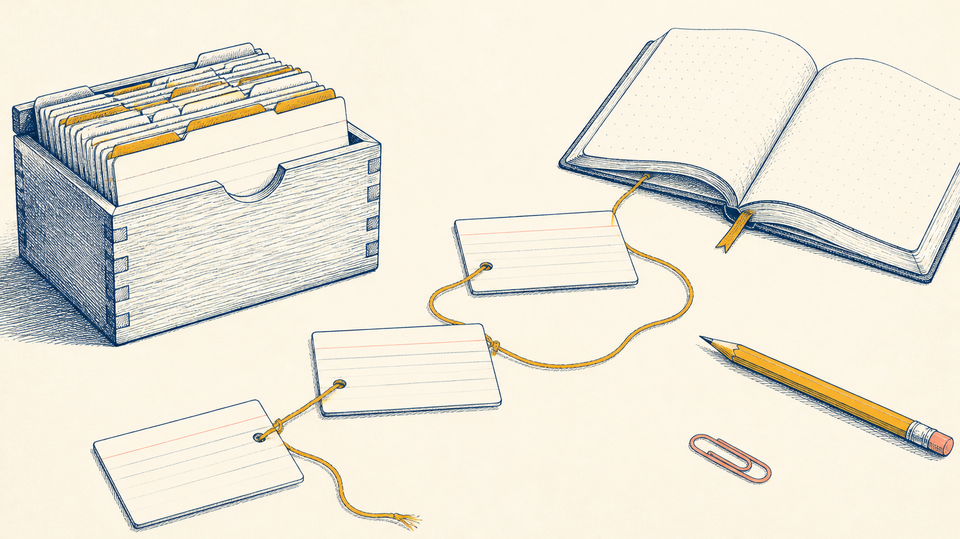
A notebook or index cards. Simple, portable, no account needed. One source per card.
A spreadsheet. One row per source, with a column for each of the six details, plus one for your notes from guide 4.
Zotero. A free program that saves a source with one click from your web browser. It stores the details and builds your bibliography in whatever style you need. It's what many professors use, and it costs nothing.
Name your files so you can find them. If you save PDFs or scans, start the file name with the date, then the source, then the title: 1887-03-11 | Daily Evening Bulletin (Maysville) | Page 3. Your folder will sort itself.
Google Scholar's Cite link, from guide 2, gives you a ready-made citation for any result. Copy it into your list as you go.
Citation patterns
Different fields use different styles, and the details matter less than consistency. Pick the one your teacher, editor or audience expects, and use it for everything. The patterns below are for a journal article.
| Style | Common in | Pattern |
|---|---|---|
| APA | Education, psychology, social sciences | Author, A. A. (Year). Title of article. Journal Name, volume(issue), pages. |
| MLA | Literature, languages, the humanities | Last, First. "Title of Article." Journal Name, vol. #, no. #, Year, pp. #–#. |
| Chicago | History, and most writing about the past | Last, First. "Title of Article." Journal Name volume, no. issue (Year): pages. |
APA and MLA also ask you to end with the DOI or URL when one exists.
For a local newspaper, in Chicago style:
"Headline of the Article." Falmouth Outlook (Falmouth, KY), Month Day, Year, page.
When there's no headline or author, as with many community columns, describe it plainly, for example "community news column," then give the date and page, so a reader can find the same page you did.
Quote, paraphrase, credit
There are three honest ways to use what someone else wrote.
Quote when the exact words matter. Copy them exactly, put them in quotation marks and cite the page.
Paraphrase when the idea matters more than the wording. Say it fully in your own words and sentence shape, then cite it anyway. The idea is still theirs.
Summarize when you need the gist of a whole article in a sentence or two. Cite that too.
If you're unsure whether something needs a citation, cite it. No reader has ever complained that a writer gave too much credit. Facts most people already know, such as the year Kentucky became a state, don't need one; a specific number, finding or argument always does.
Next: Guide 9, Use AI Without Outsourcing Your Judgment.
Research Like a Professor is a nine-part series. See all nine guides.