

The short version
- Start with a question small enough to answer.
- Start at your library, not your search bar.
- Find who holds the original, and ask them.
- If you use AI, let it point; you do the reading.
- Write down where everything came from, as you go.
The nine guides
Each guide answers one question a researcher asks, in the order they ask it. Read them in order, or jump to the one you need.
 1 · Know What You're Asking
Turn a topic into a question you can answer.
 2 · Find It
Use Google Scholar as a map of what exists.
 3 · Get It
Bring articles home free with a library card.
 4 · Read It Without Reading All of It
How professors actually read an article.
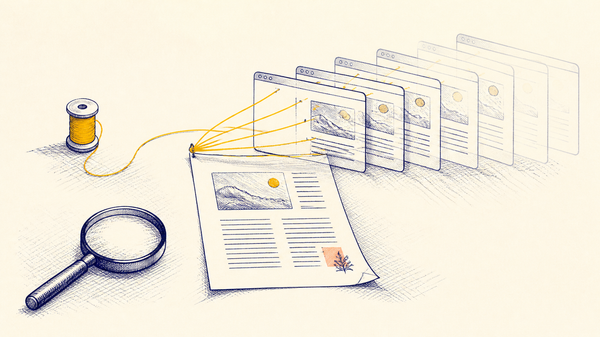 5 · Check It
Tell whether a source deserves your trust.
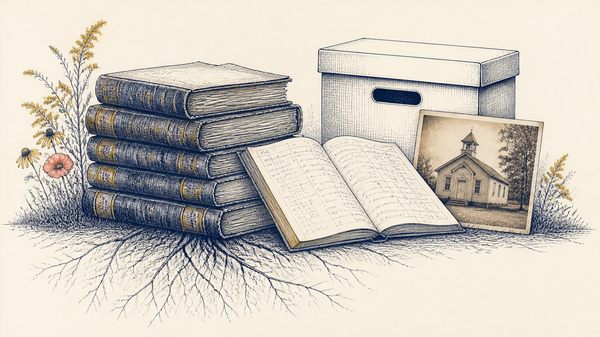 6 · Read the Past
Newspapers, census rolls, and local records.
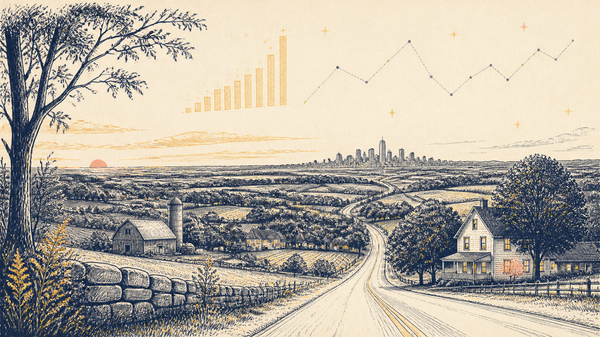 7 · Find the Numbers
Public data, and statistics versus talking points.
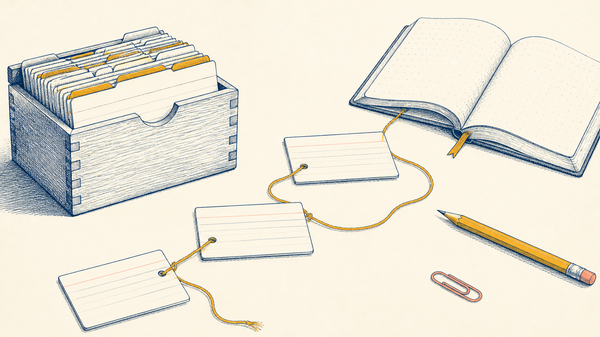 8 · Keep Track and Give Credit
Save, name, and cite as you go.
 9 · Use AI Without Outsourcing Your Judgment
Let the machine point; you do the reading.
1 · Start with a question small enough to answer
"Pendleton County history" is a shelf, not a question. "What did the newspapers say the week of the Falmouth lynching in March 1887?" is a question, and you can answer it in an afternoon.
Collecting doesn't turn into research by collecting harder. It turns into research when the question is narrow enough that you can tell what belongs and what doesn't. Write your question at the top of a page. Every time you find something, ask whether it answers that question. If it doesn't, file it for later and keep going.
If you're writing fiction, the question still helps: What did a canning-factory shift sound like in 1944? Who worked there? Fiction can invent people. It's better when the world around them is real.
Go deeper: guide 1.
2 · Start at your library, not your search bar
I work at a public library, so I'm biased. I'm also right.
Ask at the desk. The person behind it may not be a librarian by training. Library staff range from people in their first job out of high school to a recovering academic with no library coursework (that’s me), and everyone in between. Many librarian positions call for a master’s degree in library science; many public library staff, especially in small towns, learned the job by doing it. That’s fine. Whoever is there knows things a search bar doesn’t: what’s in the building and what’s in the back room, which forms to fill out, and who to call when the answer isn’t in the building at all.
So tell them your question, not just your topic, and ask, “Who here would know?” A reference librarian, a genealogy-room volunteer, a county historical society, a bigger library’s reference desk: someone’s job is to know. The conversation is free, and it’s the fastest search there is.
Use what your card already pays for. In Kentucky, public libraries offer the Kentucky Virtual Library (KYVL) databases: free in the building, and often from home with a password your library can give you. Coverage is uneven, so some articles come in full text and some don't. Many libraries also have Libby and Hoopla for books and audiobooks.
Request what they don't have. If you find a scholarly article you can't open, ask your library for it through interlibrary loan or a request form. Send the DOI (the "doi.org/…" link on the article). It's the article's fingerprint, and it saves whoever handles your request a search.
Then go local. County historical societies, genealogy rooms, vertical files, old church records, the county clerk, and the circuit court clerk hold what no database does. Small towns are full of history that never made it online. Call before you visit. Volunteers keep odd hours.
3 · Free archives worth knowing
- Chronicling America (Library of Congress): digitized U.S. newspapers, free, searchable by date and place. The page images are public domain for most of the run.
- ExploreUK (University of Kentucky): Kentucky photographs, manuscripts and newspapers. Check each item's rights statement before you publish an image.
- Kentucky Department for Libraries and Archives: state and county government records, including court records.
- UKnowledge: free full texts of many University of Kentucky publications.
- HathiTrust and the Internet Archive: older books, many free to read in full.
Paid archives like Newspapers.com have much more. Before you pay, ask your library whether it, or a bigger library nearby, gives cardholders access.
Go deeper: guide 6 for local history, guide 7 for public data.
4 · Find who holds the original, and ask
Most of what you need sits with a person: an archivist, a historical society volunteer, a newspaper editor, a family. A short, specific request gets answered. A vague one gets filed.
A good request says:
- who you are, in one line;
- exactly what you're looking for (title, date, page, box or file, if you know them);
- why, in one line;
- what you'll do with it, and that you'll credit them;
- that there's no rush.
Ask permission before you publish someone else's image or document, even if it's online. "Freely viewable" isn't the same as "free to reuse."
5 · If you use AI, let it point; you do the reading
I use Claude, an AI model, as a research partner; How I Create says how. Here is what I'd tell a friend starting out.
What it's good for:
- Finding corners you didn't know to look around: which archive holds a collection, what a record is called, which search terms the catalog uses.
- Drafting a request letter, which you then make your own.
- Reading a long document and pointing you to the pages that bear on your question.
- Arguing with you. Ask it what's wrong with your claim.
What it isn't:
- It isn't a source. It can tell you where to look. It can't be what you cite.
- It can be confidently wrong. It can produce a quote, a date, or a title that sounds right and isn't. Every quotation goes back to the original before you use it.
- A summary isn't a reading. Know whether it read the text or only saw a title. Ask it.
- It doesn't get around paywalls, and neither should you. If you can't open something, ask your library.
A worked example, from this week. I'm writing about a lynching in Falmouth, Kentucky, in March 1887. Here's how the facts traveled:
- The Maysville paper reported it the next evening: the night of the verdict, hanged from the railroad bridge.
- A 1927 Falmouth newspaper column, retelling the story forty years later, gives a different day, a different bridge and a different method. A historical society newsletter reprinted that, and a website reprinted the newsletter.
- This week, a search engine's AI summary blended both versions, pulled in a detail from yet another website, and got the date wrong.
Four retellings, but they don't add up to four sources. Three of them descend from one memory. The only way through was to read the 1887 page itself.
The checking ran both ways. My AI partner filed the first newspaper page I saved as "page 3." It was page 1. We caught it by reading the scan, corrected the file name and noted the error on the record. That's the method working, not failing.
And say how you made it. If AI helped, tell your readers what it did and what you did. My short version is at the end of every post. Borrow it if it helps.
6 · Write down where everything came from, as you go
The most expensive moment in research is trying to find a source again six months later.
- Name files so you can find them: date, source, title. For example: 1887-03-11 | Daily Evening Bulletin (Maysville) | Page 3.
- Keep a running list of what you found, where, and when you found it. A spreadsheet is enough.
- Note what you haven't checked yet. Mark it, so a guess never passes for a fact.
- Cite as you go, in whatever style you'll publish in. I use APA.
Go deeper: guide 8.
Your first afternoon
☐ Write your question on one line.
☐ Bring it to your library’s desk and ask, "Where would you look, and who here would know?"
☐ Search Chronicling America for one name, one place, and one year.
☐ Find one local holder (historical society, clerk, church, family) and write them a five-line request.
☐ Start your source list before you find anything, so it's ready.
If you try this and it helps, or doesn't, tell me. This page gets better the same way the research does: someone checks it.
Last updated October 29, 2026.