
Liberty and Justice for Who, Again?
We must mend what has been torn apart, make justice imaginable again. — Albert Camus, "The Almond Trees" (1940)
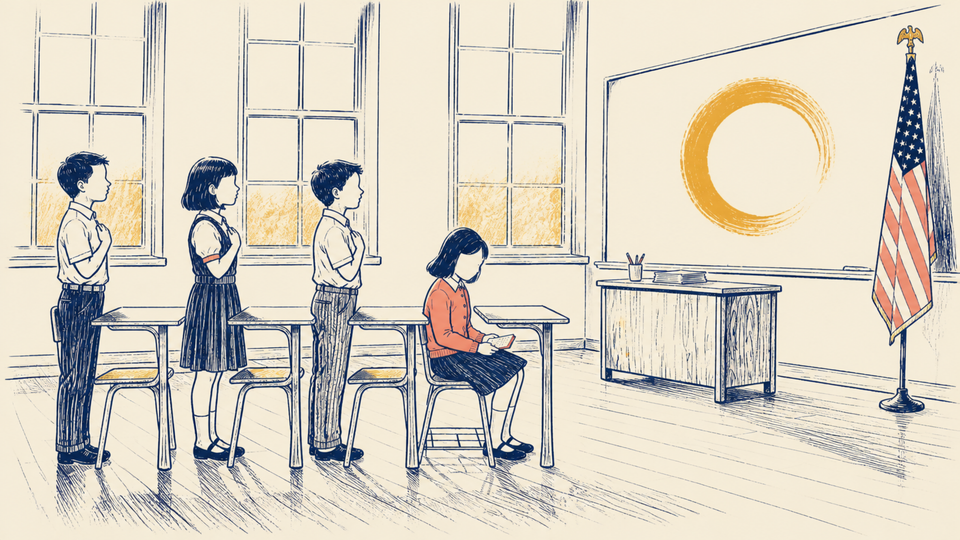
The girl who stayed seated
In 1970, in Orange County, New York, a high school girl stayed in her seat while her classmates stood for the Pledge of Allegiance. She wasn't being lazy, and she wasn't being rude. She had read the last line closely. The words were not true, she said, because there is no liberty and justice for all in America. Her school suspended her.
Her case went up to the state's commissioner of education, Ewald Nyquist, who ruled on June 23, and his ruling holds the most interesting sentence in this story. He didn't argue that she was wrong about America. He argued that she was wrong about the Pledge. She had misread it, he said. The Pledge was not "a statement of prevailing conditions in the United States" but "a statement of our goals and our national aspirations."
Read that again, slowly. New York's top education official had, in effect, agreed with the girl on the facts. Liberty and justice for all wasn't the condition of the country. It was the destination. The only disagreement was about grammar: whether the line was a description, which would make it a lie, or a promise, which would make it a job.
She wasn't the only one sitting. Seventeen days later, a federal judge in Brooklyn ruled against a 15-year-old at Hicksville Junior High on Long Island. He had stayed seated for the same reason: he didn't think "with liberty and justice for all" was true of American life. Seven months before that, another judge on the same court had ruled the other way for two seventh-grade girls in Queens, saying the Constitution doesn't treat fears of disorder as grounds for silencing peaceful dissent. Same courthouse, same clause, opposite answers. The children agreed with each other. The adults couldn't.
Nor were the students alone in noticing. Around the same time, a New York principal and his senior class president started a campaign to change the clause to seeking liberty and justice for all. The principal said he'd tried the official line on his students, that the words describe an aspiration, and they "just wouldn't buy it." The White House Conference on Children, four thousand delegates strong, sent President Nixon a recommendation to reword the Pledge so it would describe what the nation aspires to be, not its current condition. Their version had students dedicate themselves "to the task of making it one nation."
None of the changes went anywhere. The words stayed put, and so did the gap they described.
The man who wrote "all"
The girl in Orange County was closer to the truth than she knew, and closer than the commissioner. The man who wrote the line didn't mean all either.
Francis Bellamy wrote the Pledge in 1892. He said later that he'd thought about borrowing the old slogan of the French Revolution, Liberty, Equality, Fraternity, and decided that equality and fraternity were too controversial and too fanciful. He chose "liberty and justice for all" because it could fit either an individualist or a socialist state. It was a phrase built to travel.
His own sense of "all" didn't travel far. In a speech the next year he warned that "a different class" of immigrants was arriving, from Russia, Poland, Armenia, Bohemia and Italy. He called Italians "the vilest elements" and Jews expelled from Russia and Poland "parasites." He admitted that "it is hard to say what equality is," and then said what it wasn't: "there are immigrants and immigrants." A few years later he wrote that "men are not born equal," and that a democracy must guard "the quality of their blood."
He even reached for a garden. America, he said, "cannot be the dumping ground of Europe and bloom like a flower garden."
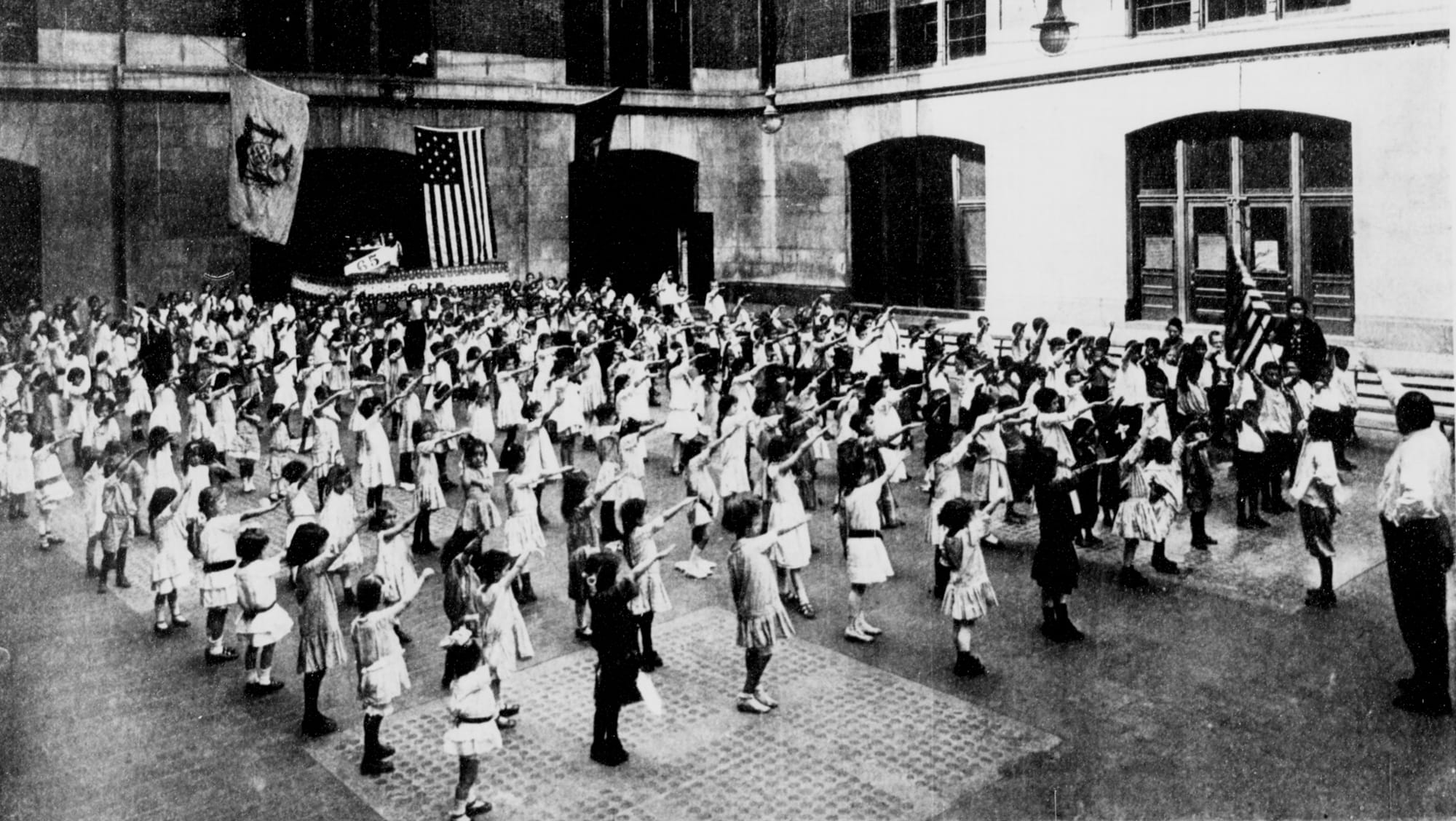
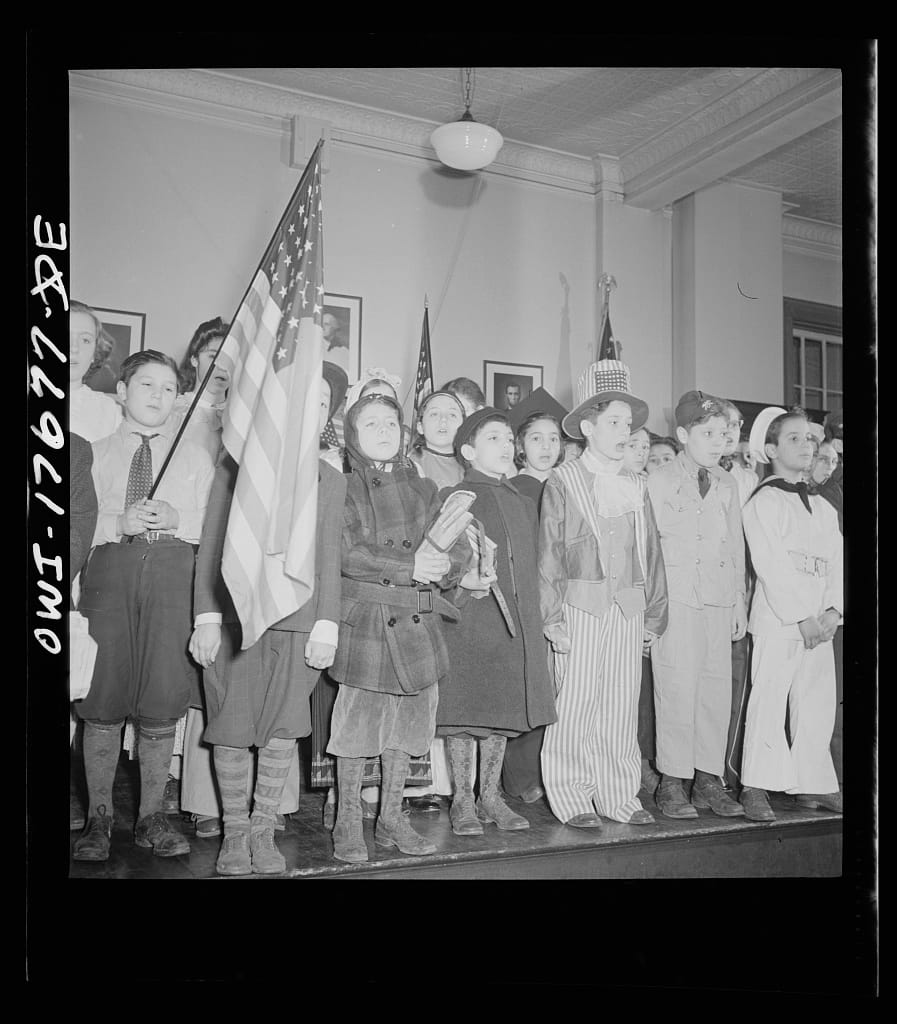
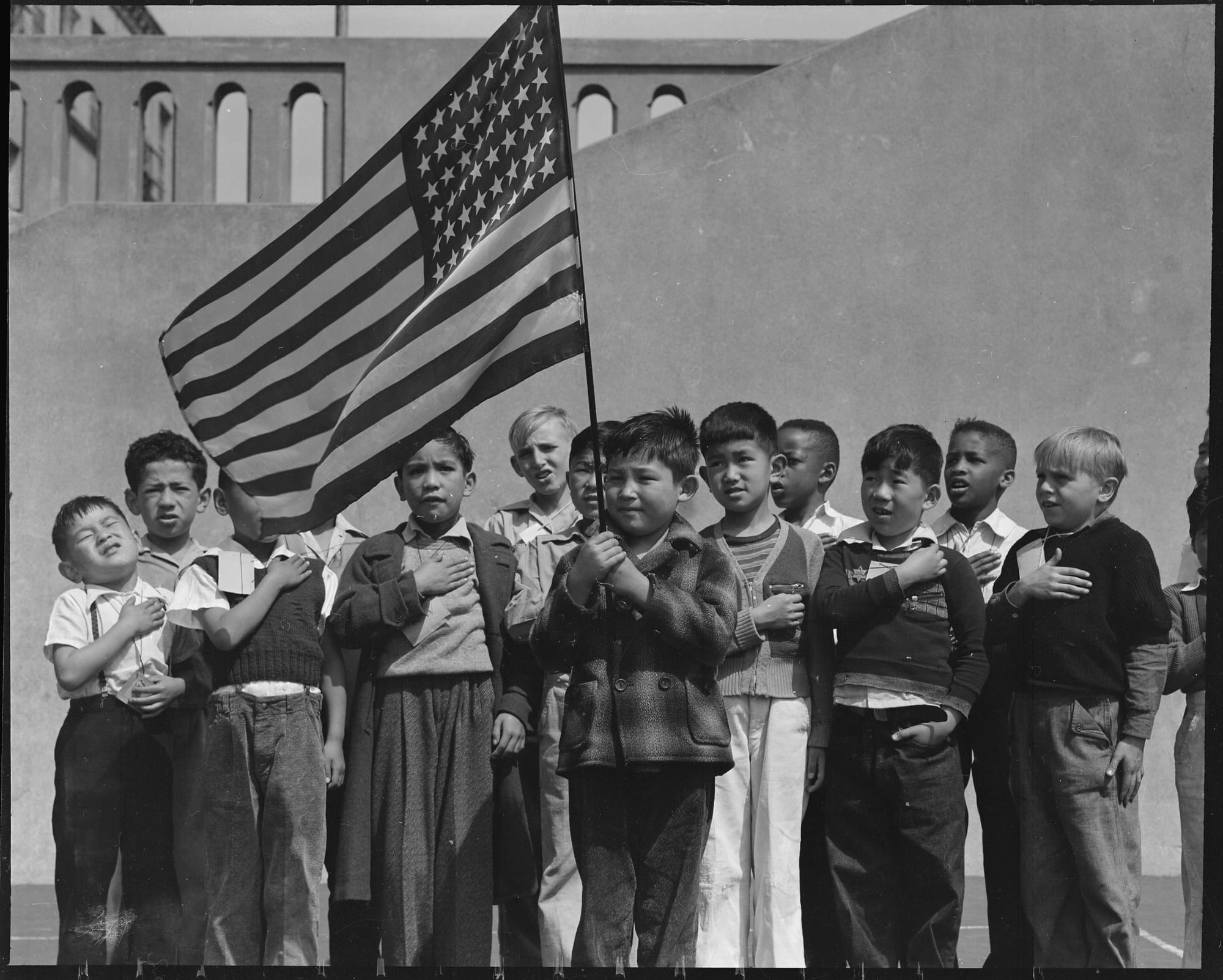
So the "all" was never whole, not even in its author's mind. There's no golden age to return to, no original "all" we fell away from. That's the first thing this essay asks you to hold: every "again" assumes a whole we never had.
And it's the reason to keep reciting the line anyway. A promise can outgrow the person who made it. The word all has always been bigger than the man who wrote it down. The girl who stayed seated was holding it to its size.
Description, aspiration, task
Look at what the people of 1970 were reaching for. The girl read the line as a description, so she called it false. The commissioner called it an aspiration, which made it true but distant. The principal and his students wanted seeking. The White House conference wanted the task of making.
That's three grammars for one promise. A description sits still. An aspiration hangs in the air. A task has a verb in it, and someone has to pick it up.
The Constitution's own first sentence already chose the third grammar. "In order to form a more perfect Union" is a comparative. Not a perfect Union, which would be a description and a lie. A more perfect one, which is a direction and a job. The founders wrote "not yet" into the opening line, then built Article V so the work could go on by hand and in the open.
The Constitution is my ensō. In Zen practice, the ensō is a circle drawn in one stroke and one breath, and no two come out alike. Some are thick, some thin, some wobbly; in some the ink runs dry and the paper shows through; one closes where it began, another stops short or overshoots. Writing about a lopsided one, Audrey Yoshiko Seo puts it plainly: "not all perfect circles are round." Mine is amendable, debatable, impermanent, unfinished. And it needs maintenance, which we have neglected. We didn't inherit a finished circle. We inherited a brush.
Kazuaki Tanahashi draws a one-stroke circle. Miracles of Each Moment (Iris Arts).
This essay is about what it means to pick that brush back up. It's about the opposite of harm, which isn't help. It's healing, from the Old English hǣlan, to make whole. And since the whole was never there, make whole can't mean again. It can only mean at last.
Two kinds of wrong
We already know how to make whole one kind of harm. Someone breaks something, we find out who, and they pay to put it back. The philosopher Iris Marion Young called this the liability model. It looks backward, finds the person at fault, and restores the situation from before. Courts are built for it. So are apologies.
But Young noticed a second kind of harm the first model can't reach. Her example was a single mother she called Sandy, a sales clerk with two children. Sandy is priced to the edge of homelessness by a housing market that nobody in particular broke. The developer who buys her building to turn it into condos follows the rules. So do the landlords, the banks and the zoning boards. Every actor is acting normally, and the result is still a harm. Young called this structural injustice, and she said the baseline we'd restore Sandy to is the thing that hurt her in the first place.
That's why make whole again fails here. There's no culprit to make pay, and no fair "before" to go back to.
The journalist Tina Rosenberg found the same split three decades ago, at the scale of nations. Latin America's juntas, she wrote, were "regimes of criminals": a few hundred men committed the crimes, and the crimes had authors. Eastern Europe's communist states were "criminal regimes." Their repression was spread thin, legal, and built into ordinary life, so nearly everyone became a small part of it. A Czech dissident put it to her plainly: the question isn't what some they did; it's what we did.
One kind of harm you can put on trial. The other you can only stop taking part in, together.
That's the difference between harm as inflicted and harm as encountered. As inflicted, the question is who did it and what they owe. As encountered, the question is where it lands now, on whom, and what we'll build so it stops landing there. The first kind looks back to settle a debt. The second looks forward to change a structure. A justice worth the name needs both. Neither one can do the other's job.
It helps to picture the two kinds of repair. The first is kintsugi, the Japanese art of mending a broken tea bowl with lacquer, the seam often dusted with gold so it shows. A verdict, an apology, a payment: repair you can see. (The bowl-as-healed-heart reading is a new one, and a therapist's; here the bowl is a country.) But the old menders did quieter work too. The same lacquer could make a break nearly vanish, or a tinted patch could match the clay and simply age along with the bowl. The second image goes further down: mycelium, the fungal network under the forest floor that keeps mending soil and root, mostly invisible when it's healthy. Fixed zoning, a school that finally teaches what happened, a town that learns to keep up what it built: repair you can't see, which is most of it.
Kyoto lacquerers Muneaki Shimode and Takahiko Sato demonstrate kintsugi at Oxford's Pitt Rivers Museum, 2015.
Ecologist Suzanne Simard on the fungal networks beneath the forest. TEDSummit, 2016.
As above, so below. Both kinds have to be done, even when no one gilds the second.
We cannot return
The historian Charles Maier noticed that every response to a great wrong starts with the same two letters: retribution, reparation, remembering, recording, reconciliation. None of them turns the clock back. "We repair and remember," he wrote, "because we cannot return."
That's the hinge the whole essay turns on. The prefix re- carries two meanings. One is back: restore, return, the motion the slogans promise and nobody can deliver. The other is again and anew: renew, re-create, and repair, whose Latin root means to make ready again. It's the same root as prepare. Repair doesn't face the past. It gets something ready for what comes next.
Structural harm has a way of making us stop. When nothing seems to mean anything, when nothing we do seems to matter, when nothing seems likely to change, what we needed most goes dark. Indifference sets in where curiosity used to be. Fog settles where clarity was. The reach for something new goes quiet. People who were cut off stop showing up. None of these is a vice. Each is what's left when meaning, agency and power all run low at once.
The historian Jill Lepore found the civic version. She says we've traded a philosophy of amendment for a philosophy of doom, on both sides. We've stopped drawing the circle at all. Doom asks nothing of us. Repair asks for a brush.
Albert Camus, writing about the almond trees of Algeria in a dark season of the last century, said the work in front of us is to "mend what has been torn apart." Then he said we have to make justice imaginable again in a world so obviously unjust. Mend comes first in his list. You can't imagine a just world while you're standing in the wreckage of an unjust one and calling it the weather.
I used to tell my students that my goal was to haunt them. I meant that I wanted the questions to follow them out of the room. I've come to think haunting is the wrong word. A ghost is the past refusing to leave. What I wanted was closer to tending: something planted on purpose, to bloom on its own schedule, sometimes long after the gardener has gone.
Near the end of the essay, Camus turned to the almond trees. They flower in a single February night, he wrote, and their blossoms last just long enough to prepare the fruit. That's all a season of repair has to do. It doesn't need to restore the world. It doesn't need to finish the circle. It needs to last long enough to prepare the fruit, and leave the brush where the next hand can find it.
The girl in Orange County stayed seated because the line wasn't true yet. The answer isn't to make her stand. It's to make the line true, at last.
Sidebar: as of November 2026
Developing stories. This box gets dated update callouts as they change.
What "make whole" looks like when a court orders it. On November 19, 2026, the International Court of Justice found, for the first time in its history, that a state had committed genocide: Myanmar, against the Rohingya. On the core finding the vote was 9 to 6, and the judges split differently on other questions. The court's restitution order reads like a list of verbs:
- Allow safe, voluntary, dignified return, and reunite families.
- Return or replace what was taken.
- Search for the disappeared and rebury the dead with dignity, in accordance with Rohingya traditions.
- Rehabilitate the injured, body and mind.
- Protect the survivors from discrimination, so it doesn't happen again.
Only the first two items return anything. The rest prepare. Watch the judgment session (UN Web TV).
Everyone wants a truth commission. In 2026 they are being proposed from both sides of American politics. In October, a House Democrat introduced a bill to create a Truth and Accountability Commission to investigate alleged abuses by federal officials; it sits in committee. In May, the Justice Department announced a nearly $1.8 billion fund to compensate people who say the previous administration wrongly investigated or prosecuted them; early reports called it a "Truth and Justice Commission." In June a federal judge blocked it, and the department said it would comply. The word is the same. Whether either deserves it depends on who holds the pen. (More on this in the next piece.)
The archive returns the past anyway. In November, Danish national-archive records showed that Denmark's oldest living person, 112, had been a local leader in the Danish Nazi party during the occupation. She had described her membership as her late husband's idea, and said it was unfair to pay for it after so long. The same country's resistance, about 20,000 strong, smuggled nearly all of Denmark's Jews to safety. Complicity and rescue, one generation, one small nation. (She disputes the characterization; this box will note any further reporting.)
This is the first of three pages on repair: what we owe, who holds the pen, and who gets counted.
References
Bartlett, C., Iten, C., & Holland, J.-H. (2008). Flickwerk: The aesthetics of mended Japanese ceramics [Exhibition catalogue]. Museum für Lackkunst; Herbert F. Johnson Museum of Art, Cornell University.
Camus, A. (2012). The almond trees. In P. Thody (Ed.), Lyrical and critical essays (E. C. Kennedy, Trans.). Vintage International. (Original essay written 1940)
Collins, M. (1943, January). New York, New York students pledging allegiance to the flag in public school eight in an Italian-American section [Photograph]. Farm Security Administration/Office of War Information Collection, Library of Congress. https://lccn.loc.gov/2017845724
Ellis, R. J. (2005). To the flag: The unlikely history of the Pledge of Allegiance. University Press of Kansas.
Faulders, K., Charalambous, P., & Mallin, A. (2026, May 17). Trump administration to create $1.776B "Truth and Justice Commission" to compensate allies: Sources. ABC News. https://abc7.com/post/trump-administration-create-1776b-truth-justice-commission-compensate-allies-sources-say/19116651/
Fonté, V. (Director), & Tanahashi, K. (2004). Miracles of each moment [Video]. Iris Arts. Vimeo. https://vimeo.com/13222194
Fried, J. P. (1970, July 12). Judge, citing disruption, bars student's sitting during Pledge. The New York Times, 35.
Harper, D. (n.d.). Heal. In Online Etymology Dictionary. https://www.etymonline.com/word/heal
Hussein, F., & Tucker, E. (2026, May 19). What to know about Trump's $1.7B fund to compensate allies claiming political targeting. Associated Press (via The Atlanta Journal-Constitution). https://www.ajc.com/news/2026/05/what-to-know-about-trumps-17b-fund-to-compensate-allies-claiming-political-targeting/
International Court of Justice. (2026, November 19). Application of the Convention on the Prevention and Punishment of the Crime of Genocide (The Gambia v. Myanmar: 11 States intervening), Judgment. https://www.icj-cij.org/case/178
Kemske, B. (2021). Kintsugi: The poetic mend. Herbert Press.
KTVU FOX 2. (2026, June). DOJ halts Trump's $1.8B "Anti-Weaponization Fund" following court order. https://www.ktvu.com/news/doj-halts-trumps-1-8b-anti-weaponization-fund-following-court-order
Lange, D. (1942, April 20). San Francisco, California. Flag of allegiance pledge at Raphael Weill Public School, Geary and Buchanan Streets [Photograph]. Records of the War Relocation Authority, National Archives (536053). https://catalog.archives.gov/id/536053
Lepore, J. (2025). We the people: A history of the U.S. Constitution. Liveright.
Maier, C. S. (2003). Overcoming the past? Narrative and negotiation, remembering, and reparation: Issues at the interface of history and the law. In J. Torpey (Ed.), Politics and the past: On repairing historical injustices. Rowman & Littlefield.
New-York Tribune. (1915, September 12). First the flag of our country—The melting pot of the nations at white heat [Photograph]. Library of Congress, via Wikimedia Commons.
Pitt Rivers Museum. (2015). Kintsugi at Pitt Rivers Museum [Video]. Vimeo. https://vimeo.com/145874663
Reynolds, J. C. (2026, November 20). Denmark's oldest living person identified as former Nazi party member, report claims. The Independent. https://www.the-independent.com/news/world/europe/denmark-oldest-nazi-party-kristen-schwalbe-b3088501.html
Rosenberg, T. (1995). The haunted land: Facing Europe's ghosts after communism. Random House.
Seo, A. Y. (2007). Ensō: Zen circles of enlightenment. Weatherhill.
Shinoda, Y. (2022). Mended bodies: Ceramics restored with lacquer. Ars Orientalis, 52, 244–258. https://doi.org/10.3998/ars.3995
Simard, S. (2016). How trees talk to each other [Video]. TED. https://www.youtube.com/watch?v=Un2yBgIAxYs
Truth and Accountability Commission Act, H.R. 10878, 119th Cong. (2026). https://www.congress.gov/bill/119th-congress/house-bill/10878
United Nations Web TV. (2026, November 19). The International Court of Justice delivers its judgment in The Gambia v. Myanmar [Video]. https://webtv.un.org/en/asset/k17/k17p1wcdm0
Young, I. M. (2011). Responsibility for justice. Oxford University Press.