
The Arithmetic of Belonging
For years, I opened a unit in my classroom with two equations that refuse to balance. Legal does not equal right. Illegal does not equal wrong. Slavery was legal. The Underground Railroad was not. History has since graded both papers, and the law came out looking like the cheater.
Hold those equations up to the Thirteenth Amendment. In 1865, it abolished slavery and involuntary servitude, “except as a punishment for crime whereof the party shall have been duly convicted” (U.S. Const. amend. XIII, § 1). Emancipation arrived with a trapdoor built in. Three years later, the Fourteenth Amendment promised equal citizenship, and its second section allowed states to strip the vote for “participation in rebellion, or other crime” (U.S. Const. amend. XIV, § 2).
Watch: 13th (Ava DuVernay, 2016) takes its title from that exception clause and follows it from 1865 to today’s prisons.
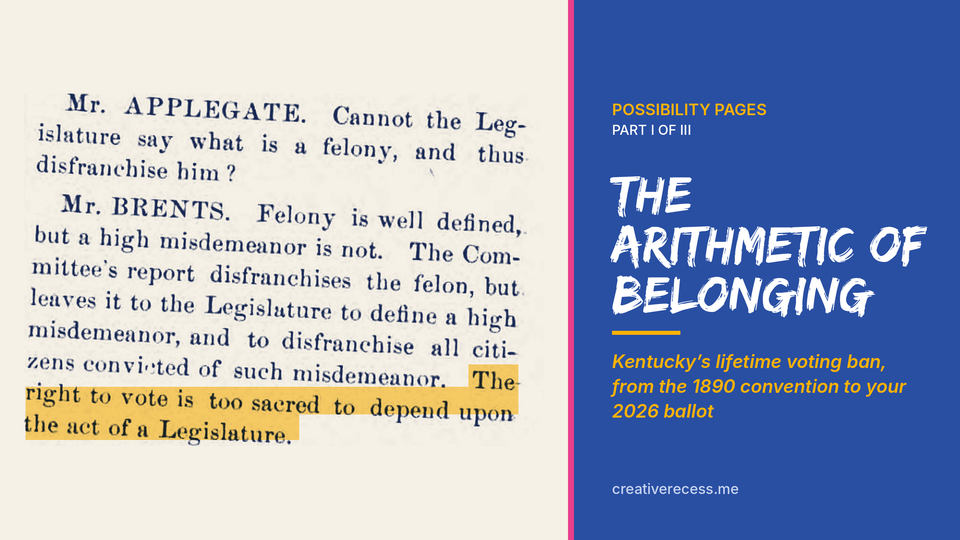
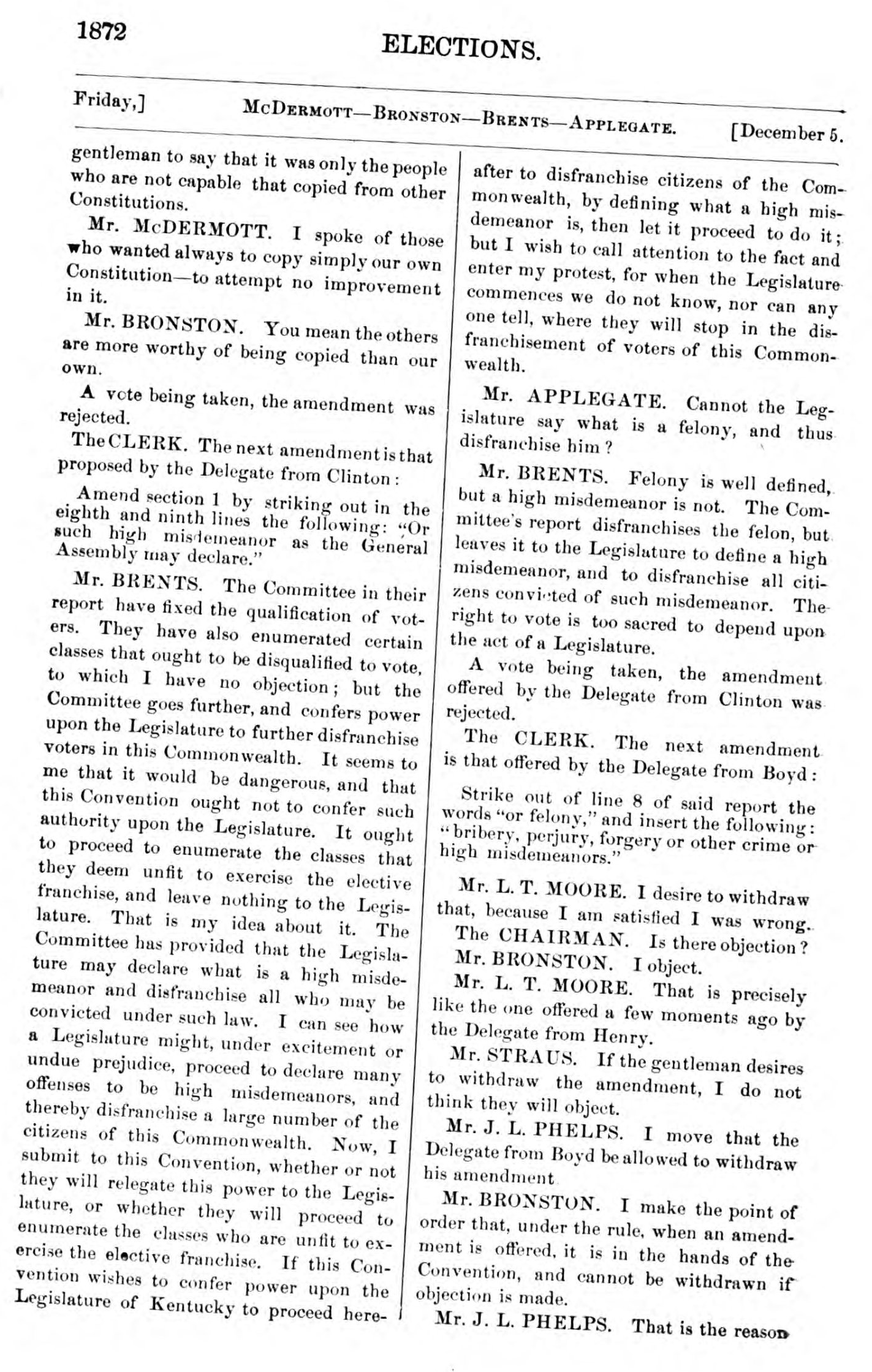
Kentucky had long kept a trapdoor of its own. Its first three constitutions, in 1792, 1799, and 1850, told the legislature to pass laws excluding people convicted of high crimes, so the bar lived in statute, where lawmakers could narrow it. Then, in 1891, Kentucky changed who holds the key. The 1890–91 convention wrote the exclusion into the constitution itself, in Section 145, and made a governor’s pardon the only way back. The debates don’t name race. The delegates argued about what a pardon could reach and about how to “elevate suffrage.” One of them, Brents of Clinton County, warned that a legislature acting “under excitement or undue prejudice” could declare new offenses to be high misdemeanors “and thereby disfranchise a large number of the citizens.” Pendleton County’s delegate, Leslie T. Applegate, pressed him: “Cannot the Legislature say what is a felony, and thus disfranchise him?” Felony was well defined, Brents answered, but a high misdemeanor was not, and “the right to vote is too sacred to depend upon the act of a Legislature.” The convention kept that power anyway (Kentucky Constitutional Convention, 1890–1891, p. 1872).
Five weeks before that debate, Mississippi’s convention had shown exactly what such choosing could do, writing into its constitution a list of disqualifying crimes its framers believed Black citizens were more likely to commit (Mississippi Free Press, 2023; Mississippi Today, 2023). Kentucky’s motive remains unproven, but the temperature of the room does not. McDermott assured the hall that “for every good man sent to the penitentiary you will find ninety-nine vicious and depraved men” (p. 1880). Pugh asked whether the legislature would defer the vote “of that class just emerging from the illiteracy of slavery” (p. 2320). And notice the pronouns. The convention was deciding when a man would lose his vote. Women had no vote to lose, and the word “male” stayed. Kentucky didn’t build the trapdoor in 1891. It welded it shut.
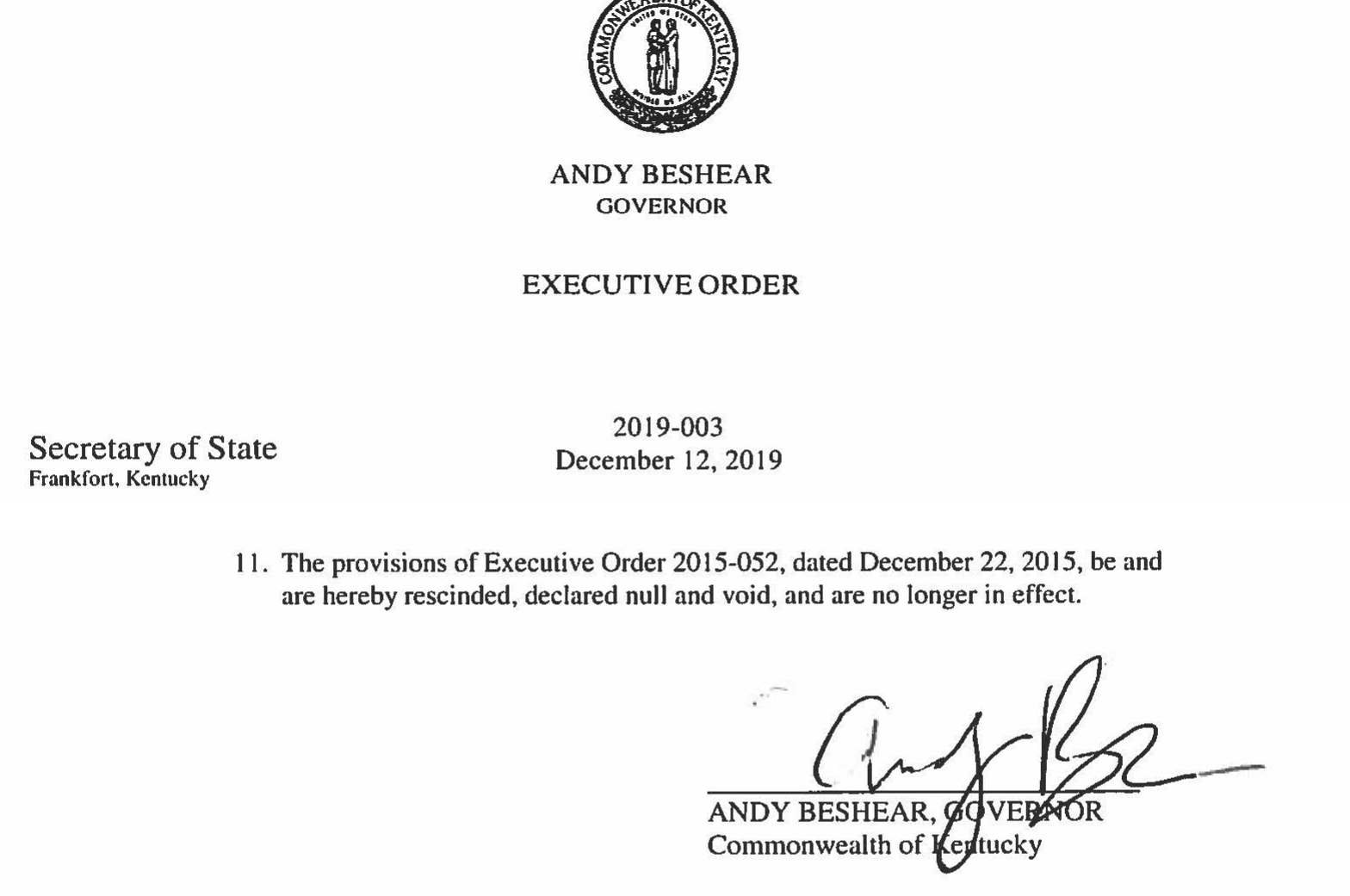
It’s still welded. More than 158,300 Kentuckians cannot vote because of a felony conviction, more than in 40 other states, and Kentucky has the third-highest disenfranchisement rate in the nation for Black and Latino citizens (The Sentencing Project, 2025). It is one of only three states, with Iowa and Virginia, that disenfranchise for life (League of Women Voters of Kentucky, 2025). Because the 1891 constitution made pardon the only remedy, no ordinary law can fix this. Governors have restored rights by executive order, but an executive order is grace, not a right. Read Executive Order 2019-003 to the end and you’ll find the seesaw printed in its final paragraph: it voids the 2015 order that had suspended the one before it (Exec. Order No. 2019-003, 2019; Exec. Order No. 2015-052, 2015). Even the governor who suspended it agreed on the cure. Restoration, Matt Bevin wrote, “must come through an amendment to the Kentucky Constitution and not by executive action.” This year that amendment, Senate Bill 80, passed the state Senate 35–3, then died in a House committee without a floor vote (The Sentencing Project, 2026).
We’ve learned to name the problem when politicians draw districts to pick their voters. Disenfranchisement is the same move made with an eraser instead of a map. Suffrage was never meant to be a game of subtraction, yet Kentucky keeps playing it, one conviction at a time.
The strongest reply deserves a fair hearing. It holds that whoever breaks the social contract forfeits a say in writing its terms, and the U.S. Supreme Court read the Fourteenth Amendment’s “other crime” clause as permission for exactly this (Richardson v. Ramirez, 1974). Fine. But a contract with no path back to good standing is not a contract. It’s exile in place.
Kentucky has heard this argument before, from inside its own convention record. On October 1, 1890, the delegates received a petition from Mary B. Clay of the Kentucky Equal Rights Association. She protested that Kentucky’s women were “governed without our consent; taxed without representation,” and observed that “only disfranchised men are the legal peers of women” (Clay, 1890/1891, pp. 335–336). The convention referred her petition to committee and kept the word “male.” Her own subtractions deserve naming too. Like much of the white suffrage movement, Clay’s appeal leaned on her whiteness. She signed as a “white born citizen” and resented being “held subject to the will of the black and white men.” When the Nineteenth Amendment finally came in 1920, it opened the ballot box to white women far more reliably than to Black women in the South, many of whom waited until the Voting Rights Act of 1965. The arithmetic of belonging has rarely been done by one hand, and the work Clay began is still unfinished.
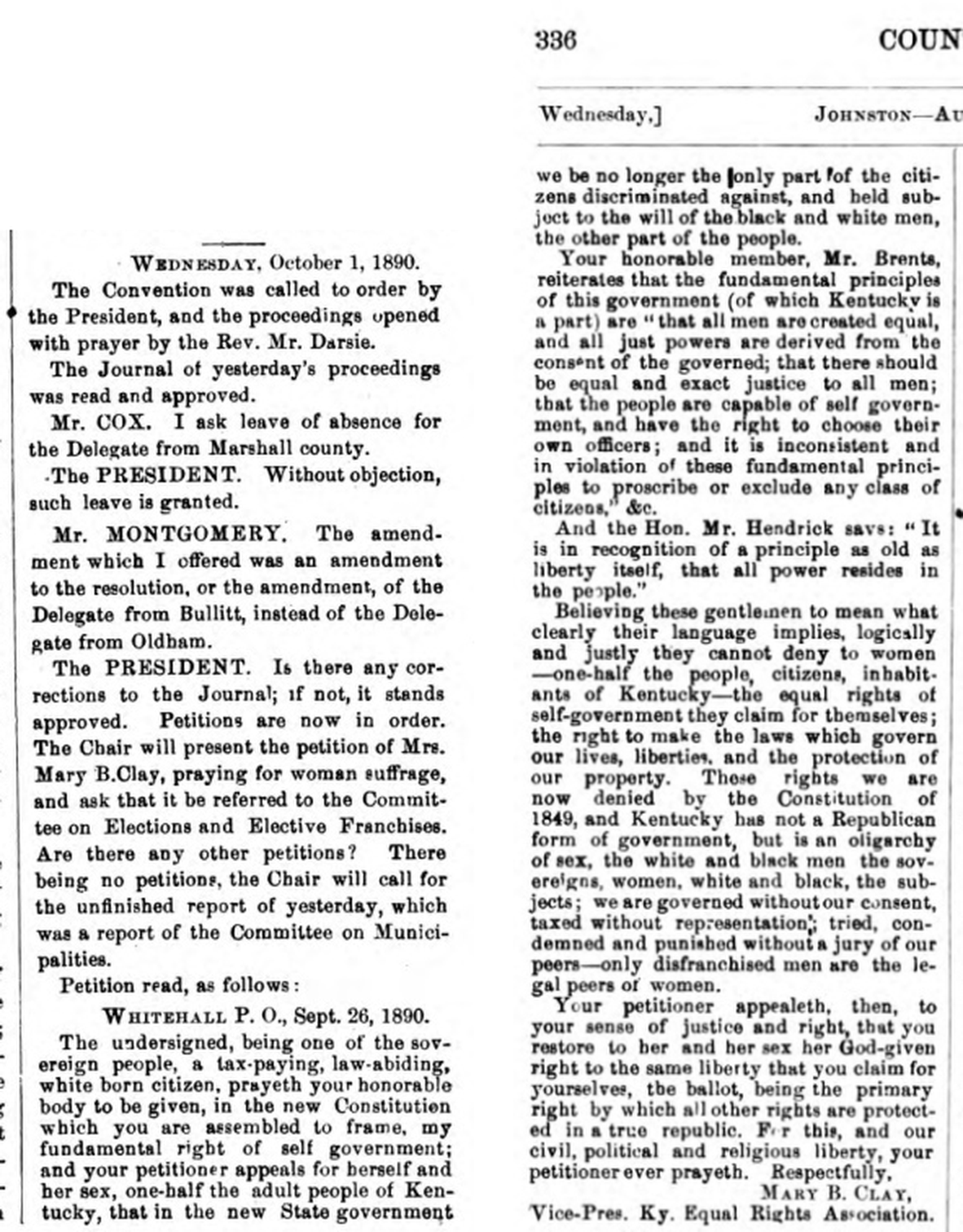
Her phrase still fits. Disenfranchised Kentuckians pay sales tax on their groceries and income tax on their paychecks, with no say in how either is spent. The arithmetic gets stranger behind bars. The Census counts incarcerated people where they’re locked up rather than where they live, even though Kentucky’s own law says a prison cell is not a residence. Their bodies pad the districts that hold them. In one House district, two-thirds of the Black residents counted were incarcerated (Kajstura, 2025). We once counted enslaved people as three-fifths of a person to swell the power of the men who held them. Now we count incarcerated people as whole persons in the census and as zero in the electorate, and we demonize them in the debate. Counted, discounted, and condemned.
Watch: Last Week Tonight with John Oliver, “Felony Disenfranchisement” (HBO, 2018). Florida-focused and funny, and Oliver frames it the way Clay did, as taxation without representation.
In 1789 Thomas Jefferson wrote to James Madison that “the earth belongs to the living, and not to the dead.” He drew a hard conclusion from it: “Every constitution then, and every law, naturally expires at the end of 19 years. If it be enforced longer, it is an act of force, and not of right” (Jefferson, 1789). There are my classroom equations again, in his own hand: force is not right. Jefferson, who enslaved more than 600 people over the course of his life, never extended that principle to them (Monticello, n.d.). Kentucky took the rest of his idea seriously for a while, writing new constitutions in 1792, 1799, and 1850. Then it stopped. The 1891 framers even left a door marked “fifth constitution,” opened by two successive General Assemblies and then the voters, and no one has walked through it (Ky. Const. § 258). We still live under the fourth, a 135-year-old instruction from a room that decided some Kentuckians could be subtracted for good. It’s 2026, not 1890.
Look closely at your ballot this year and you’ll find the 1891 key on it. Amendment 1 asks whether to bar governors from granting pardons and commutations in the 60 days before a gubernatorial election through the next inauguration (Horsley, 2026). You can vote your conscience on that question; there are honest arguments on both sides. But notice what the same legislative session chose to send you and what it chose to keep. It put the governor’s key on your ballot and left the door, a restoration amendment, in a House committee. Kentuckians were asked whether to trim a governor’s grace. They were not asked whether a finished sentence should restore a citizen’s vote.
You head to the polls in less than a month. Registration for this election closed on October 5, but if you or someone you love completed a sentence for a Kentucky felony, check your status now, and if you aren’t registered yet, register for the next election. Since 2019, restoration has been automatic for most state felonies once a sentence is complete, though unpaid court costs can keep a sentence from ever being complete: 1,820 Kentuckians had theirs extended in a single year because they couldn’t pay (League of Women Voters of Kentucky, 2025). And understand which key you’re holding. A governor’s order is grace, and the next governor can take it back. A constitutional amendment would make it a right. In 2018, Floridians petitioned restoration onto their own ballot and passed it. Kentucky’s constitution offers no such route. Here the key passes through Frankfort first: three-fifths of each chamber to put an amendment on the ballot, then a majority of Kentucky voters, with no governor’s signature required (Ky. Const. § 256). The earliest that ballot could reach you is November 2028. So whatever your party, ask anyone who wants to represent you in the General Assembly: will you vote to let Kentuckians decide whether a finished sentence finishes the punishment?
Watch: Desmond Meade, “The Right to Vote: Never Take It for Granted” (TEDxJacksonville Salon, 2024). The formerly incarcerated organizer who led Florida’s 2018 restoration amendment.
A month after his question to Brents, Pendleton’s Applegate rose again. Arguing that married women should keep their own property, he gave the hall a principle that outlived his debate: “Because a thing has existed for a hundred years, it should exist for another hundred, is an argument against our civilization” (Kentucky Constitutional Convention, 1890–1891, pp. 2254–2255).
Section 145 has now existed for 135 years. If serving your time doesn’t make you a citizen again, what exactly are we releasing people into? And who gets paid for every night they spend inside? That’s where Part II begins.
Keep going
Listen
- Eastern Standard (WEKU), “Democracy Optimist,” Episode 4 (May 2, 2024): Debra Graner, a Kentuckian who regained her vote, and Desmond Meade. Listen
- Race Unwrapped (Louisville Public Media), “They’ve completed their sentence and they’re still disenfranchised” (Oct. 21, 2024). Listen
- League of Women Voters of Kentucky, “Second Chances: Restoration of Voting Rights,” with Cameron Mills. Listen
- Democracy Deciphered (New America), Episode 7, “Felony Disenfranchisement” (April 16, 2025; 20 min). Listen
Read
- Carol Anderson, One Person, No Vote (2018)
- Alexander Keyssar, The Right to Vote (rev. ed.)
- Michelle Alexander, The New Jim Crow (2010)
- The Sentencing Project, Locked Out 2024
References
Clay, M. B. (1891). [Petition for woman suffrage, Whitehall P.O., Sept. 26, 1890]. In Official report of the proceedings and debates in the convention assembled at Frankfort, on the eighth day of September, 1890 (pp. 335–336). E. P. Johnson. (Original work presented 1890) https://hdl.handle.net/2027/njp.32101079239008?urlappend=%3Bseq=345
Exec. Order No. 2015-052 (Dec. 22, 2015). Relating to restoration of civil rights for convicted felons. Commonwealth of Kentucky. https://www.brennancenter.org/sites/default/files/blog/Bevin%20Order%202015-052.pdf
Exec. Order No. 2019-003 (Dec. 12, 2019). Relating to the restoration of civil rights for convicted felons. Commonwealth of Kentucky. https://civilrightsrestoration.ky.gov/
Horsley, M. (2026, June 1). With legislature on board at last, Kentuckians will vote on pardon limits amid elections. Kentucky Lantern. https://kentuckylantern.com/?p=40700
Jefferson, T. (1789, September 6). [Letter to James Madison]. Founders Online, National Archives. https://founders.archives.gov/documents/Jefferson/01-15-02-0375-0003
Kajstura, A. (2025, August 27). Federal Census policy breaks Kentucky’s democracy — state lawmakers can fix it. Prison Policy Initiative. https://www.prisonersofthecensus.org/news/?p=10790
Kentucky Constitutional Convention. (1890–1891). Official report of the proceedings and debates in the convention assembled at Frankfort, on the eighth day of September, 1890 (Vols. 1–4). E. P. Johnson. https://catalog.hathitrust.org/Record/001144015
Ky. Const. § 145, § 256, § 258. https://apps.legislature.ky.gov/law/constitution
League of Women Voters of Kentucky. (2025, February). Restoring voting rights to Kentuckians with felony convictions: A statistical update. https://static1.squarespace.com/static/5da3dbee03dd2c4493abed8b/t/67b4e3b8d227b73db56b2bee/1739908025536/2025+Restoring+Voting+Rights+Statistical+Update.pdf
Mississippi Free Press. (2023, June 30). Mississippi Jim Crow felony voting law will remain after Supreme Court denies appeal. https://www.mississippifreepress.org/34312/mississippi-jim-crow-felony-voting-law-will-remain-after-supreme-court-denies-appeal
Mississippi Today. (2023, November 1). On this day in 1890: Mississippi adopted new constitution. https://mississippitoday.org/2023/11/01/on-this-day-in-1890-mississippi-adopted-new-constitution/
Monticello. (n.d.). How many people did Thomas Jefferson own? Thomas Jefferson Foundation. https://www.monticello.org/slavery/slavery-faqs/property
Richardson v. Ramirez, 418 U.S. 24 (1974). https://supreme.justia.com/cases/federal/us/418/24/
The Sentencing Project. (2025). Kentucky bars over 158,300 citizens from voting. https://www.sentencingproject.org/fact-sheet/kentucky-bars-over-158300-citizens-from-voting/
The Sentencing Project. (2026). 158,300 Kentuckians remain disenfranchised ahead of May 19th primary election. https://www.sentencingproject.org/press-releases/158300-kentuckians-remain-disenfranchised-ahead-of-may-19th-primary-election/