
The Box and the Ballot Box
Part I ended with a question: who gets paid for every night someone spends inside? Kentucky answered part of it in the same room that wrote Section 145.
The 1890–91 convention that welded the ballot-box trapdoor shut also wrote the rules for prison labor. Section 253 requires people sentenced to the penitentiary to work, and Section 254 sets the terms of the arrangement: the Commonwealth keeps control of discipline and supplies, “and the labor only of convicts may be leased” (Ky. Const. § 254). Section 254 has never been amended. The constitution that subtracted the vote also budgeted the work. Hold that next to the Thirteenth Amendment’s exception clause from Part I, and the arithmetic comes into focus. A conviction didn’t only take something away. It also made someone available.
Watch: Last Week Tonight with John Oliver, “Prisoner Re-entry” (HBO, 2015). What happens in the first minutes, months, and years after the gate opens.
Punishment or rehabilitation
I’ve long believed a prison can’t be built for both punishment and rehabilitation, and that rehabilitation is the half we’ve forgotten. Kentucky’s own government has said as much in writing. Executive Order 2019-003, the order that restores most voting rights after a completed sentence, opens by stating that “people who have completed their sentences and who vote are less likely to re-offend and return to prison,” and that restoring the vote “is an important aspect of promoting rehabilitation and reintegration into society” (Exec. Order No. 2019-003, 2019). The state knows what helps people come home. The question is whether the system is built to pay for that, or for something else.
Heads in beds
Follow the money and it runs two ways: to counties and to a corporation.
The county route is the larger one. Kentucky houses a large share of its state prisoners in county jails and pays the counties to keep them: a per diem of $35.34 per person per day. As of November 2024, 36% of Kentucky’s state inmates were held in county jails, and the state reimbursed counties $115 million for housing them in fiscal year 2023 (Kentucky Association of Counties, n.d.-a; n.d.-b). In parts of eastern Kentucky, researchers found, “the money that the state pays for locking up state prisoners in local jails has supplanted the role of coal as a revenue source for county budgets” (WOUB, 2019). That isn’t a story about villainous jailers. It’s a story about counties left with few other ways to keep the lights on, and a payment structure that makes a full jail look like a balanced budget.
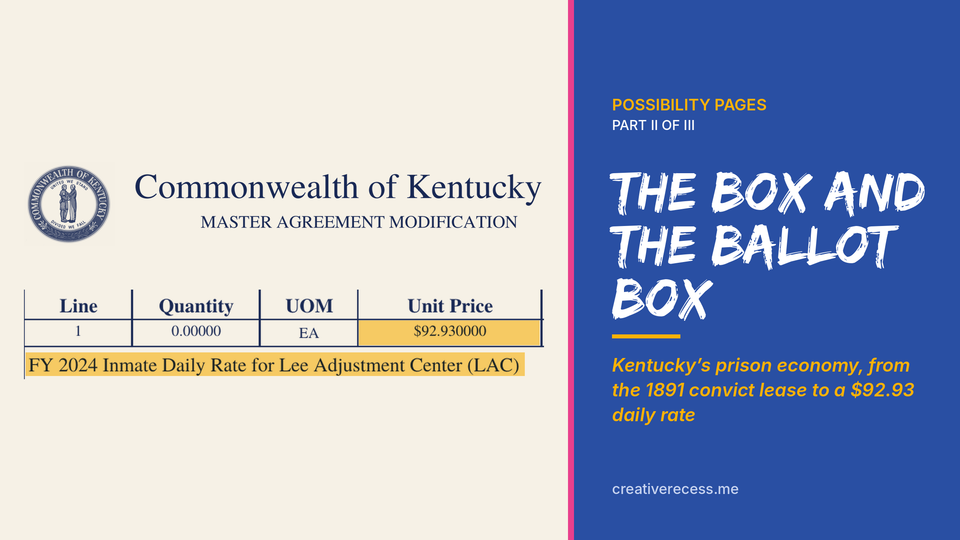
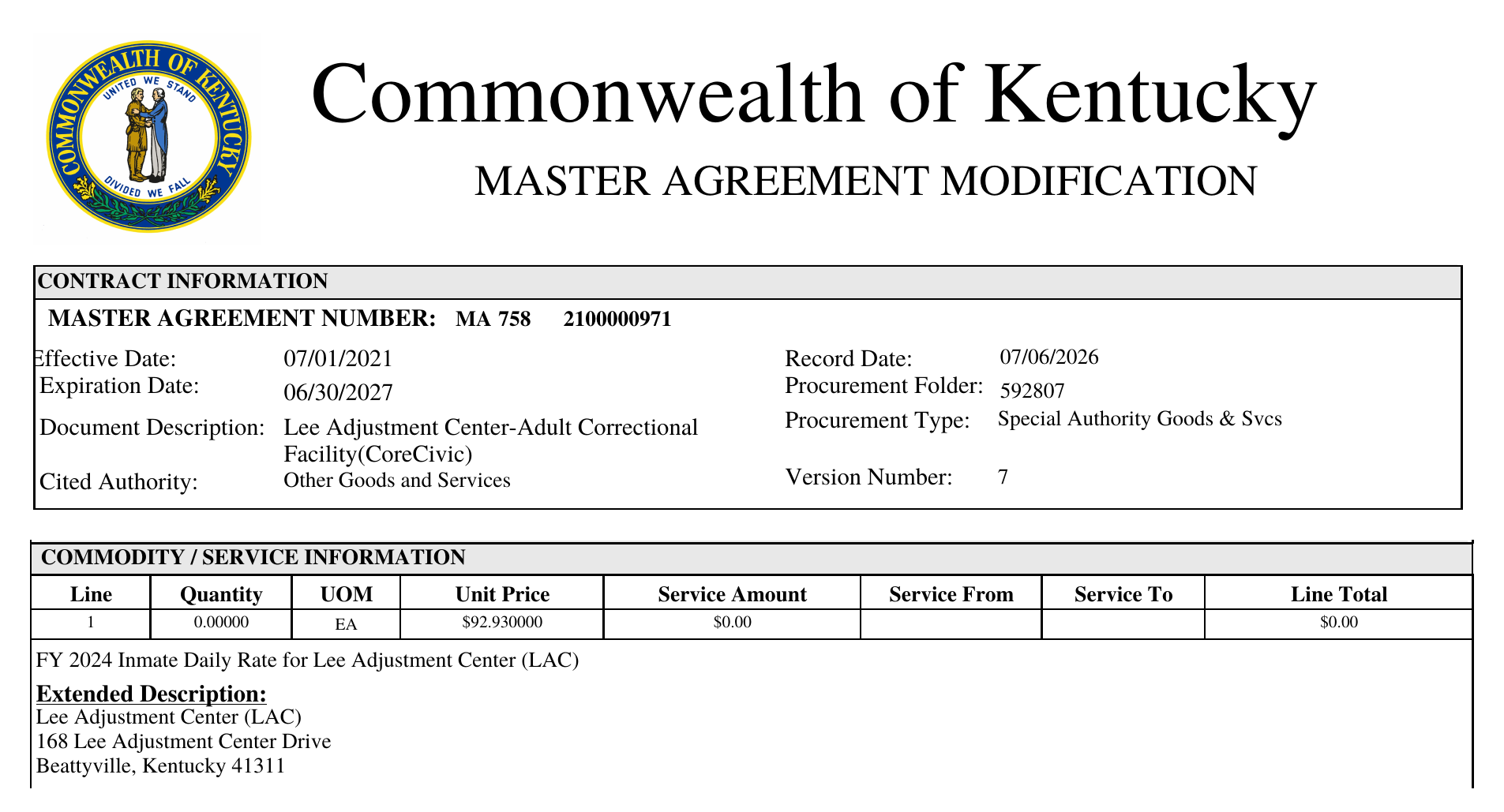
The corporate route runs through Beattyville. Since 2017, CoreCivic, one of the country’s largest private prison companies, has run the Lee Adjustment Center under contract with the state. When it signed, the company told investors the 816-bed prison would bring in “approximately $15.0 million to $17.0 million of annual revenue” once it reached “normalized occupancy” (CoreCivic, 2017). The current contract runs through June 30, 2027, and lists a daily rate of $92.93 per person, the figure set for fiscal year 2024 (Commonwealth of Kentucky, 2026a). CoreCivic describes itself as a real estate investment trust. On that ledger, the cell is the asset.
Fairness requires the rest of the contract, too. Kentucky does not guarantee CoreCivic a minimum number of prisoners, as many private-prison contracts elsewhere have. State law requires the arrangement to cost at least 10% less than housing the same people in a state prison. And the contract promises re-entry programming, substance-abuse treatment, and academic and vocational education comparable to the state’s own institutions. CoreCivic says its programs “improve lives and reduce recidivism.” Those are real commitments. Whether they’re delivered is harder to know, because the contract makes the company’s records public, “except financial records,” and lets the corrections commissioner forbid the company’s public statements about the prison.
Then there’s the building in Floyd County. In 2012, Kentucky closed CoreCivic’s Otter Creek Correctional Center in Wheelwright after allegations of sexual abuse forced the state to move the women held there (Barton, 2017). In 2019, the state reopened that same prison as the Southeast State Correctional Complex under a 10-year lease from CoreCivic, and now runs it with its own staff (WYMT, 2019; Justice and Public Safety Cabinet, 2020). This fiscal year’s rent is $4,341,093.76 (Commonwealth of Kentucky, 2026b). The company that lost the contract kept the building, and now collects rent on it. That is what it means for the cell to be the asset.
I’ll say plainly where I land. I would end for-profit incarceration in Kentucky. A prison is a place where the state holds people in its name, and the state should not be paying anyone a margin on that.
The accountability gap
In January 2026, a federal court in Lexington screened a lawsuit by a man formerly held at the Lee Adjustment Center. He alleges that in November 2024, officers pepper-sprayed him after he complied with their orders, cuffed him with one set of handcuffs though his size required two, and pressed their weight on him until a bone in his hand broke. He also alleges that the state monitor assigned to the prison, the oversight the 2017 contract promised, knew of the officers’ conduct through grievances and didn’t report it (Peeler v. Jones, 2026). These are allegations, not findings. At this stage a court must take a complaint’s facts as true, and nothing has been proven.
What the court did decide is instructive. It dismissed CoreCivic from the case. Under federal civil-rights law, a private prison company isn’t automatically liable for what its employees do; a plaintiff has to show that a company policy or custom caused the harm. That’s the same rule that shields cities and counties, not a special favor to private prisons. But it means that, by default, the revenue flows up to the company and the liability stops at the officer.
The box
Then the gate opens. Kentucky releases people into a world that asks, on page one of many job applications, whether they’ve ever been convicted of a felony. That checkbox is the box in “Ban the Box.”
Kentucky has taken a first step. In February 2017, Governor Matt Bevin removed the conviction question from the initial application for executive-branch state jobs. “Ours is a nation of second chances, founded upon core principles that include mercy and redemption,” he said (WMKY, 2017). Agencies can still ask later and can still weigh the answer. The order covers state government, not the private employers where most Kentuckians work.
The objections deserve a fair hearing. Employers worry about safety and about being sued for negligent hiring. Victims and their families worry that a clean application erases harm that was real. Banning the box answers both more modestly than critics fear: it moves the question later, after an applicant has been seen as a person with skills, rather than deleting it.
The other doors are narrower than they look. Expungement, which seals a record, has been available since 2016 to Kentuckians who stay offense-free for five years and pay a $290 fee, and no expungement is granted until the fee is paid in full. Research cited by the League of Women Voters of Kentucky found that expungement is followed by an average 22% wage increase in the first year (League of Women Voters of Kentucky, 2025). And in a single year, 1,820 Kentuckians had their sentences extended because they couldn’t pay what a court ordered. Their punishment grew because their bank accounts didn’t.
Put the pieces side by side. The state pays by the head to hold people. It charges them fees on the way out. It releases them with a record that closes the doors to work and, for many, to the ballot. Then it counts the ones who come back as proof they were never going to change. That isn’t rehabilitation failing. It’s rehabilitation never being on the invoice.
What you can ask
Whoever wants to represent you in Frankfort or at your county fiscal court, there are questions worth asking. Will you extend fair-chance hiring beyond state jobs? Will you make expungement affordable for the people it was written for? Will you stop extending sentences for debts people can’t pay? And will you tell us, in dollars, what we pay to hold our neighbors, and to whom?
The final subtraction
Part I followed the vote: a citizen subtracted from the electorate, sometimes for life. Part II followed the money: a person counted as a head, a bed, a per diem. Both rest on the same quiet premise, that some debts to society can never be fully paid. Part III follows that premise to its end, to the one punishment that can’t be extended, appealed, or undone, and to the state’s new appetite for watching it happen.
Keep going
Listen
- Ear Hustle (Radiotopia/PRX), made inside San Quentin by incarcerated and formerly incarcerated co-hosts, with later seasons following life after release.
Read
- Judah Schept, Coal, Cages, Crisis: The Rise of the Prison Economy in Central Appalachia (NYU Press, 2022).
- Michelle Alexander, The New Jim Crow (2010)
- Kentucky’s transparency portal, to search the Commonwealth’s contracts and see what it pays its vendors: transparency.ky.gov
References
Barton, R. (2017, November 16). Kentucky reopens contract with troubled private prison company. LPM News. https://www.lpm.org/news/2017-11-16/kentucky-reopens-contract-with-troubled-private-prison-company
Commonwealth of Kentucky, Justice and Public Safety Cabinet. (2026a). Master agreement MA 758 2100000971: Lee Adjustment Center–Adult Correctional Facility (CoreCivic) (Version 7; original work effective 2021). https://secure2.kentucky.gov/TransparencyWebApi/v1/Contract/ContractPDF?documentId=1B103E7D-0CA5-4AC3-A20F-014E758C062A&docId=2100000971
Commonwealth of Kentucky. (2026b). Purchase order CTRP1 527 2600000333: FY27 SSCC lease, CoreCivic [Purchase order]. https://secure2.kentucky.gov/TransparencyWebApi/v1/Contract/ContractPDF?documentId=012F8B5E-5699-43BE-A94C-05BD98529C80&docId=2600000333
CoreCivic, Inc. (2017, November 16). CoreCivic enters into new management contract with the Commonwealth of Kentucky at the Lee Adjustment Center [Press release]. https://corecivic.gcs-web.com/node/10251
Exec. Order No. 2019-003 (Dec. 12, 2019). Relating to the restoration of civil rights for convicted felons. Commonwealth of Kentucky. https://civilrightsrestoration.ky.gov/
Justice and Public Safety Cabinet. (2020, December 4). Gov. Beshear announces opening of Southeast State Correctional Complex in Wheelwright [News release]. Commonwealth of Kentucky. https://justice.ky.gov/News/Pages/ssccopening.aspx
Kentucky Association of Counties. (n.d.-a). Understanding the county jail per diem. https://kaco.org/articles/understanding-the-county-jail-per-diem/
Kentucky Association of Counties. (n.d.-b). County 101: State funding sources for county jails. https://kaco.org/articles/county-101-state-funding-sources-for-county-jails/
Ky. Const. §§ 253, 254. https://apps.legislature.ky.gov/law/constitution
League of Women Voters of Kentucky. (2025, February). Restoring voting rights to Kentuckians with felony convictions: A statistical update. https://static1.squarespace.com/static/5da3dbee03dd2c4493abed8b/t/67b4e3b8d227b73db56b2bee/1739908025536/2025+Restoring+Voting+Rights+Statistical+Update.pdf
Peeler v. Jones, No. 5:25-cv-00428-KKC (E.D. Ky. Jan. 15, 2026). https://www.govinfo.gov/content/pkg/USCOURTS-kyed-5_25-cv-00428/pdf/USCOURTS-kyed-5_25-cv-00428-0.pdf
WMKY. (2017, February 6). Governor Bevin orders “fair chance” for workers seeking state jobs. https://www.wmky.org/employment/2017-02-06/governor-bevin-orders-fair-chance-for-workers-seeking-state-jobs
WOUB. (2019, March 6). Profiting off prisoners: State inmates mean big bucks for local jails. https://woub.org/2019/03/06/profiting-off-prisoners-state-inmates-mean-big-bucks-for-local-jails/
WYMT. (2019, October 18). Former Floyd County prison reopening, bringing nearly 200 jobs. https://www.wymt.com/content/news/Watch-Gov-Bevin-making-special-announcement-at-former-Otter-Creek-Correctional-Facility-563375411.html