
The Hole Next Door
Ribbons and wrenches
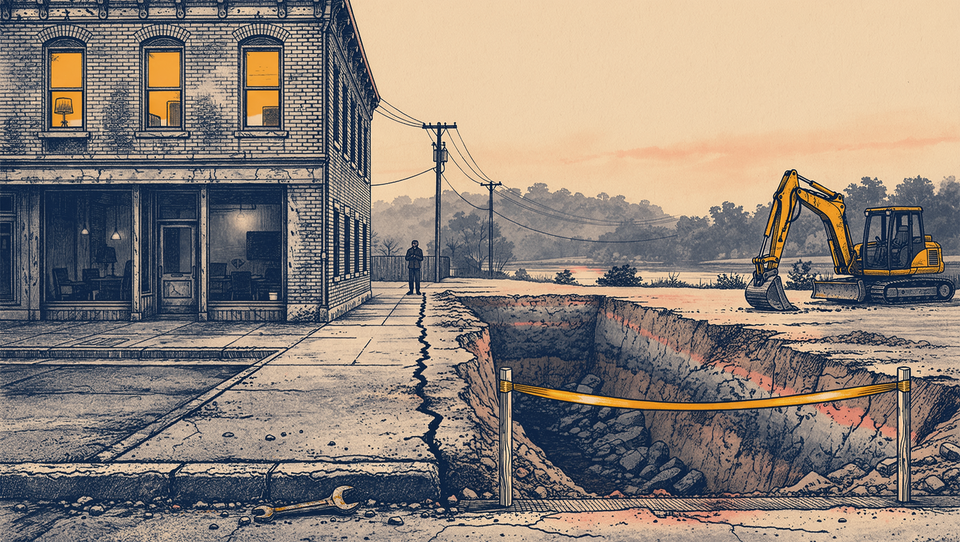
We love a ribbon-cutting. We don't love the routine maintenance that keeps things shiny and running at full capacity. The historians of upkeep have a name for that love. Lee Vinsel and Andrew Russell call it the innovation delusion: a culture that celebrates the ribbon and starves the wrench. Their 2020 book of that name argues that all our talk of disruption and the next big thing has taught us to see the new as the only kind of progress, when most of what keeps a society running, and much of the work people actually do, is keeping existing things going.
We fund the new building and the new network, cut the ribbon, take the photo. The inspection, the cleared drain, the dull work of keeping the old thing standing gets filed as overhead, the first line cut when the budget is tight and the last one anyone thanks. Henry Petroski, the engineer who spent a career on why things break, saw the trap from both ends. In To Engineer Is Human, he argued that failures come "in the wake of prolonged success," because a long run without trouble invites thinner margins and less attention. In The Road Taken, he traced how, by the late 1980s, investment in the public works we already had had taken a back seat to new construction, and he went looking for the truth about roads in their least glamorous parts: their seams, their edges, their potholes. The seam between the new and the old is the one nobody is paid to watch.
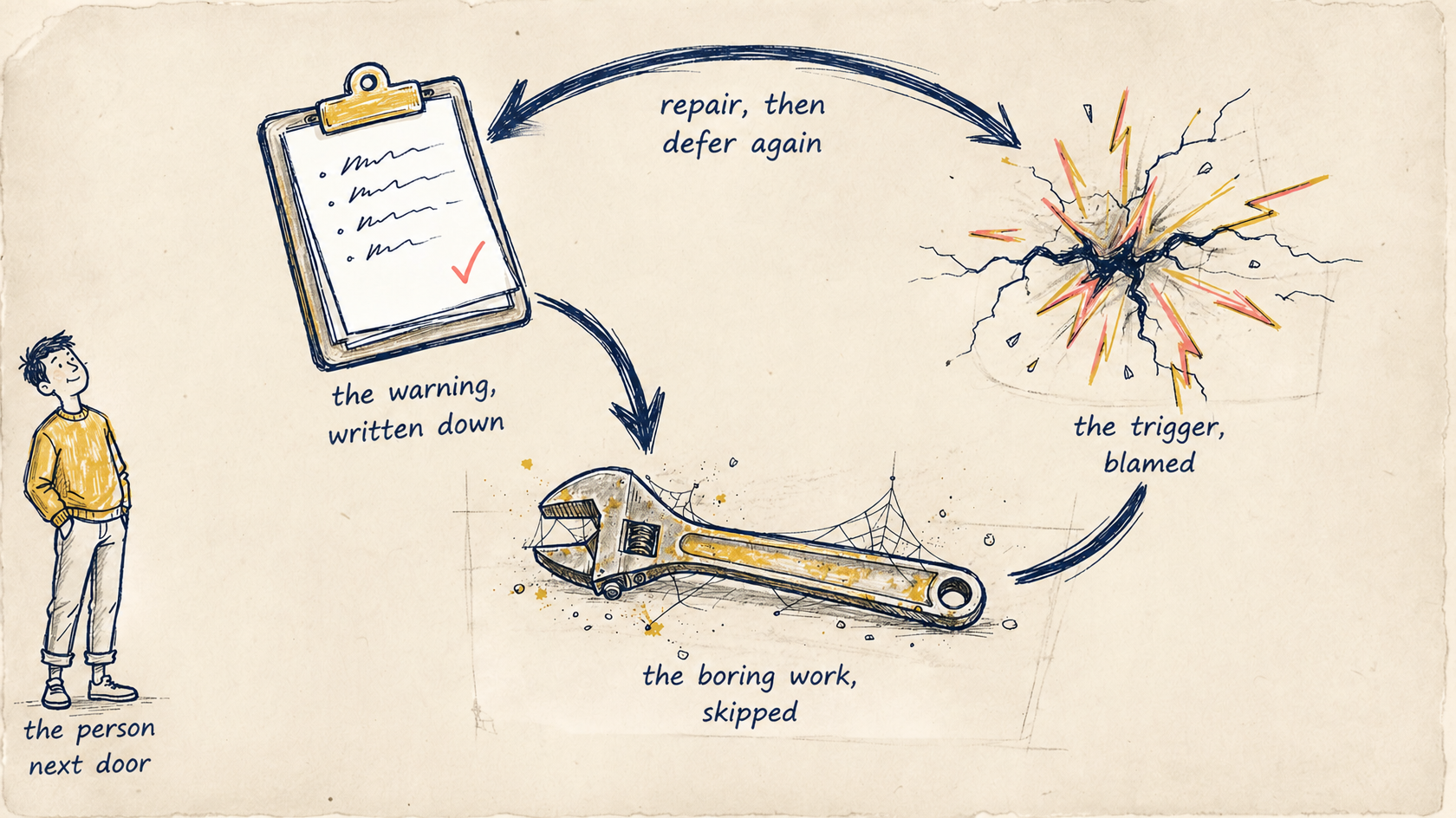
Once you know the pattern, you start seeing it everywhere. It has three beats. First, someone writes the warning down: an inspection report, a work order, a tenant's complaint, an audit. Second, nobody does the boring work. Third, a trigger makes the failure visible: a storm, a truck, a router, a backhoe next door. The trigger gets the headline and the blame, but the story happened in the first two beats, in an office, on a form, years before anything fell.
The people who keep things running saw this long before the historians did. In 1969, Mierle Laderman Ukeles was a young artist and a new mother in New York, and she had found that the work of keeping a baby alive left no room for the work the art world counted as art. Her answer was a short typed proposal, the Manifesto for Maintenance Art. It splits the world into "two basic systems: Development and Maintenance." Development is the new thing: individual creation, progress, the advance. Maintenance keeps the dust off it, preserves it, sustains it, renews it. Then she asks the question every movement skips: "After the revolution, who's going to pick up the garbage on Monday morning?"
The manifesto's sharpest point is about status. Maintenance is dull and endless, Ukeles writes, and the culture pays it accordingly: minimum wage for the people who do it for a living, nothing at all for the people who do it at home. Her list of chores runs from changing the diaper to mending the fence to resealing the thing that leaks again. Then she took the argument out of the gallery and into the city.
In 1977 she became the unsalaried artist-in-residence of New York's Department of Sanitation, and for a piece called Touch Sanitation she spent some eleven months shaking the hand of every sanitation worker in the city, about 8,500 people, and thanking each one for keeping New York alive. Her point is the one this essay keeps arriving at: the people who maintain things are invisible until the day they stop, and then they are all anyone can see.
Utilities have a blunter phrase for the opposite habit. PG&E's own 2017 asset strategy prescribed it for low-risk parts of its century-old transmission lines, one of which started the 2018 Camp Fire: run to failure, which the chart spelled out as "no maintenance" and "only replacement no repairs." The Butte County district attorney concluded that the company had run the whole Caribou–Big Bend stretch of that line this way, and that renaming the policy "run to maintenance" a year later was "semantical only." The break came at about 6:30 on the morning of November 8, 2018, when a worn hook holding up one of those lines, near Pulga, in Butte County, California, gave way. The fire that followed reached the town of Paradise, about 26 miles off, within hours.
Eighty-five people died, and 18,804 buildings were destroyed, most of them homes. Paradise had about 26,000 residents before the fire; the 2020 census counted fewer than 5,000. PG&E pleaded guilty to 84 counts of involuntary manslaughter, went into bankruptcy, and set aside $13.5 billion for fire victims. Replacing one hook would have cost almost nothing next to what running it to failure cost the people who lived downhill.
It does not have to go that way, and anyone who has stood on a New Orleans parade route has seen the proof. When the last float of a Mardi Gras parade passes, the cleanup is already right behind it: the sweepers and loaders line up at the staging area behind the final float, and within hours a street buried in beads, cups and trampled boxes is clear again. Over a season the city hauls off well over a thousand tons, a record this year. Nobody calls that overhead. It is scheduled, staffed and paid for before the first parade rolls. Ukeles asked who picks up the garbage on Monday morning; New Orleans answers it by Ash Wednesday.

Theatre people know the same discipline by another name. Every production plans its strike, the night the set comes down after closing, as carefully as it plans opening night: who unscrews what, where the flats go, which pieces get stored for the next show and which get scrapped. Nobody leaves the stage the way it stood at the final bow, because the next company has to walk onto it. Neither New Orleans nor a community theatre is richer or smarter than a city council. They decided, in advance, that the cleanup is part of the show.
Set the innovation delusion beside Ukeles's Monday morning, the hook above Paradise, the sweepers behind the last float and the crew at strike, and you have the reading this whole piece keeps circling: deferred maintenance is not an absence of decision. It is a decision made quietly and paid for loudly, usually by someone else. Every deferral is a bet that the bill will come due on someone else's watch and land on someone else's street. Here is what it looks like when the bet comes due, from a nation's airspace down to one apartment house, and then what it looks like in a town with 14 miles of road.
Where the seams gave way
Eight places where the bet came due, newest first. They differ in scale and in material: wire, soil, brick, water, steel, concrete, cladding, sludge. Read them for the three beats, and for the seam each one tore along.
The national airspace, 2026
On Friday, November 13, the country stopped flying because of one box in one place. A contractor swapping copper lines for fiber at a remote FAA site in El Dorado, Arkansas, installed a new router that began flooding the network with connection attempts; a second, in Amarillo, Texas, joined in. As many as 17 of the country's 22 en route centers struggled to hear their own radar and radio, and the FAA held every departure in the country for more than four hours, the longest stop since 9/11. By the FAA's own count, operators canceled about 12,500 flights that day. Nothing was hacked. The system tripped over its own repair. Two months earlier, the GAO had warned that the $12.5 billion rebuild had no master schedule and "could be prioritizing speed over costs and air traffic disruptions." The seam was between the new network and the old one it was being bolted onto, deferred so long that even fixing it sent it haywire.
Flatbush, Brooklyn, 2026
Two days earlier, on Wednesday afternoon, November 11, workers near the corner of Flatbush and Bedford Avenues were digging a foundation pit on an empty lot, cut for a new building. Beside the pit stood a three-story building of apartments over shops, nearly a century old, and that afternoon it came down. Eight people died, two of them children. The cause is still under investigation, and officials have not said the dig caused the collapse. But the paper trail was already thick. The city had issued a stop-work order at the lot next door in March, then cited its builders in April for demolishing a structure there anyway, and the building that fell carried 98 violations on the city's books. The seam here is literal: a property line, with new work on one side, an old building on the other, and the people inside finding out which of the two anyone had been watching.
The Davenport, Davenport, Iowa, 2023
On May 28, 2023, the back wall of a 116-year-old apartment building in downtown Davenport peeled away, and three men died in the rubble. The city had been hearing complaints about the building since at least 2019, more than 140 of them, and knew its walls were bulging by 2021. An engineer warned days before the collapse that a section could fall. Forensic engineers later listed inadequate repair techniques and repairs left unfinished. When it was over, the owner pleaded guilty to a civil infraction and paid a $300 fine. The seam ran between the tenants who reported the danger and the officials who logged it.
Jackson, Mississippi, 2022
In late August 2022, flooding on the Pearl River pushed Jackson's main water treatment plant past what it could handle, and about 150,000 people in Mississippi's mostly Black capital went without safe tap water for weeks. It was not a surprise. The mayor called it decades of deferred maintenance. The EPA's inspector general found a utility too thinly staffed to do preventive work and a state that offered little financial help. Between 2014 and 2022, Jackson issued roughly 1,570 boil-water notices. The flood was only the trigger. The seam ran between a city that could not pay for its pipes and a state that would not help.
Fern Hollow Bridge, Pittsburgh, 2022
Before dawn on January 28, 2022, the bridge carrying Forbes Avenue over a ravine in Pittsburgh's Frick Park dropped into the gully below, taking a city bus and several cars with it. No one died, though about ten people were hurt. The National Transportation Safety Board later found that inspections from 2005 to 2021 had recommended repairs again and again, and the city had not made them. Clogged drains let water sit on the steel legs until corrosion ate through, and a tie plate on one leg gave way. The board named the cause in plain words: the city failed to act on the recommendations it had been given. The seam ran between the inspector who writes the report and the budget that never funds it.
Ponte Morandi, Genoa, 2018
On August 14, 2018, in a summer rainstorm, a section of the Morandi highway bridge over Genoa collapsed, and 43 people died. Two of the bridge's three main supports had been repaired over the decades; the third was never properly checked. This July, after a four-year trial, an Italian court convicted 32 people and called the collapse "foreseeable and preventable." The former chief executive of the private company that ran the highway got 12 years. It is the rare case in which a maintenance failure became criminal accountability at the top, and the defense is appealing. The seam ran between a public road and the private returns it was run for.
Grenfell Tower, London, 2017
Shortly before 1 a.m. on June 14, 2017, a faulty fridge-freezer set a fourth-floor kitchen alight in a London public-housing tower, and the fire raced up the outside of the 24-story building, along cladding picked over a fire-resistant zinc option to save money during a refurbishment. Seventy-two people died. Residents had warned for years, in public, that the building was a firetrap. The inquiry's final report in 2024 called the record "decades of failure," found every death avoidable, and found that the landlord had not listened to its tenants. The seam ran between the people who lived in the building and the people paid to keep it.
Martin County, Kentucky, 2000 to now
On October 11, 2000, a coal-slurry impoundment near Inez gave way and sent some 250 to 300 million gallons of sludge into local streams, and the county's water system has been in crisis ever since. In 2025 testimony, its operators said they lose about 45 percent of the water they treat to leaks, against a state average near 15 percent. Years earlier, the state's Public Service Commission found that many local water commissioners lacked basic business skills. This April, the governor released more than $52 million for water problems statewide. Water that leaks is paid for twice: once to treat it, and again by the households who pay the rates. Here the seam runs straight through the monthly bill.
Falmouth's street list
The smallest version of this story is the one outside my door. On November 15 I asked the City of Falmouth, under Kentucky's open records law, for its street inventory and its paving records. The first reply said no inventory existed. The second, the next morning, sent a 2023 council resolution listing 66 city routes, about 14 miles of road by my count, plus five roads the city says are not its own.
That list is a start, and it is not an inventory. It says what the city owns. It does not say what shape any of it is in, what each stretch last cost to fix, or what it will cost next. A town that can't say what it owns and what condition it's in can't make honest promises about fixing it; it can only make purchases.
And the purchase is in limbo. In June, the city asked for paving bids and got four. On June 25, the council awarded the job to Mago Construction at $534,870, although Riegler Blacktop had bid $514,300, the lowest of the four. The minutes give the reason in one line: council member Anthony Cox said only those two bids fit the street budget and suggested Mago because it was "more local"; the vote was 6–0. In the same discussion, the representative from Eaton Asphalt, another bidder, noted that Mago's bid caps the tons milled, which could mean added fees. Riegler protested in July. As of the city's November 17 reply, the Mago contract is still unsigned, and Mago has said it will honor its prices only through November 30. Meanwhile, a state agreement signed July 2 sends up to $283,000 from Kentucky's new Local Assistance Road Program, which pays only to bring existing roads back to their original condition. It covers seven streets, about three of the city's 14 miles, and anything over the cap is the city's to pay.
None of this is scandal. It is the street-level version of the FAA's problem: money arriving in lumps, a schedule nobody owns end to end, and a list standing in for knowledge. By November 30, a price either holds or it doesn't.
Who lives next door
The bill for deferred maintenance lands on whoever lives closest to the hole, not on whoever deferred it. That is the injustice tucked inside the boring word.
Go back through the cases and count who paid. It was not the people who deferred. It was the tenants in Flatbush and Davenport, the stranded passengers and the controllers working a network that kept dropping its feeds, the families who boiled water in Jackson and pay for leaks in Martin County, the residents on Grenfell's upper floors. The people next door are almost always the people with the least say over the maintenance schedule and the most exposure to its failure.
There is a quieter version too. When systems fray, the work of keeping life running shifts onto the people using them: the hours on hold, the second application, the drive to the next town because the bridge is closed. Annie Lowrey calls it the time tax, and like most taxes nobody votes for, it falls hardest on people with the least time to spare.
Deferral is also a way of choosing who pays. Put off the repair, and the cost moves from the budget, where it is visible and argued over, to the neighbor, where it is private and borne alone. The people who decide to defer rarely live next door.
Drips and drabs
After the ground stop, the President wrote that the overhaul "should be done all at once, not in drips and drabs." Upkeep is the opposite argument. It is nothing but drips and drabs, done on schedule, by people who know the system, paid for every year whether or not anything is on fire. John Gradek, an aviation scholar at McGill, said after the ground stop that the American system's funding model is the whole problem and that the United States should look north, where NAV Canada runs on user fees and never has to wait on the public purse.
A town can do three small things before the next lump arrives.
- Turn the list into an inventory. For each of Falmouth's 66 routes: condition, last repair, cost, next likely repair. Washington, D.C., went from inventorying 14 percent of its assets in 2016 to 96 percent; a city of 14 miles can build a spreadsheet.
- Fund upkeep as a habit. In 2024, Lexington's voters approved a dedicated parks tax, about $8 million a year for park infrastructure, not new land or salaries. Louisville parks advocates now want the same rate on the ballot for a system carrying $177 million in deferred maintenance. A dedicated stream is a promise that the drips keep coming.
- Keep the schedule you have. The Mago prices expire on November 30. Sign the contract, rebid it, or say in public why neither, before the season decides for you.
None of this is glamorous, and that is the point. The hole next door is what we get for preferring ribbons to wrenches. This is the first of three pieces on upkeep. The second follows the money: who pays for the wrench, and how a town that can't yet say what it owns can start. The third follows the hands: the crews, stagehands and repairers who keep things standing, and what it would take to see them before the day they stop. Underneath all three, the roots are already reaching toward two more pieces, both still growing: a newer kind of neighbor, the server farm next door, and the oldest excuse in the book, that change is hard. Next: Who Pays for the Wrench.
References
Associated Press. (2019, December 6). PG&E says it has reached $13.5 billion wildfire settlement (via The Washington Times). https://www.washingtontimes.com/news/2019/dec/6/pge-says-it-has-reached-135-billion-wildfire-settl/
Associated Press. (2020, June 16). Profits over safety: Utility blamed in fire that killed 85 (via Claims Journal). https://www.claimsjournal.com/news/west/2020/06/18/297758.htm
Associated Press. (2026, November 12). Death toll rises to 8 in Brooklyn building collapse as rescuers dig through rubble (via Anchorage Daily News). https://www.adn.com/nation-world/2026/11/12/death-toll-rises-to-8-in-brooklyn-building-collapse-as-rescuers-dig-through-rubble/
Associated Press. (2026, November 14). Why a problem on the ground can affect flights thousands of miles away, among other issues (via WAFB). https://www.wafb.com/2026/11/14/why-problem-ground-can-affect-flights-thousands-miles-away-among-other-issues/
Associated Press. (2026, November 15). Trump breaks silence on nationwide ground stop and demands more money from Congress (via WAFB). https://www.wafb.com/2026/11/15/trump-breaks-silence-nationwide-ground-stop-demands-more-money-congress/
Bipartisan Policy Center. (n.d.). D.C. leads the way with a comprehensive asset inventory. https://bipartisanpolicy.org/blog/d-c-leads-the-way-with-a-comprehensive-asset-inventory/
Butte County District Attorney. (2020, June 16). The Camp Fire public report: A summary of the Camp Fire investigation. https://www.buttecounty.net/Portals/30/CFReport/PGE-THE-CAMP-FIRE-PUBLIC-REPORT.pdf
Canadian Press. (2026, November 14). Flight ground stop in Canada, like the FAA's on Friday, unlikely: Aviation expert (via CTV News). https://www.ctvnews.ca/canada/article/flight-ground-stop-in-canada-like-the-faas-on-friday-unlikely-aviation-expert/
CBS News. (2026, November). Flatbush, Brooklyn building that collapsed had 98 open violations, city records show. https://www.cbsnews.com/news/flatbush-brooklyn-building-collapse-violations/
City of Falmouth. (2023). Resolution 04.18.23 [List of city-maintained streets]. Provided in response to the author's open records request, November 16, 2026.
City of Falmouth. (2026a, June 25). Minutes of the regular meeting of the Falmouth City Council. Provided in response to the author's open records request, November 2026.
City of Falmouth. (2026b, November 17). Response to open records request [Correspondence to the author].
Creative Time. (n.d.). Mierle Laderman Ukeles: Sanitation Celebrations. https://creativetime.org/projects/sanitation-celebrations/
Engineering News-Record. (2026, July). Italian court convicts 32 in Morandi Bridge collapse case. https://www.enr.com/articles/63330-italian-court-convicts-32-in-morandi-bridge-collapse-case
Federal Aviation Administration. (2026, November 15). Nationwide ground stop: Questions and answers. https://www.faa.gov/newsroom/nationwide-ground-stop-questions-and-answers
Fox Weather. (2026, November 14). Thousands of flights canceled, delayed as US air travel slowly recovers from historic nationwide ground stop. https://www.foxweather.com/weather-news/flights-canceled-delayed-us-ground-stop-november-2026
Grist & Verite News. (2026). New Orleans wants to fix its Mardi Gras mess. So why is the trash pile still growing? Grist. https://grist.org/cities/mardi-gras-trash-record-new-orleans-carnival-beads/
HuffPost UK. (2017, June 30). Grenfell Tower cladding was changed to save council almost £300,000. https://huffingtonpost.co.uk/entry/grenfell-tower-cladding-was-changed_uk_59560927e4b05c37bb7d6fb3
ITV News. (2024, September 4). 'Decades of failure': Key findings from the Grenfell inquiry's final report. https://itv.com/news/2024-09-04/decades-of-failure-key-findings-from-the-grenfell-inquirys-final-report
Kentucky League of Cities. (2025, June 2). Understanding Kentucky's Local Assistance Road Program (LARP). https://www.klc.org/News/12906/understanding-kentuckys-local-assistance-road-program-larp
Kentucky Public Service Commission. (2019, November 22). Water loss report [Press release]. https://psc.ky.gov/agencies/psc/press/112019/1122_r02.pdf
Kentucky Transportation Cabinet. (2026, July 2). Local Assistance Road Program agreement with the City of Falmouth. Provided in response to the author's open records request, November 2026.
Kidwell-Ross, R. (n.d.). Mardi Gras: Disciplined sweeper teams perform precision drill maneuvers to keep up with the chaos. World Sweeper. https://mail.worldsweeper.com/Street/Profiles/v6n2MardiGras.html
Ky. Rev. Stat. § 176.243 (2025). https://law.justia.com/codes/kentucky/chapter-176/section-176-243/
LEX 18. (2024, November). Fayette County voters pass new tax for public parks on Election Day. https://www.lex18.com/news/state-of-the-commonwealth/fayette-county-voters-pass-new-tax-for-public-parks-on-election-day
Lowrey, A. (2021, July). The time tax. The Atlantic. https://www.theatlantic.com/politics/archive/2021/07/how-government-learned-waste-your-time-tax/619568/
Martin County Water and Sanitation Districts. (2025, July 11). Presentation to the House committee [Presentation]. Kentucky General Assembly. https://apps.legislature.ky.gov/CommitteeDocuments/192/35587/Martin%20County%20Water%20and%20Sanitation%20Districts%20Presentation_House%20Committee_07_11_2025.pdf
McCluskey, M., & Devlin, K. (2023, June 12). Owner of Iowa building where deadly collapse happened pleads guilty to civil infraction: Documents. CNN (via ABC7). https://abc7.com/davenport-iowa-building-collapse-andrew-wold-ia/13373371/
McFetridge, S., Hollingsworth, H., & Fingerhut, H. (2023, June 12). Residents reported cracked floors, bowed walls at Iowa building before deadly collapse. Associated Press (via Insurance Journal). https://www.insurancejournal.com/news/midwest/2023/06/12/724889.htm
National Transportation Safety Board. (2024, February 21). Maintenance and oversight failures led to 2022 Pittsburgh bridge collapse [Press release]. https://www.ntsb.gov/news/press-releases/Pages/NR20240221.aspx
New York Times. (2023). Repair blunders led to fatal Iowa building collapse, investigators find (via Star Tribune). https://www.startribune.com/repair-blunders-led-to-fatal-iowa-building-collapse-investigators-find/600303352
NPR. (2022, August 31). The water crisis in Jackson follows years of failure to fix an aging system. https://www.npr.org/2022/08/31/1120166328/jackson-mississippi-water-crisis
Petroski, H. (2016). The road taken: The history and future of America's infrastructure. Bloomsbury.
Petroski, H. (2018). To engineer is human: The role of failure in successful design. St. Martin's Publishing Group. (Original work published 1985)
Ukeles, M. L. (1969). Manifesto for maintenance art 1969! Proposal for an exhibition “CARE”. Queens Museum. https://queensmuseum.org/wp-content/uploads/2016/04/Ukeles-Manifesto-for-Maintenance-Art-1969.pdf
U.S. Census Bureau. (n.d.). QuickFacts: Paradise town, California. https://www.census.gov/quickfacts/paradisetowncalifornia
U.S. Environmental Protection Agency. (2000, November 9). Kentucky/West Virginia coal slurry spill: Pollution report no. 10. https://www.epa.gov/sites/production/files/2014-03/documents/polrep10.pdf
U.S. Environmental Protection Agency, Office of Inspector General. (2024). Lack of state financial support and local capacity prolonged the Jackson, Mississippi, drinking water crisis (Report No. 24-P-0038). https://www.epa.gov/office-inspector-general/report-lack-state-financial-support-and-local-capacity-prolonged-jackson
U.S. Government Accountability Office. (2026, September 14). Air traffic control systems: Ambitious new modernization effort needs to improve cost and schedule planning (GAO-26-107992). https://www.gao.gov/products/gao-26-107992
Vinsel, L., & Russell, A. L. (2020). The innovation delusion: How our obsession with the new has disrupted the work that matters most. Currency.
WDRB. (2026). New proposal aims to raise property taxes in Louisville to fund park improvements. https://www.wdrb.com/news/new-proposal-aims-to-raise-property-taxes-in-louisville-to-fund-park-improvements/article_a17d2573-360c-48a6-a797-85a3e19f3b7e.html
WEKU. (2024, August 14). Official kickoff of new Lexington parks tax campaign held at one of the city's oldest parks. https://www.weku.org/lexington-richmond/2024-08-14/official-kickoff-of-new-lexington-parks-tax-campaign-held-at-one-of-the-citys-oldest-parks
WEKU. (2026, April 21). Beshear releases funding to address water issues in Martin County. https://www.weku.org/the-commonwealth/2026-04-21/beshear-releases-funding-to-address-water-issues-in-martin-county