
The Rehearsal Is the Real Thing
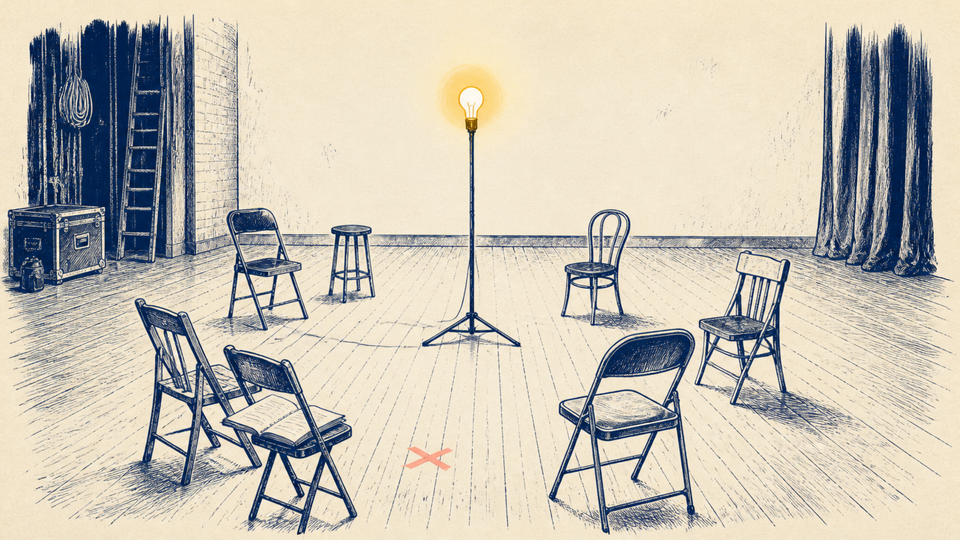
Yesterday I argued that the pause isn’t what you do instead of the change, or before it. Practiced well, the pause is what the change looks like: recess is revolution.
Today is about what happens inside the pause: what we rehearse, what we keep skipping, and what repair actually asks of us. If you missed yesterday’s map of grace and accountability, start there. Everything below leans on it.
 KP Williams
A while back, an old friend and I had dinner in Winchester and saw 9 to 5 at the Leeds. Before the show, she introduced me to a retiree she’d met during her stint at the local library. When I described my work, recess and play and all, he made a joke. I’ve forgotten the joke. I haven’t forgotten the reflex behind it: that play is what you do once the real work is done, a treat rather than a tool. It’s the most common reaction my work gets, and the most revealing.
Theatre people know this in their bones. Augusto Boal, who built the Theatre of the Oppressed, allowed that theatre might not be revolutionary in itself, “but have no doubts, it is a rehearsal of revolution!” (Boal, 2008, p. 135). His spect-actors stop a scene, step onstage, and try the move that might change the ending, at a scale where getting it wrong costs nothing but a laugh and another try.
Doctors don't graduate out of practice, either. They practice medicine for an entire career. Lawyers practice law. Nobody hears that and thinks it's the lesser version of the work. Practice is the work, done in a way that keeps learning possible.
Last winter I wrote that the encounter in a Circle, a PLAY LAB, or a civic dialogue “is not preparation for the real thing. That is the real thing, at the scale where learning is still possible.” I put that sentence under a title that said before. The title was wrong. The sentence was right.
That is not preparation for the real thing. That is the real thing.
Moving on instead of settling up
This country has a habit, and it's worth naming now that the people who were out are in. When public power is abused, we forgive first and account never. We call it healing. It's closer to deferral.
Andrew Johnson pardoned the Confederacy. Gerald Ford pardoned Richard Nixon to spare the nation a trial. And on January 20, 2025, his first day back in office, Donald Trump pardoned roughly 1,500 people charged in the attack on the Capitol carried out in his name, and commuted the sentences of 14 more, after the courts had spent four years doing the accounting (Associated Press, 2025). That isn't grace without accounting. It's accounting, undone.
Each time, the country chose to move on instead of settling up, and each time the bill came back with interest. On Friday I'll lay out the receipts, from emancipation to the restitution victims will never see. Today the point is simpler. This isn't Nixon and Ford. What's broken now is not a single burglary and a cover-up.
Return, accountability, repair
So the day-after conversation reaches for one of three words.
Return is the one the exhausted want most: back to normal, back to boring, back to a news cycle you can ignore for a week. I understand the craving. But normal is the speed that brought us here, and moving on is the habit that keeps sending us the bill. Returning is how you rebuild the same storm.
Accountability is the one the angry want, and it isn't wrong. When public power is abused, it needs consequences, or the abuse becomes the precedent. Some of the loudest voices for moving on are on the side that just won.
A week before the election, Kamala Harris said that going in the direction of impeachment “is not a good idea” if Democrats took the House; better, she argued, to spend limited resources on oversight and investigations (Yahoo News, 2026). Last December, House Democratic leaders Hakeem Jeffries, Pete Aguilar and Katherine Clark voted “present” on an impeachment measure to keep the fight focused on affordability (ABC News, 2026).
Now that Democrats hold the gavels, that's no longer a hypothetical. Within hours, Rep. Robert Garcia, in line to chair the House Oversight Committee, had a two-word message for Trump administration officials: “lawyer up” (The Hill, 2026a). Rep. Bobby Scott wrote to the heads of ten departments and agencies, reminding them that destroying federal records can mean fines or prison (The Guardian, 2026), and committee staff describe a long list of investigations to come (NPR, 2026).
I understand the math. People are struggling to pay for groceries. But governing or accountability is a false choice. A Congress can lower costs and hold power to account in the same session. Oversight is accountability. So is restoring restitution, reforming the pardon power, and refusing to treat the last ten years as a closed chapter. The tool can be debated. The accounting can't be skipped.
Repair is the word I keep coming back to, because it refuses to choose between the other two. It's the same tension I've been living with for years, between grace and accountability, and it was never an either/or. It's a yes, and. Grace without accountability enables harm; we've run that experiment for 160 years. Accountability without grace becomes punitive, the same against energy that won the vote and cannot govern: a politics of exile that mistakes punishment for justice.
Grace opens the door. Accountability walks through it. Repair is what we build on the other side, and the question it asks is harder than either: what do we make together now, and who gets to help make it? One limit holds through all of it. Dialogue ends where dignity is denied. Grace is not an invitation to bargain over anyone's right to exist.
Grace opens the door. Accountability walks through it. Repair is what we build on the other side.
And here's the catch. You can't answer that question at the speed we've been living. If the people you voted for won, they now have to govern: not just celebrate, not just punish, and not squander the moment by rushing it. If they lost, the work of building something worth voting for starts today, not two years from now. Either way, the scarce resource isn't outrage. We have plenty of that. The scarce resource is imagination, and imagination needs room.
Four commitments, revised
Four commitments hold up one claim
Rest is radical
Depletion can’t listen.
Rest isn’t withdrawal from the work; it’s the condition under which the work stays ethical.
Play is rehearsal
Practice before stakes.
You cannot improvise your way through a crisis you have never practiced for.
Imagination is infrastructure
Picture it to build it.
An imagination that can’t picture an alternative can’t build one, or picture a for.
Practice is the action
Democracy, small scale.
The small room where people try something together isn’t the warm-up for democracy. It is democracy.
Hover or tab through the pillars to see more.
Rest is radical. Exhaustion can't listen. The mind running on depletion defaults to the first story it was told, and usually that story has an other in it. Rest isn't withdrawal from the work; it's the condition under which the work stays ethical.
Play is rehearsal. Play is how people practice possibility before the stakes are real. It builds imagination, courage, and the ability to relate to people unlike us: the three things acceleration erodes first. You cannot improvise your way through a crisis you have never practiced for.
Imagination is infrastructure. Change begins in story and possibility, before legislation, before organizing, before protest. An imagination that can't picture an alternative can't build one, and it can't picture a for without one. Feeding it isn't a luxury; it's the most structural thing a change-maker can do.
Practice is the action. Courage grows from rehearsal, iteration, and experiment. The small room where people try something together isn't the warm-up for democracy. It is democracy, at the scale where we can still learn how.
Firsts worth celebrating
Tuesday also brought a string of firsts, from statehouses to the Senate, and from both parties. Chris Pappas became the first openly gay man elected to the U.S. Senate (Axios, 2026; CNN, 2026), Abdul El-Sayed the first Muslim senator (PBS News, 2026), and Peggy Flanagan the first Native American woman elected to the Senate (Native News Online, 2026). Keisha Lance Bottoms became the first Black woman ever elected governor in the United States (Democracy Now!, 2026), one of five Black governors elected in a single night, a group that includes the first Black Republican elected governor (Stateline, 2026). They deserve more than a paragraph in someone else's essay, so they'll get a page of their own.
One day we won't have to celebrate firsts. For now, they're worth celebrating twice: once for the people who earned them, and once for what they say. Every one of them is a repudiation of the status quo. Not a return to normal, not a door held open by the usual gatekeepers, but a plain answer to the question of who gets to help make what comes next. On Tuesday the answer was: more of us than ever before.
That question doesn't stop at the ballot. It reaches the leadership offices too, on both sides of the aisle. A new class of firsts shouldn't have to wait in line behind the same few names who have held the gavels, the podiums and the purse strings for decades. Party-flavored nepotism, red or blue, is still the status quo. The jockeying started before the last ballots were counted. Speaker Mike Johnson told staff he won't run for minority leader, and Steve Scalise and Jim Jordan, two of the most familiar names in the House GOP, both moved to replace him (The Hill, 2026c). Chuck Schumer says he'll be reelected majority leader, even though several of the senators just elected, among them Adam Hamilton, Abdul El-Sayed and Peggy Flanagan, have said they won't vote for him (The Hill, 2026b).
I'd gladly welcome new leadership in both chambers. I’ve signed two petitions that ask for it: one urging Senate Democrats to choose a new majority leader, and one urging House Democrats to choose a new Speaker. Bridges count, too. Elizabeth Warren is no newcomer, but the week before the election she was reported to be weighing a move up to the Senate Democrats' No. 3 post. Amy Klobuchar is leaving that seat to become Minnesota's governor, and without a successor, the top tier would have no women in it (POLITICO, 2026).
An old hand who opens the door for the new class is its own kind of repair. And it's one more reason I keep coming back to term limits: not as punishment, but as a way to make room. The question is never only who wins. It's who gets to lead, and from what pedestal, podium, or perch.
Non-partisan, not neutral
Creative Recess is non-partisan. Creative Recess is not neutral.
I won't tell you how to vote. I will name what I see, including when it's my own side choosing comfort over courage, or choosing a new other over a new for. And I will tell you that a democracy running permanently on threat response can't think, and that a people who can only vote against will keep electing the next thing to be against. That's not a messaging problem. It's a tempo problem. The answer isn't to pick the right tribe. It's to tend the ecosystem that keeps producing them.
So this is my offer, to the relieved and the devastated alike. Take a recess. Not as a retreat from the fight and not as a reward for surviving it, but as the fight's first honest move: slowing down enough to think together, disagree honestly, and stay in the room with the people we didn't vote with.
Friday: Settling Up: A Short History of Moving On, with the receipts.
Come practice with us. The 2027 Possibility Calendar opens in January with a Pause: a new year begun without resolutions. Or bring your own circle for six weeks with a Studio Sprint.
References
ABC News. (2026, January 17). Democrats grapple with 'rising clamor' for Trump impeachment ahead of midterms. https://abcnews.com/Politics/democrats-grapple-rising-clamor-trump-impeachment-ahead-midterms/story?id=129291674
Associated Press. (2025, January 20). Trump issues sweeping pardon of 1,500 Jan. 6 defendants, including rioters who attacked police (via Anchorage Daily News). https://www.adn.com/nation-world/2025/01/20/trump-issues-sweeping-pardon-of-1500-jan-6-defendants-including-rioters-who-attacked-police/
Axios. (2026, November 4). Chris Pappas wins N.H. Senate race, defeating John Sununu. https://www.axios.com/2026/11/04/new-hampshire-nh-senate-results-sununu-pappas
Boal, A. (2008). Theatre of the oppressed (New ed.; C. A. McBride, M.-O. Leal McBride, & E. Fryer, Trans.). Pluto Press. (Original work published 1974)
CNN. (2026, November 3). The historic firsts of the 2026 election (via KVIA). https://kvia.com/politics/cnn-us-politics/2026/11/03/the-historic-firsts-of-the-2026-election/
Democracy Now! (2026, November 4). “Over a decade of organizing”: Keisha Lance Bottoms becomes first Black woman governor in U.S. history. https://www.democracynow.org/2026/11/4/keisha_lance_bottoms_becomes_first_black
The Guardian. (2026, November 4). Democrats warn Trump officials to keep records or risk criminal penalties after midterm victories. https://www.theguardian.com/us-news/2026/nov/04/democrats-warn-trump-officials-preserve-records
The Hill. (2026a, November 4). Incoming House Oversight chair to Republicans: ‘Lawyer up’. https://thehill.com/homenews/house/6197457-robert-garcia-house-oversight-warning/
The Hill. (2026b, November 4). Schumer has votes for majority leader despite some Democratic dissent. https://thehill.com/homenews/senate/6198456-schumer-senate-majority-leader-support/
The Hill. (2026c, November 4). Speaker Mike Johnson won’t run for minority leader, setting up GOP battle. https://thehill.com/homenews/house/6197725-mike-johnson-gop-house-minority-leader/
Native News Online. (2026, November 4). Peggy Flanagan makes history with historic Senate victory. https://nativenewsonline.net/currents/peggy-flanagan-makes-history-with-historic-senate-victory/
NPR. (2026, November 4). Back in the majority, Democrats have plans for a long list of Trump investigations. https://www.npr.org/2026/11/04/g-s1-150276/2026-midterms-democrats-investigations
PBS News. (2026, November 4). Democrat Abdul El-Sayed wins election to U.S. Senate from Michigan (Associated Press). https://www.pbs.org/newshour/politics/democrat-abdul-el-sayed-wins-election-to-u-s-senate-from-michigan
POLITICO. (2026, October 29). House Dems' war of the wings is underway (Inside Congress newsletter: "Warren eyes post-election leadership move").
Stateline. (2026, November 3). In historic night, voters elect 5 Black governors, including first woman, first Republican. https://stateline.org/2026/11/03/in-historic-night-voters-elect-first-black-woman-first-black-republican-as-governors/
Yahoo News. (2026, October 29). Kamala Harris warns Democrats against another Trump impeachment if they win House in midterm elections. https://www.yahoo.com/news/politics/articles/kamala-harris-warns-democrats-against-183007656.html