
Any Port in a Storm

Civic P.E. · 1st Period: What You Believe
2016 was an especially enlightening year, if only for my course load. As a rare full-time doctoral student, I took three courses a term rather than one or two, and I studied abroad twice. Across the spring, summer, and fall of 2016, I completed core leadership coursework in Leading from Within and Leading Change (politics, policy, and advocacy); core research coursework in Theories Framing Inquiry, qualitative methods, and advanced survey methods; and two of the most consequential encounters of my scholarship: Dr. Suzi SooHoo’s Critical Pedagogies in Curriculum and Dr. Whitney McIntyre Miller’s Leadership in International Contexts, a study abroad course in Siem Reap, Cambodia, in July 2016.

One of my classmates in Leading Change that fall was a retiree named Doug. He could have played Santa Claus without a costume. In a course on politics, policy and advocacy, with the election bearing down, he said two things I haven’t been able to shake. The first was “any port in a storm will do.” The second was “there are no passionate moderates.” Ten years later, the storm is worse. This short series is my answer to Doug, in three class periods. This one is about what we believe. 2nd Period is about how we show up. 3rd Period is about how we meet.
The map I taught with
When I taught, one of the tools I brought into the classroom was Pew Research Center’s political typology quiz. Given the climate and conditions at Iowa State and more generally in 2024, I cautiously encouraged students in my own Leading Change and Leadership in a Diverse Society courses to consider taking the quiz before the election. I treated this as an extended learning opportunity: not required, and not “extra credit.” Ideally, I could have assigned the quiz and used the anonymous group data to dialogue across difference in real time. Alas.
The typology is the idea that launched Pew in 1987. Instead of asking whether you’re a Democrat or a Republican, it sorts you by your values, and then shows you who else shares them.
In June, Pew redrew the map for the ninth time (Pew Research Center, 2026a). It surveyed 10,357 adults and found nine groups. From left to right:
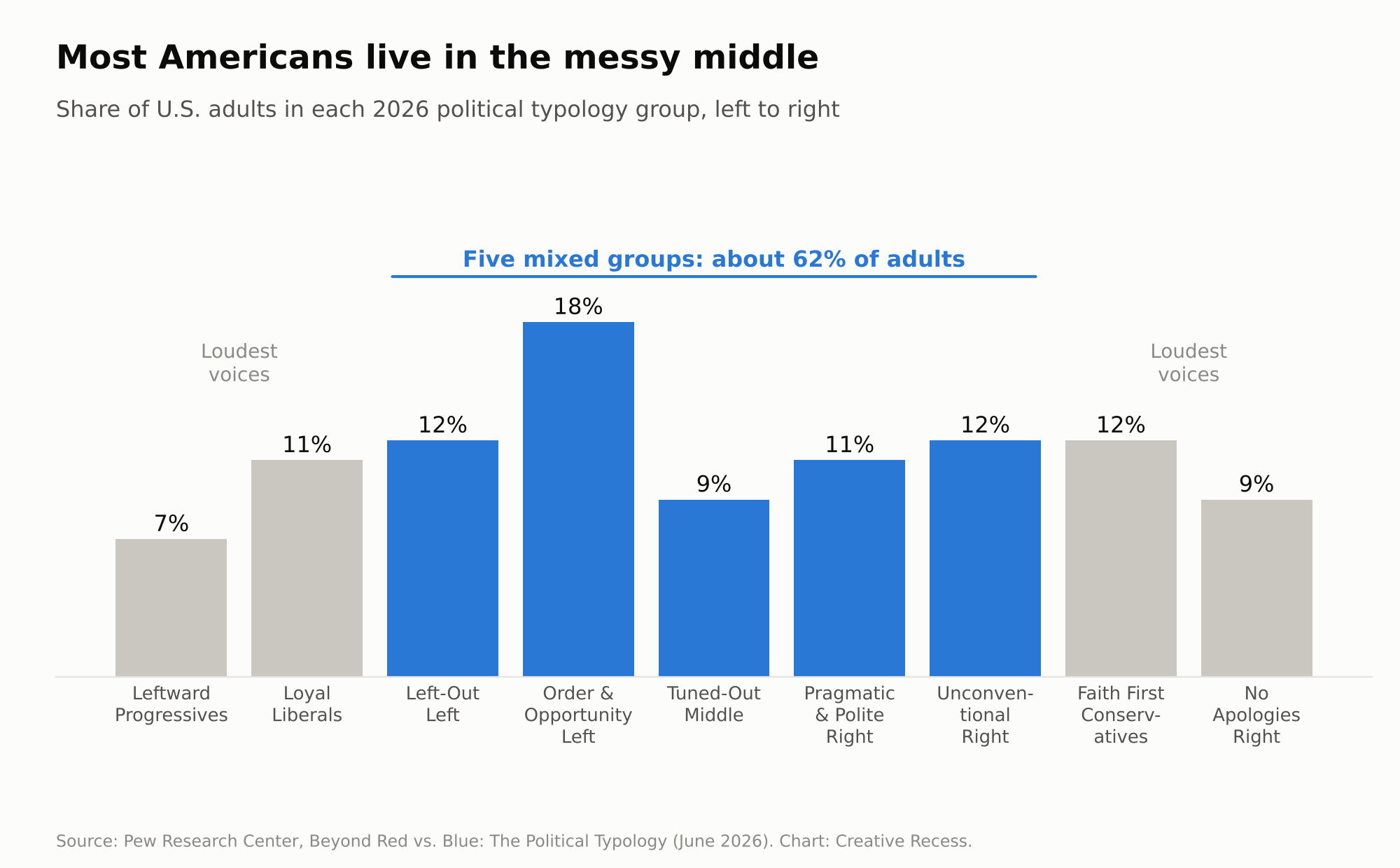
The headline isn’t the names. It’s the shape. Four highly ideological groups, two on each side, are what Pew calls “the loudest voices in the room.” Yet “they do not represent the majority of Americans.” The five groups in between make up about 62% of the country. In Pew’s words, “most Americans – in both partisan coalitions – are neither consistently liberal nor consistently conservative in their values” (Pew Research Center, 2026a).
The loud groups are also the ones who show up. In 2024, 83% of No Apologies Right and 79% of Loyal Liberals voted. Only 32% of the Tuned-Out Middle did (Pew Research Center, 2026b). They don’t even hear the same voices. No Apologies Right regularly get news from Joe Rogan (42%) and Newsmax (32%), Loyal Liberals from NPR (58%), and the Tuned-Out Middle from Fox and CNN in nearly equal measure (Pew Research Center, 2026b).
Leaning against
If most of us aren’t consistently anything, why do elections feel like a war between two armies? Part of the answer is in another Pew study from this month: people choose their side by what they’re against (Shepard, 2026).
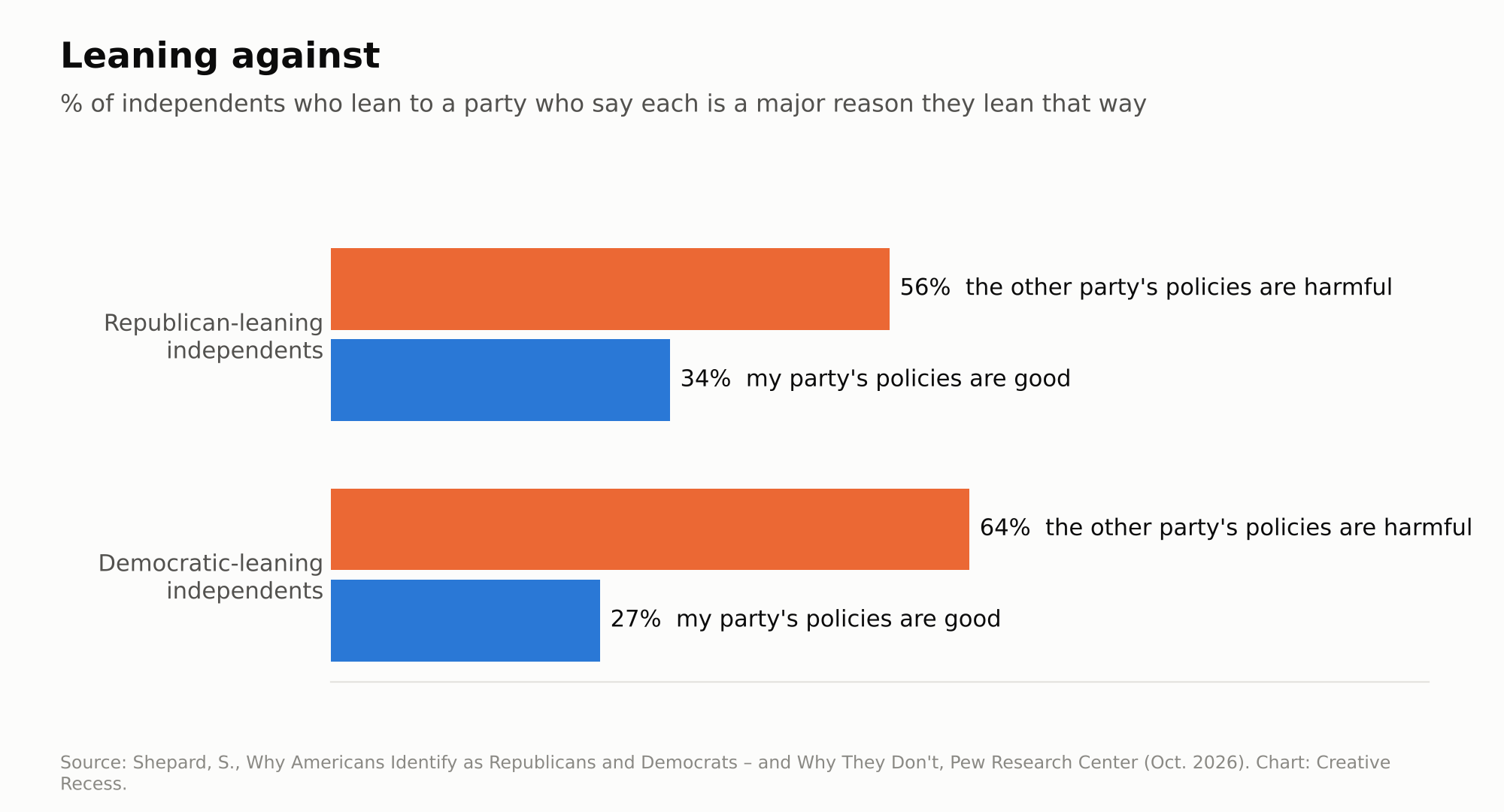
Among independents who lean toward a party, 56% of Republican leaners and 64% of Democratic leaners say a major reason is that the other party’s policies are harmful. Only 34% and 27% say a major reason is that their own party’s policies are good. Roughly four in ten leaners on each side say they keep their distance from the party they lean toward because they disagree with it on important issues, or because they’re frustrated with its leaders. Among Democratic leaners, frustration with party leaders has climbed from 28% in 2016 to 44% now (Shepard, 2026).
Any port in a storm. Many of us aren’t sailing toward a party. We’re running from the other one.
The passionate-moderate problem
So was Doug right? The case for “no passionate moderates” is stronger than it sounds, and it deserves a fair hearing.
Dr. King made the hardest version of it in 1963. In his Letter from Birmingham Jail, he described his greatest disappointment as “the white moderate, who is more devoted to ‘order’ than to justice” (King, 1963). Writers this year have pressed the same point (Rashid, 2026): the middle can be a comfortable place to stand while other people pay the price of waiting.
The research adds a twist. In a 2026 set of studies, people with strong views on issues like abortion rated moderates as belonging to the other side. The effect was strongest on emotional, moral issues. And it seemed to turn on one thing: partisans looked at whether moderates disliked the same people they disliked (Maimone & McKenzie, 2026; Markman, 2026). The researchers call it the “moderate as out-group” effect. In a polarized country, the middle isn’t a meeting place. It’s suspect from both ends.
Here’s where I think Doug was half right. A passionate moderate may be a contradiction. If “moderate” means a lukewarm average of two sides, nobody marches for it. But Pew’s middle isn’t lukewarm. It’s cross-pressured. Each of these groups holds some convictions that cut against its own coalition:
- The Order and Opportunity Left, the largest group in the country, is economically liberal and racially diverse. 84% favor photo ID to vote, and 65% favor automatic voter registration.
- The Pragmatic and Polite Right is economically conservative. Yet 62% want higher taxes on large corporations, and 86% want officials to avoid heated language (Pew Research Center, 2026a).
Those aren’t people without passion. They’re people whose passions don’t fit in one party’s box.
I’ve been calling them Pluralists without Umbrellas. The middle is not unmotivated. It is uncontained.
Three days before I sat down to finish this, I heard it from a stage half an hour from home. At President Trump’s rally at Northern Kentucky University on October 17, a congressional candidate accused his opponent of deceiving voters “when he campaigns as a moderate,” and the Republican running in my own district called the election “a pick a side moment” (Glynn et al., 2026).
Kentucky’s version
Kentucky is living this out in its voter rolls. In July, more Kentuckians registered as Independents or with other parties than as Republicans and Democrats combined. Independents and other parties grew by 2,530 voters. Republicans grew by 2,483, and Democratic registration fell by 32 (Northern Kentucky Tribune, 2026). Independents now make up 11% of the state’s voters, 383,889 people. “Neither party can prevail in a statewide race with only its base; both must reach out to the center,” Secretary of State Michael Adams said (Metzmeier, 2026).
That’s a lot of people standing in the rain without an umbrella, and a lot of people a campaign would be foolish to ignore.
Take the quiz
Before you read 2nd Period, take Pew’s 2026 political typology quiz through our Creative Recess group link, and notice two things: where your label fits, and where it pinches. The pinch is the interesting part. It’s where your convictions refuse to line up the way a party says they should.
Then ask yourself Doug’s question. Are you sailing toward a port, or just out of the storm?
Keep going
Where do you fit in the political typology? (Creative Recess group link). Then read 2nd Period and take the civic personality quiz with the rest of the class.
About the group link: The quiz is run by Pew Research Center, and your answers go to Pew under its privacy policy, not to me. Joining through our link adds your result to a Creative Recess group page, which shows answers only as group totals. No names or individual results appear. I’ll share how our readers compare once there are enough responses that no one’s answers can be picked out.
Read
- Pew Research Center, Beyond Red vs. Blue: The Political Typology (June 2026)
- Steven Shepard, Why Americans identify as Republicans and Democrats – and why they don’t (Pew Research Center, October 2026)
- Martin Luther King Jr., Letter from Birmingham Jail (1963)
References
Glynn, E., Tucker, R., & Almendarez, J. (2026, October 17). President Trump holds midterm rally in Highland Heights, Kentucky. The Cincinnati Enquirer. https://www.cincinnati.com/story/news/politics/2026/10/17/president-trump-holds-midterm-rally-in-highland-heights-kentucky--live/92265338007/
King, M. L., Jr. (1963, April 16). Letter from Birmingham Jail. https://www.africa.upenn.edu/Articles_Gen/Letter_Birmingham.html
Maimone, G., & McKenzie, C. R. M. (2026). Whoever is not with me is against me: The “moderate as out-group” effect. Journal of Experimental Psychology: General. Advance online publication. See American Psychological Association. (2026, July 27). Political moderates may be perceived as disloyal by both sides [Press release]. https://www.apa.org/news/press/releases/2026/07/political-moderates-disloyal-perception.html
Markman, A. (2026, October 8). Political moderates may not be liked by either side. Psychology Today. https://www.psychologytoday.com/us/blog/ulterior-motives/202610/political-moderates-may-not-be-liked-by-either-side
Metzmeier, L. (2026, August 9). More Independents registered than other parties combined in KY in July. The Cincinnati Enquirer.
Northern Kentucky Tribune. (2026, August 8). “Other” voter registration surges in July as 8,598 new Kentucky voters registered. https://nkytribune.com/2026/08/other-voter-registration-surges-in-july-as-8598-new-kentucky-voters-registered/
Pew Research Center. (2026a, June 10). Beyond red vs. blue: The political typology. https://www.pewresearch.org/politics/2026/06/10/beyond-red-vs-blue-the-political-typology/
Pew Research Center. (2026b, June 10). How voting, political participation and news sources differ across political typology groups. https://www.pewresearch.org/politics/2026/06/10/how-voting-political-participation-and-news-sources-differ-across-political-typology-groups/
Rashid, Q. (2026, June 3). Why did Dr. King say white moderates are worse than the KKK? https://www.qasimrashid.com/p/why-did-dr-king-say-white-moderates
Shepard, S. (2026, October 2). Why Americans identify as Republicans and Democrats – and why they don’t. Pew Research Center. https://www.pewresearch.org/short-reads/2026/10/02/why-americans-identify-as-republicans-and-democrats-and-why-they-dont/