
One Rep Every Four Years
Civic P.E. · 2nd Period: How You Show Up
I took a quiz this week and found out I'm a Mobilizer.
That's Pew's word for the 9% of American adults who do it all: they vote, they contact their officials, they wear the button, they give, they show up to the meeting, and they follow the news like it owes them money. The quiz is called "What Is Your Civic Personality?" (Pew Research Center, 2026d), and it's built on a large Pew-Knight study of how 5,393 Americans engage, or don't, with public life (Pew Research Center, 2026a).
My result didn't surprise me. The details did. I've never volunteered for a campaign, and I didn't march this year. I still landed in the top tier. I was pleasantly reminded and reassured: change comes in many shapes and sizes. We don't have to move mountains. We can start with stones. On November 3, I'll set down one of mine as a precinct officer at Northern Elementary, the school I attended, as did my siblings, my niece, and my nephew. I'm registered Independent, but for the County Clerk's purposes I'm the Democrats' rep, for "balance." I don't think a county this size needs partisan elections at all, but I've made that argument before.
Here's why that matters thirteen days before an election. Most of civic life isn't an election, and most of what Pew measured isn't voting.
Four ways to show up
Pew sorted the public into four groups using 19 questions about politics, community, religious life, and news (Pew Research Center, 2026a).
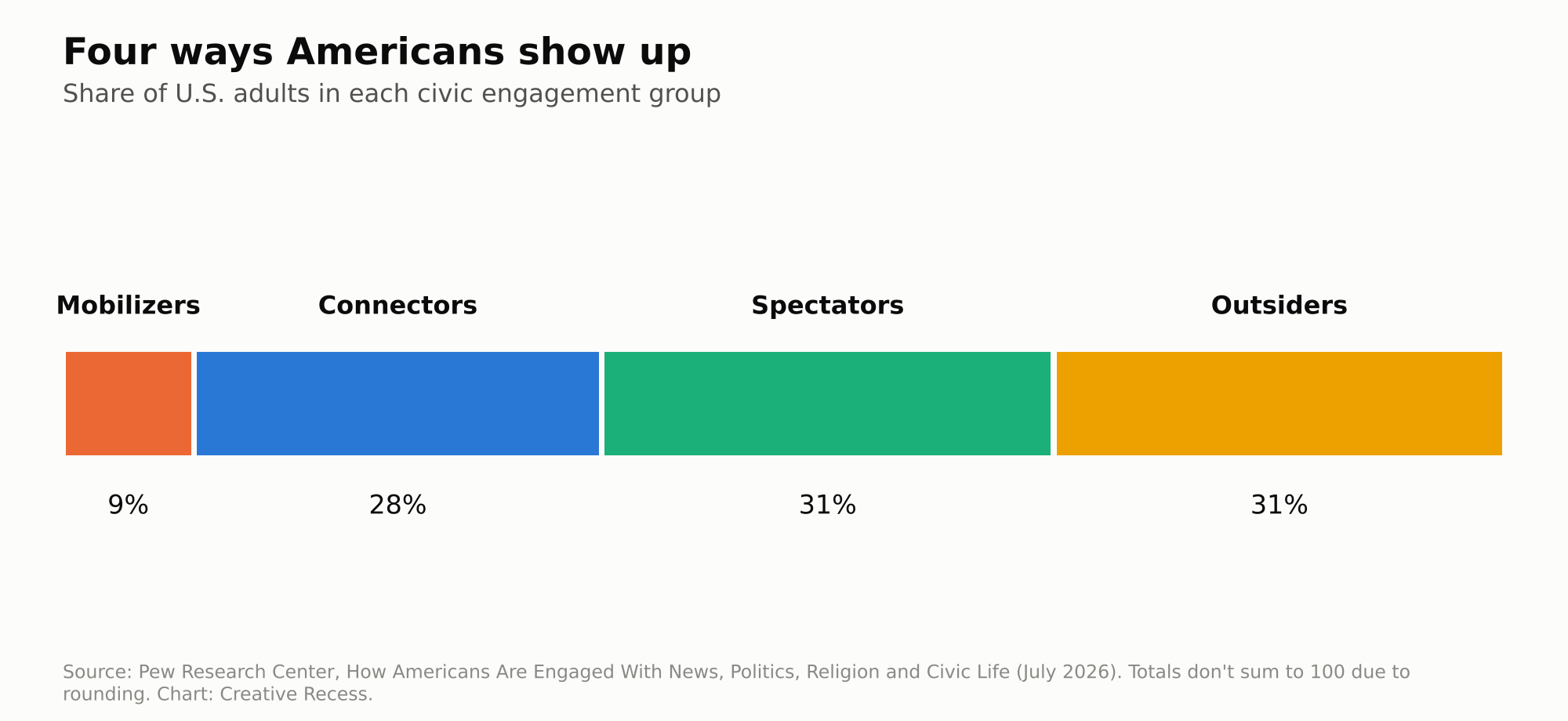
Mobilizers (9%) are active everywhere. In the past year, 74% have displayed a political sign or worn something to support a cause, and 65% have contacted an elected official.
Connectors (28%) are deeply involved, just not politically. About nine in ten gave money to a nonpolitical cause, and many anchor their week in a congregation, a club, or a volunteer shift. They vote and follow the news, but they rarely take public political action.
Spectators (31%) keep an eye on things. Eighty-four percent follow national news at least somewhat closely, but they engage privately: a like, or a share in a group chat, rarely a public post. They're the youngest group, and the most likely to be online almost constantly.
Outsiders (31%) take part less in nearly everything Pew asked about. Even so, 41% voted in 2024.
Read those last two together. Nearly a third of American adults follow politics closely and do little else with it, and another third show up mostly, if at all, once every four years.
The quiz measures habits, not moments
Every question on the quiz asks about the past year (Pew Research Center, 2026d). Did you volunteer? Belong to a group? Attend a local government meeting, in person or online? Give more than $25 to a cause? Talk about the news with someone? It isn't asking whether you care. It's asking what you did, and how often.
That's the right question, because the civic muscle atrophies like any other. A single heavy lift every four years isn't a workout. It's an injury waiting to happen. When we only show up for the presidential sprint, civic life starts to look like a contest over who can turn out the most fury in the least time. The candidates notice. So do the people who profit from our fury.
The Connectors are the quiet rebuke to all that. Their civic muscle gets a weekly workout in places that have nothing to do with parties: the fish fry, the food pantry, the theatre board, the church council, the PTA. Pew counts them as "less political." I'd call them in training.
Where we live
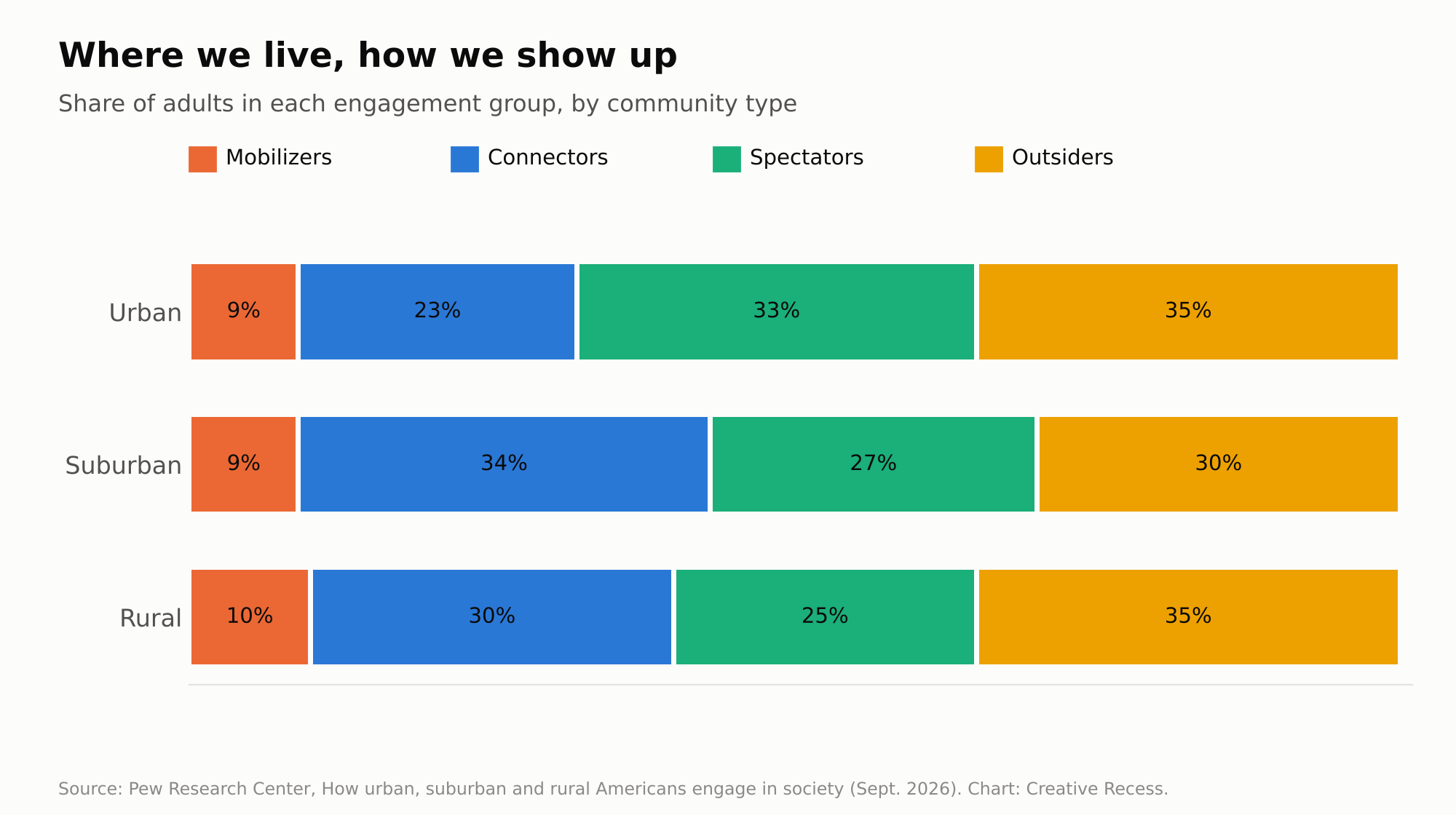
Pew broke the four groups out by community type, and the rural numbers surprised me (Pew Research Center, 2026b).
- Rural Americans are slightly more likely to be Mobilizers (10%) than urban or suburban Americans (9% each).
- They're the most likely to attend religious services at least monthly (42%).
- Among those who belong to a group, they're also the most likely to meet mostly in person (63%).
- They're more likely to put out a yard sign or wear campaign gear (19%), and the least likely to march (6%).
They're also tied with city dwellers as the most likely to be Outsiders (35%). That's the rural paradox I know from home: the people who are in the room are really in the room, and the people who aren't are really not. Here, finding the meeting is half the rep. Some of us are working on that.
At the library, where I work the circulation desk, civic life has a cadence: Thursdays, Fridays, rotating weekends. The mailman comes every morning. The bulletin lady comes on Fridays for her twenty weekly copies, on paper she supplies. The littles come every Friday for story hour, following the school calendar. And we complete a surprising number of faxes and shipping label print jobs. The theatre has been the sprint, three productions in as many months. The library is the rep.
The Mobilizer's question
The study has an uncomfortable finding for people like me. Mobilizers skew toward higher education and income, and they include more conservative Republicans and liberal Democrats than the public as a whole (Pew Research Center, 2026a). In other words, the most engaged Americans overlap with the people Pew's new political typology calls "the loudest voices in the room" (Pew Research Center, 2026c).
So I have to ask whether I'm one of the loud voices or a translator for the quiet ones. A Mobilizer can spend all that activity shouting louder at people who already agree. Or that same energy can build places where Connectors, Spectators, and Outsiders can practice showing up without having to sprint.
My answer is yes, and. I've found myself a bridge across people, places, and times: generational, political, socioeconomic; town and gown, old and new, rural and urban. It's the thread that runs from my dissertation, On the Move (Williams, 2019), back to my first published chapter, on service-learning that transcends classrooms, communities, and cultures (George-Hirons et al., 2018).
I couldn't be my most authentic self in the academy. I self-censored, fell short of competing demands, and struggled to comply creatively while still doing what I saw as my role as an educator, especially at a land-grant university. As an independent professor, I choose my own curriculum, for myself and for others. I have truer academic freedom, and I set my own standards and my own transparency. The best part: no grading.
One more rep before November 3
Voting matters, and you should do it. Early voting in Kentucky begins October 29, and Election Day is November 3. But if you'd like to treat this election as more than a single lift, pick one rep you haven't done this year:
- Call or write one local official about something you've noticed where you live.
- Sit in on one public meeting, such as fiscal court, the school board, or the library board, even online.
- Join one group that meets in person.
- Talk about the news with one person who doesn't already agree with you, and listen longer than you talk.
Then do it again next month. That's the whole program: repetition, rehearsal, recess, revolution.
- Repetition, because the muscle only grows with reps.
- Rehearsal, because practice should be safe to fail.
- Recess, because the muscle grows during rest, not during the lift.
- Revolution, in both senses: the wheel coming round again, and the change only a body in shape can carry.
As ever, I'm planting seeds. Not everything I share is immediately relevant or consequential. But at some point, two weeks, two years, two kids, two jobs from now, some seed will bloom.
Keep going
Take the quiz: Find your civic personality through the Creative Recess group link: What Is Your Civic Personality? You'll see your own result right away.
About the group link: The quiz is run by Pew Research Center, and your answers go to Pew under its privacy policy, not to me. Joining through our link adds your result to a Creative Recess group page, which shows answers only as group totals. No names or individual results appear. I'll share how our readers compare once there are enough responses that no one's answers can be picked out.
Read
- Pew Research Center, How Americans Are Engaged With News, Politics, Religion and Civic Life (July 2026)
- Pew Research Center, How urban, suburban and rural Americans engage in society (September 2026)
If you missed it, start with 1st Period, "Any Port in a Storm," on what we believe. 3rd Period, on how we meet, comes next.
References
George-Hirons, A., Reuber, A., & Williams, K. P. (2018). Transcending classrooms, communities, and cultures: Service-learning as an integral component of foreign language teaching methods courses. In J. Purdy (Ed.), Language beyond the classroom: A guide to community-based learning for world language programs (pp. 76–123). Cambridge Scholars Publishing.
Pew Research Center. (2026a, July 16). How Americans are engaged with news, politics, religion and civic life. https://www.pewresearch.org/journalism/2026/07/16/how-americans-are-engaged-with-news-politics-religion-and-civic-life/
Pew Research Center. (2026b, September 28). How urban, suburban and rural Americans engage in society. https://www.pewresearch.org/short-reads/2026/09/28/how-urban-suburban-and-rural-americans-engage-in-society/
Pew Research Center. (2026c, June 10). Beyond red vs. blue: The political typology. https://www.pewresearch.org/politics/2026/06/10/beyond-red-vs-blue-the-political-typology/
Pew Research Center. (2026d). Quiz: What is your civic personality? https://www.pewresearch.org/journalism/quiz/what-is-your-civic-personality/
Williams, K. P. (2019). On the move: Storying the authentic leadership development of millennial gay men [Doctoral dissertation, Chapman University].