
The Field of Encounter

Civic P.E. · 3rd Period: How You Meet
When did someone who votes differently from you last change your mind about anything?
Pew can tell you a great deal. 1st Period used its new political typology to show what we believe: most of us sit in a cross-pressured middle that no party fully holds. 2nd Period used its civic personality study to show how we show up: some of us every week, many of us once every four years. Neither one asks the question I care about most: whether meeting each other can still change us.
The closed field
There are signs the answer is getting harder to reach. In a 25-country Pew survey this year, 53% of American adults said Americans have bad morals and ethics. The U.S. was the only country surveyed where more people judged their fellow citizens' morals bad than good (Pew Research Center, 2026b). It's hard to be changed by someone you've already decided is a bad person.
In two weeks this month, four Trump rallies showed the same pattern. On October 7, at the Freeman Coliseum in San Antonio, protesters said they were hit, shoved, and punched as they were removed. The Bexar County sheriff called the assaults "minor," charged one person, and asked the public to help identify others (Oates & Luna, 2026).
On October 12, at the Covelli Centre in Youngstown, Ohio, a woman wore a T-shirt that read "Release the Epstein Files." On video, one attendee pushes her down. Another jumps on her, appears to punch her in the face several times, pulls her hair, and puts her in a headlock (Li, 2026). Sheriff's deputies restrained her and walked her out. The man who hit her was allowed to stay, and no one was arrested; a sheriff's spokesman said deputies "may not have seen the entire altercation" (Date, 2026). From the stage, the president mocked her weight and said, without evidence, "You know they're paid protesters." Youngstown's mayor, Derrick McDowell, wrote that "senseless (political) violence has absolutely NO place in our community" (Li, 2026).
On October 17, half an hour from my home, at Northern Kentucky University, a man who shouted during the rally was walked out. This time, the coverage describes no punches. "Back home to mom," the president said (Goffinet & Elming, 2026). Then, again without evidence: "They pay them $250." A Kentucky mother, he added, would "slap the hell out of" him (Mathur, 2026). Outside, Nikki Wessel held a sign she hoped would "maybe make people think while they're going in" (Glynn et al., 2026).
On October 21, in Pendleton, South Carolina (a different Pendleton from mine), a protester named Matthew McDaniel was removed from the rally. He says one man held him in a chokehold while another punched him, and he went to the hospital with neck injuries. The Anderson County Sheriff's Office is investigating (Connor, 2026). From the stage, the president asked, "Who's the guy that threw that punch?" and compared him to Evander Holyfield. "Man, I loved that," he said. "He got whacked" (Ede-Osifo, 2026). McDaniel, asked about witnesses, named the president: "he's actually my best witness" (Connor, 2026).
The pattern is the point. I noticed the people initiating, encouraging, and, worst of all, doing nothing. Any of them would probably tell you they're good people. Goodness that only shows up when it's convenient isn't goodness; it's a costume.
In "The State as Spectator," I wrote about the state that watches. Youngstown had spectators in layers: deputies who "may not have seen," a stage that mocked, and a crowd that watched. Nine days later, in Pendleton, the stage had moved from mocking to cheering. Pew has a civic personality called Spectators. Watching isn't neutral when someone is being hit in front of you. The opposite of a spectator isn't only a participant. It can also be a witness.
A field, not a line
For a while now I've used a different map from the left-to-right spectrum. I call it the Field of Encounter. A spectrum is a line. A field has space, texture, and movement. The positions on it aren't about what you believe but about how open you are to being moved: what I call permeability. That isn't the same as how engaged you are. You can be very active and completely closed, or barely visible and wide open. The German philosopher Otto Bollnow drew the line I'm drawing: "a human meeting as such is not yet an encounter" (Pantazis, 2012, p. 647). You can attend every meeting and never be moved.
Pew doesn't measure permeability, so what follows is my reading of its data, not its findings. With that said plainly, here's how the 2026 groups fall on the field, using the typology's shares (Pew Research Center, 2026a):
- The Extremists and Radicals (about 28%). No Apologies Right, Faith First Conservatives, and Leftward Progressives are highly engaged, highly ideological, and very cold toward the other party.
- The Preservationists / Tinkerers (about 11%). Loyal Liberals have the most trust in institutions of any group, and 82% say their party represents people like them well. What surprised me is that this band is nearly empty on the right.
- Pluralists without Umbrellas (about 41%). The Order and Opportunity Left, the Pragmatic and Polite Right, and the Unconventional Right each hold convictions that cut against their own coalition. That cross-pressure doesn't guarantee openness, but it's where openness is most possible.
- The Refusers (about 12%). The Left-Out Left aren't apathetic. They've judged the options and said "not these." 78% lack confidence in the political system, 39% say neither party represents them, and they're the only group in which fewer than half say voting gives people like them a say.
- The Depleted (about 9%). The Tuned-Out Middle doesn't refuse. Half can't pay some of their bills, and only 32% voted in 2024. Yet 37% say both parties care at least somewhat about people like them, the top figure among the groups Pew's text reports. They haven't rejected the door. They can't reach it.
The middle is not unmotivated. It is uncontained, and the 2026 data suggests it's uncontained in two different ways: some people walked out, and some never had the bandwidth to walk in.
Are the edges mirror images?
It's tempting, and lazy, to say "both sides." The data says something more precise.
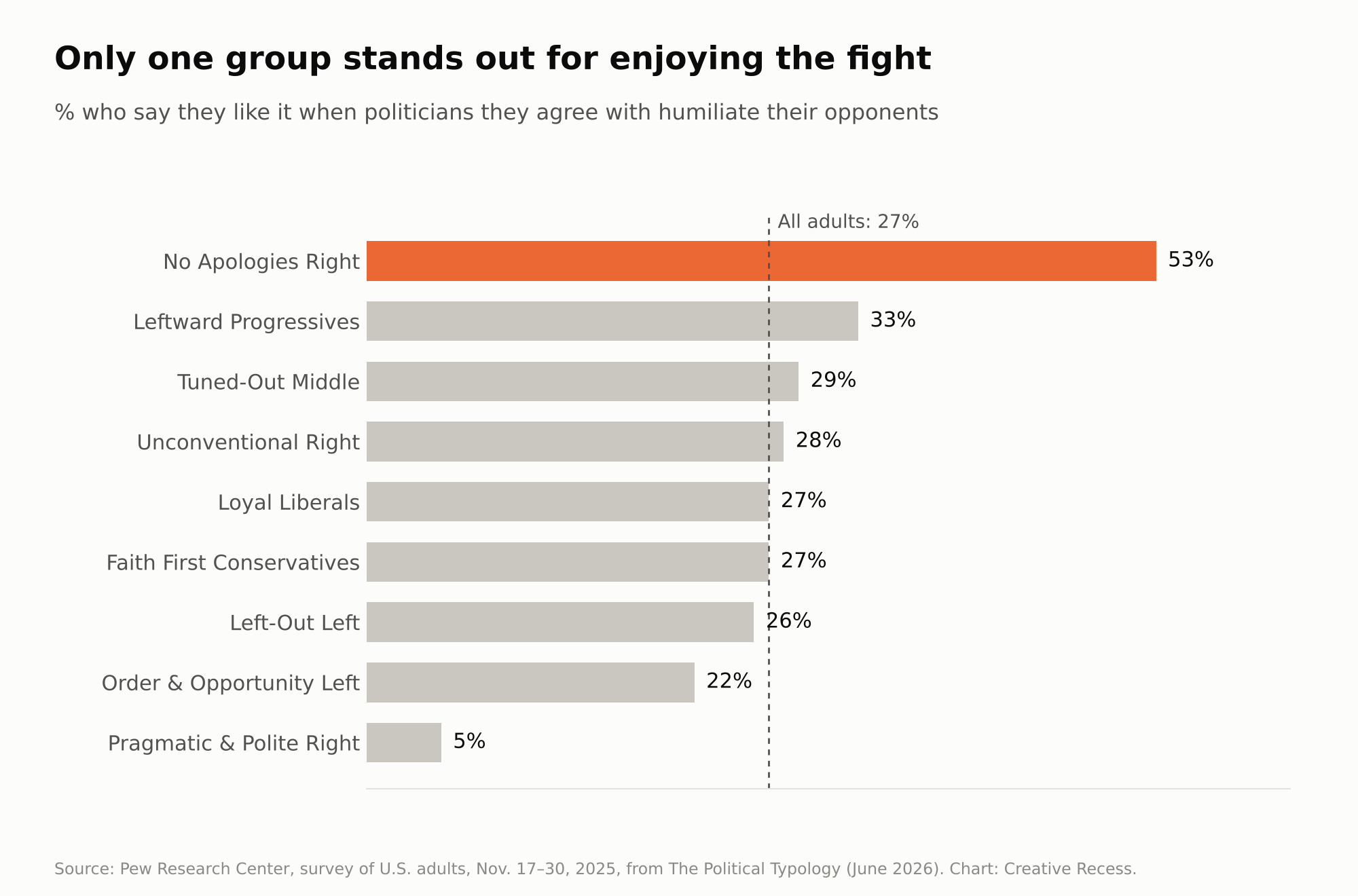
Pew asked whether people like it when politicians they agree with humiliate their opponents. Across the public, 27% said yes. No Apologies Right stood alone at 53%. Leftward Progressives were next at 33%. Every other group fell between 22% and 29%, Faith First Conservatives included. The Pragmatic and Polite Right were at 5% (Pew Research Center, 2026c).
The parties' feeling-thermometer ratings tell the other half. Each edge is about equally cold toward the other side: Leftward Progressives rate Republicans a 9 out of 100, and No Apologies Right rate Democrats a 9. But the right's edges run warm toward their own party, while the left's edges are only lukewarm toward theirs (Pew Research Center, 2026d).
So here's the honest version. Both edges are equally cold. Only one group, about 9% of adults, relishes the fight. That isn't a verdict on any party's voters. Most people on both sides sit at or below the national average on that question. But it's not nothing, either. In Youngstown and Pendleton, we saw what it looks like in an arena.
Four endings and a fifth
The sociologist Hartmut Rosa spent a long book on social acceleration: the way modern life keeps speeding up until institutions, politics, and people can no longer keep pace. He ends with "four alternatives," "not all equally probable" (Rosa, 2013, p. 320). Society might find a new balance "at a higher level of speed," though he thinks those hopes are "unrealistic." It might give up on modernity's project of self-government altogether. It might "reach for the emergency brake" and force everything to slow down, which he calls "highly unrealistic," because no one can say "who the political and institutional bearers of such a politics of deceleration could be" (pp. 320–322). Or, "most likely," we continue "the unbridled onward rush into an abyss" (p. 322).
Then, on the book's last page, he hopes that "a creative contemporary social theory can find the impulse to discover a fifth ending for the history of acceleration" (p. 322).
I take that as an invitation. Rosa also left a warning that I take just as seriously. Some slowing down, he wrote, is really "slowdown as a strategy of acceleration": retreats, meditation, and yoga that rest us up only so we can run faster (pp. 87–88). A recess that just makes us better workers isn't a recess. A civic practice that just calms us down before the next fight isn't a fifth ending.
A starter kit, not a list
I don't have a complete list of futures, and I don't trust anyone who does. I have a starter kit: practices worth building now, so we're ready for more than one ending.
Some of them I wrote into a fantasy constitution earlier this year, "250 for 250," for the country's semiquincentennial. Three stand out:
- Citizens’ assemblies chosen by lot. Ordinary residents deliberate on hard questions. Kentucky already has one. In March, Lexington’s first civic assembly spent a month on the city charter, with residents chosen by lottery from thousands of mailed invitations. Every recommendation had to clear an 80% bar the members set for themselves, and all three did. “People actually changed their mind — in opposite directions — when receiving new evidence,” wrote the assembly’s organizer (Young, 2026). All three recommendations are on Fayette County’s ballot on November 3 (Peterman, 2026; Young, 2026).
- A right to the pause. Civic life gets protected intervals, so deliberation has time to happen.
- What I call the Practice Ecology Clause. It recognizes that democracy survives only with "containers, rhythms, and rituals" in which democratic capacities are actively grown.
None of these can make an encounter happen. They can only make one possible. Most of the kit is humbler and closer to home. It's libraries, community theatres, fair boards, and church basements, the places where people who vote differently still have to share a folding table. A survey of more than 1,400 local officials found local governments "largely insulated from the harshest effects of polarization," especially in communities of fewer than 50,000 people (Hall, 2026). It's a county calendar, so people can actually find the meeting.
Here’s what it looks like when the field opens. Megan Phelps-Roper grew up in the Westboro Baptist Church. Conversations with people who disagreed with her, on Twitter of all places, helped her leave (Phelps-Roper, 2017).
A self-check
Pew's quizzes ask what you believe and what you do. Here's one they don't ask. It isn't scientific, and it isn't a typology. It's a mirror.
If those are hard to answer, you're not alone. That's the work. Keep the first four questions for yourself. Sit with them on a walk, or in the car before you go in somewhere. But answer the last one out loud: reply to this email, or tell me in the comments wherever you found this. Where's the last place you sat at a shared table with people you didn't choose? I'll gather the answers into a map of where we still meet.
Back to Doug
Ten years ago, Doug said any port in a storm will do. He was describing something true: when the weather turns, people grab whatever shelter is closest. That's also what an untrained body does in a crisis.
The answer to the storm isn't a better port. It's a civic body strong enough to build one: repetition, rehearsal, recess, revolution.
Ten years later, here's what I'd tell Doug: passion is a privilege and a paradox. It takes bandwidth not everyone has, and the people with the most of it are often the hardest to move. Maybe the passionate moderate isn't a contradiction. Maybe it's a practice.
Keep going
Start at the beginning
- 1st Period: "Any Port in a Storm." What we believe.
- 2nd Period: "One Rep Every Four Years." How we show up, with the civic personality quiz.
Read
- Hartmut Rosa, Social Acceleration: A New Theory of Modernity (Columbia University Press, 2013), especially the conclusion
- Pew Research Center, Beyond Red vs. Blue: The Political Typology (June 2026)
- Danielle Allen, Talking to Strangers: Anxieties of Citizenship since Brown v. Board of Education (University of Chicago Press, 2004). Find it at a library near you.
- Lauren Hall, "Local governments provide proof that polarization is not inevitable" (The Conversation, February 2026)
References
Connor, E. (2026, October 22). Anti-Trump protester punched at South Carolina rally speaks. The Post and Courier. https://www.postandcourier.com/politics/protester-trump-sc-rally-punched-video/article_88300b28-350b-4ab2-9a9d-4bc4230d4bab.html
Date, S. V. (2026, October 13). Youngstown police: If assault victim at Trump rally files a report, they will investigate. HuffPost. https://www.huffpost.com/entry/trump-ohio-rally-assault_n_6ace5414e4b0447f8d48cb98
Ede-Osifo, U. (2026, October 21). "Man, I loved that": Trump cheers South Carolina rally attender who hit protester. The Guardian. https://www.aol.com/articles/man-loved-trump-cheers-south-012304000.html
Glynn, E., Tucker, R., & Almendarez, J. (2026, October 17). President Trump holds midterm rally in Highland Heights, Kentucky. The Cincinnati Enquirer. https://www.cincinnati.com/story/news/politics/2026/10/17/president-trump-holds-midterm-rally-in-highland-heights-kentucky--live/92265338007/
Goffinet, J., & Elming, A. (2026, October 17). Protester removed from President Trump rally in Northern Kentucky. FOX19. https://www.fox19.com/2026/10/17/protester-removed-president-trump-rally-northern-kentucky/
Hall, L. (2026, February). Local governments provide proof that polarization is not inevitable. The Conversation. https://theconversation.com/local-governments-provide-proof-that-polarization-is-not-inevitable-273986
Li, D. K. (2026, October 13). Trump rally protester attacked in act of 'senseless' political violence, Ohio mayor says. NBC News. https://www.nbcnews.com/news/us-news/trump-rally-protester-attacked-act-senseless-political-violence-ohio-m-rcna603249
Mathur, A. (2026, October 17). Trump trolls rally heckler with warning that his Kentucky mom would "slap the hell out of him." MEAWW. https://news.meaww.com/trump-trolls-rally-heckler-with-warning-that-his-kentucky-mom-would-slap-the-hell-out-of-him
Oates, Z., & Luna, J. (2026, October 12). Assaults at President Donald Trump's rally in San Antonio lead to BCSO investigation. KSAT. https://www.ksat.com/news/local/2026/10/13/videos-of-assaults-at-president-donald-trumps-rally-lead-to-bcso-investigation/
Pantazis, V. E. (2012). The "encounter" as an "event of truth" in education: An anthropological-pedagogical approach. Educational Theory, 62(6), 641–657. https://doi.org/10.1111/edth.12002
Peterman, A. (2026, April 8). Inside a Kentucky city's unusual experiment in citizen-led governance. Next City. https://nextcity.org/features/inside-a-kentucky-citys-unusual-experiment-in-citizen-led-governance
Pew Research Center. (2026a, June 10). Beyond red vs. blue: The political typology. https://www.pewresearch.org/politics/2026/06/10/beyond-red-vs-blue-the-political-typology/
Pew Research Center. (2026b, March 5). In 25-country survey, Americans especially likely to view fellow citizens as morally bad. https://www.pewresearch.org/religion/2026/03/05/in-25-country-survey-americans-especially-likely-to-view-fellow-citizens-as-morally-bad/
Pew Research Center. (2026c). No Apologies Right are less concerned about offensive language and embrace a brasher approach to politics than other groups [Chart]. https://www.pewresearch.org/chart/no-apologies-right-are-less-concerned-about-offensive-language-and-embrace-a-brasher-approach-to-politics-than-other-groups/
Pew Research Center. (2026d, June 10). How the political typology groups feel about the Republican and Democratic parties. https://www.pewresearch.org/politics/2026/06/10/how-the-political-typology-groups-feel-about-the-republican-and-democratic-parties/
Phelps-Roper, M. (2017, February). I grew up in the Westboro Baptist Church. Here's why I left [Video]. TED Conferences. https://www.ted.com/talks/megan_phelps_roper_i_grew_up_in_the_westboro_baptist_church_here_s_why_i_left
Rosa, H. (2013). Social acceleration: A new theory of modernity (J. Trejo-Mathys, Trans.). Columbia University Press.
Young, R. (2026, October 26). Commentary: What happens when Kentuckians have the chance to work through their differences?. Kentucky Lantern.