
The State as Spectator

Part II ended on a premise: that some debts to society can never be fully paid. Part III follows that premise to the place where the ledger closes for good.
On August 14, 1936, in Owensboro, Kentucky, a crowd that newspapers put anywhere from 10,000 to 20,000 gathered before dawn to watch the state hang Rainey Bethea, a young Black man convicted of the rape of a 70-year-old white woman, Lischia Edwards (Mother Jones, n.d.; Ryan, n.d.). He had confessed to robbing and killing her, without a lawyer, and he was first charged with murder. Then the commonwealth’s attorney, Herman A. Birkhead, made what one historian of the case calls “the extraordinary decision to charge him only with rape” (Ryan, n.d.).
Under Kentucky law at the time, a rape conviction meant a public hanging in the county where the crime happened. A murder conviction would have meant the electric chair, out of sight at the penitentiary in Eddyville. “I expect to prosecute for rape,” Birkhead said, “and if he is convicted, he will be hanged in Daviess County” (Lea, 2025). The prosecutor’s choice of charge decided where Bethea would die, and who would get to watch. It was the last public execution in the United States, and it went wrong in front of everyone. The press came for a show the state had all but advertised: a woman sheriff, Florence Thompson, who might spring the trap herself.
Hundreds of reporters arrived, and the Chicago Times brought a truck fitted with a darkroom (Lea, 2025). Thompson stayed in a car near the scaffold. The man assigned to the lever, a former Louisville policeman named Arthur Hash, climbed the steps drunk, in a white linen suit, and fumbled it; a deputy finished the job (Ryan, n.d.). The stories went out under headlines like “Death Makes a Holiday: 20,000 Revel Over Hanging,” with souvenir hunters clawing at the black hood. The Louisville Courier-Journal turned the state’s pride against it: “Her Derby parties are known all over the country. Her hanging parties should have an even wider fame” (Lea, 2025).
Kentucky’s leading papers reprinted editorials from across the country denouncing a “carnival of sadism” and demanded that the law be changed. Only Owensboro’s own paper insisted the town had been slandered, and blamed out-of-town reporters for writing the story they had come to write (Lea, 2025, quoting The New York Times). Eyewitnesses still disagree about how much jeering there was; some remember a hush (Ryan, n.d.). What nobody disputes is that the whole country watched Kentucky watch.
In 1938, a bill from Charles W. Anderson Jr., the state’s first Black legislator, who had joined Bethea’s appeal team, repealed the requirement that rape be punished by hanging (Lea, 2025; Notable Kentucky African Americans Database, n.d.).
Public killing in America has a lineage, and Owensboro sits inside it. The historian Timothy Snyder traces it to lynching: killings staged for crowds, meant to humiliate the person killed and to terrorize everyone who shared his race (Snyder, 2026). Rainey Bethea got a trial, and the Owensboro crowd was legal. But it gathered out of the same tradition, and the shame Kentucky felt afterward was a kind of recognition. The critic Doreen St. Félix describes the century that followed as the state reclaiming killing from the mob, trading the rope and the tree for protocol and a needle, “making the whole thing look medicalized” (St. Félix, 2026).
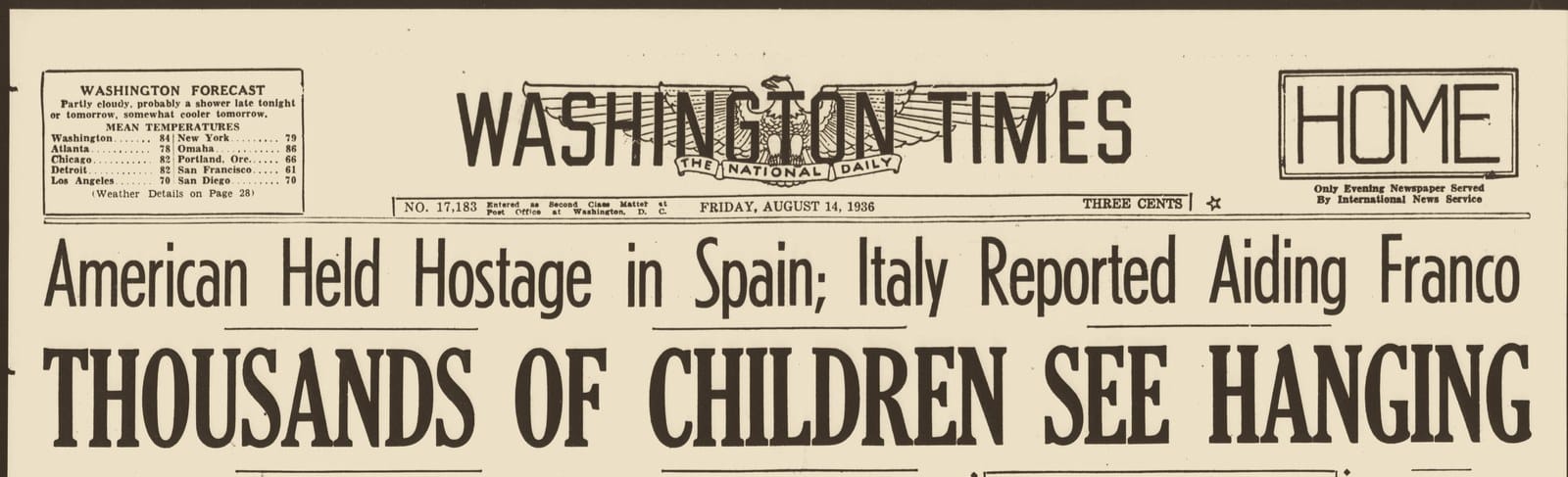
The writer Sonya Lea learned in her forties that her grandparents, newlyweds of eighteen and nineteen, were in that crowd. White Owensboro made a night of it: cots beside the gallows, vendors selling popcorn and Coca-Cola on ice, “necktie parties” (Lea, 2025). Parents who had stayed up all night carried children, some of them babies, on their shoulders to see (Washington Daily News, 1936). “THOUSANDS OF CHILDREN SEE HANGING,” the Washington Times told its readers that day (Washington Times, 1936).
Lea asks what happens if we turn the camera away from the Black man on the scaffold and toward the white faces watching him (Lea, 2025). Susan Sontag, writing about the photographs of lynchings that crowds once posed for as souvenirs, put the cost of looking in one line: “The display of these pictures makes us spectators, too” (Sontag, 2003, §5). Lea’s question is the one this essay keeps asking of the state, and of us.
The rope and the tree have not entirely gone. Since the fall of 2025, Black people have been found hanging from trees across the South: Demartravion “Trey” Reed, 21, on the campus of Delta State University in Mississippi; Juliana Nzita, 16, in Charlotte; To’Nea Nicole Miller, 27, in a Miami park (NAACP Legal Defense Fund, n.d.; DeBerry, 2026). Officials ruled Miller’s death a suicide within two days (NAACP LDF, n.d.). The medical examiner ruled Nzita’s death a suicide within days, and Charlotte police closed the case soon after: no autopsy, her phone never recovered, and the man who found her body never contacted (Atlanta Black Star, 2026, reporting the Charlotte Observer; WBTV, 2026).
Some of these deaths may be what officials say they are. The columnist Jarvis DeBerry warns against any rule about what Black people never do, and in Jackson, the hanging death of Tasia Fortune was ruled a homicide, and a 51-year-old Black man was charged with her murder (DeBerry, 2026). This is a velocity crisis in miniature. A coroner who looks at a body in a tree and names the death within days is the state as spectator in another form: it watches, and then it decides what it saw. One older woman, praying in church this summer, used the older word. She called them “lynchings” (DeBerry, 2026).
Ninety years after Owensboro, the federal government wants the audience back. Then the crowd fit in a town square. This one fits in every pocket.
Every pocket
On December 3, at Fort Hood, the Army plans to execute Nidal Hasan by firing squad. Hasan, an Army psychiatrist, killed 13 people and wounded 32 in a 2009 shooting in a medical building where soldiers were waiting for vaccinations and deployment clearance. It would be the military’s first execution of any kind since 1961, when Private John Bennett was hanged, and its first by firing squad since Private Eddie Slovik was shot for desertion in 1945 (Treisman, 2026).
Defense Secretary Pete Hegseth first called it public: “We’ll make sure that people are able to watch it, that it’s public.” Asked whether Hasan had made any final requests, he answered, “Don’t care. We’ll see him on December 3rd.” On October 8, the Pentagon confirmed that the execution will be livestreamed (Toropin, 2026). President Trump has since said the choice is his: “So I’ll make a decision ultimately. I know what the military would like to do.” He also offered the case for broadcasting it: “By showing it, maybe other people won’t be doing what he did” (McBride, 2026).
Not everyone in the administration seems sure. Vice President JD Vance said, “I don’t know that that’s actually going to happen,” and added that he won’t be watching. Archbishop Paul Coakley, president of the U.S. Conference of Catholic Bishops, called the plan “a barbaric promotion of a culture of death” (Smyth & Price, 2026). Republicans in Congress began saying so out loud. House Speaker Mike Johnson warned that the video could become “a recruiting tool for future terrorists.” Sen. Thom Tillis, who wants Hasan executed, called streaming it “beyond disgusting” (Swai, 2026). Asked about the recruiting worry, Trump hedged on the camera and not on the killing: “I’m going to make a determination about that. But he will be killed” (Filkins, 2026).
By October 14, CNN and ABC News were reporting that Trump and his advisers were debating whether to call off the livestream. No decision had been announced (CNN, 2026; Ng, 2026). The military’s own Catholic archbishop went further. Timothy Broglio, who presided at the funeral of Michael Grant Cahill, the only civilian Hasan killed, said Catholic soldiers assigned to the firing squad should ask to be excused. Hasan’s crime “was heinous,” he said, “but does exposing the public to his execution serve any purpose?” Is there “really a value,” he asked, “to throwing them in the same boat with terrorists by broadcasting the image of the execution of a man in a wheelchair to the whole world?” (Associated Press, 2026b). The date may not hold. A habeas petition in the federal courts could delay it, and military approval is no guarantee of speed: Ronald Gray’s death sentence was approved by President George W. Bush in 2008, and he is still on military death row (Treisman, 2026).
Some of those screens will belong to children. In 1936, the Washington Times counted them in the crowd. The Army now has a rule against that: “No person under the age of 18 shall witness” a military execution. Whether a livestream “counts as a presence,” a military law professor told the Associated Press, is an open question (White & Lauer, 2026). AP reporters spent two days asking the White House whether anyone had considered children seeing the footage and got no answer. Child psychiatrists are already telling parents to assume their kids will hear about it, if not see it, and to say something simple: “you’re safe, you’re secure, this is what we believe” (Kellman & Boone, 2026).
The belief that watching teaches is older than the republic, and so is the doubt. In 1787, Benjamin Rush, a physician who had signed the Declaration of Independence, asked what crowds actually learned at a hanging. “How often,” he wrote, “do we find pockets picked under a gallows, and highway-robberies committed within sight of a gibbet?” Worse, pity for the condemned could turn the lesson around: “We secretly condemn the law which inflicts the punishment” (Valsania, 2026). The historian Maurizio Valsania puts Cesare Beccaria’s old question to the new plan: “What future harm does this additional spectacle prevent?” Officials can stage the spectacle, he writes, but they cannot control its meaning.
I want to be precise about what I’m questioning. It isn’t Hasan’s guilt, which is not in doubt, and it isn’t the grief of the families he made. It’s the camera. Kentucky learned in 1936 what a public execution does to a public. Kentucky’s lawmakers moved the gallows indoors because they were ashamed of the show, not because they had stopped believing in hanging. A livestream doesn’t restore the town square; it erases the walk home. There’s no crowd to look at itself, only millions of private screens, each one an audience of one.
There is a more serious argument for the camera, and it deserves an answer. When the state kills, it kills in our name, and we have a real interest in seeing what it does. The ethicist Jacqueline Boaks takes that argument seriously and still comes down against the livestream: transparency “at most requires some witnesses, not live-streaming” (Boaks, 2026). Witnesses report back to the public. A livestream makes the public the audience. She ends with a question I'm still orbiting: we should “think about what it does to us to watch such footage.”
Made to look like medicine
Bringing executions indoors was step one. Making them look gentle was step two. Oklahoma lawmakers authorized lethal injection in 1977, and the method entered use in 1982, sold as clean, clinical, and painless, a death that looked like a medical procedure (Greene, 2026; Strange, 2026). The legal scholar Corinna Lain says it kept the death penalty “out of sight, out of mind” for most Americans for five decades (Treisman, 2026). The journalist Pamela Colloff witnessed a Texas execution in 1998 and said: “it was as if I were watching someone go to sleep” (Abrams, 2026). That was the design.
On September 30, Tennessee tried to execute Christa Pike for the 1995 killing of her classmate Colleen Slemmer. Two days earlier, Governor Bill Lee had denied her request to commute the sentence to life without parole (Jeyaretnam, 2026). The reporter Catherine Sweeney was one of seven media witnesses. When the drugs have finished flowing, she writes, staff open a small door in the wall of the death chamber and set a rock on a platform; that is the state’s signal. The rock came out at 7:41 p.m. At 7:44, Pike was still talking to her spiritual adviser about the burning in her arm. The staff ran a second round of pentobarbital. Pike began to snore. The curtain closed at 8:16, and for nearly forty minutes the witnesses listened to her breathe over the loudspeaker (Sweeney, 2026).
Help was slow to reach her. The first call for emergency help came from the execution chamber at 8:40 p.m. At 9:03, a voice on the dispatch line passed along what supervisors had decided: “We have been informed it is a false call. … There is no medical assistance needed at Riverbend Prison.” Prison officials did not confirm the emergency until 9:11, roughly half an hour after the first call (Johnson et al., 2026). The state had built a room to make a death look like medicine. When the medicine was actually needed, the system’s first answer was that nobody needed it.
According to the Death Penalty Information Center, she is the first person in the modern era to survive lethal doses of execution drugs. Her lawyers later wrote in a court filing that the execution team apparently never realized the IV lines were placed wrong or that her veins had blown; she reached the hospital with both arms “swollen, burned, and blistered” (Sweeney, 2026). By October 8, she was conscious, eating, and walking with help; her attorneys call her recovery “remarkable” and are again asking Governor Lee to commute her sentence (Hall & Chandler, 2026). On October 10, she was discharged from the hospital and returned to the prison where she has spent three decades (Associated Press, 2026a).
It was Tennessee’s second failed execution this year. In May, the execution team spent more than an hour failing to place an IV line in Tony Carruthers. A physician tried a central line he had not set in decades, and Carruthers was pierced with needles and cut with a scalpel before the governor called it off and granted a one-year reprieve (Bruenig, 2026; Blakinger, 2026). The same physician was involved in both. Dr. Mark Fowler took part in the failed Carruthers attempt and confirmed in August that he would oversee Pike’s execution (Wethington, 2026). After Pike, Lee ordered an independent investigation and suspended executions through the end of the year; the state’s prison chief resigned.
One more detail matters for Kentucky. Tennessee’s execution protocol is a guidebook the Department of Correction writes for itself; there is no other regulation over executions in the state, and the law keeps the IV placement hidden behind a curtain (Sweeney, 2026). Hold onto that.
Fairness belongs here. Colloff, who has reported on the death penalty for decades, says plainly that Lee is “pro-death penalty,” and that “you can be pro-death penalty and want this system to work as well as it possibly can” (Bryan, 2026). Lee says as much himself: “The people of Tennessee make that decision, and my job is to make sure then that those sentences are carried out” (Jeyaretnam, 2026). His pause isn’t a conversion. It’s an admission that the machine failed at the one thing it was built to hide. Two weeks later, in Florida, the machine worked. James Robertson was pronounced dead about ten minutes after the injection, and a corrections spokesperson promised a process that is “humane and dignified” (Fischer, 2026b).
Lethal injection and the livestream orbit the same question from opposite sides. One makes killing look like medicine; the other makes it look like what it is. Each gives away what the other was hiding.
The arithmetic of one hand
In Part I, a single hand held the key back to the ballot box: in Kentucky, a governor’s pardon is the only way a person with a felony conviction gets the vote back. Florida has its own version, and it runs the other way.
Among the states that still carry out executions, Florida is the one where a single official, the governor, decides which person on death row gets a warrant, and when. Colloff, whose new book follows a Florida capital case, says there’s “no rhyme or reason” to the choosing (Bryan, 2026). On The Daily she put it more starkly: “There is zero transparency. It’s like in a black box how Governor DeSantis picks these men and why” (Abrams, 2026). When a man gets his date, he is moved from death row to Death Watch: three cells, about thirty feet from the execution chamber (Bryan, 2026). He waits there about thirty days, “within steps of where this will take place.” When Colloff was reporting this spring, all three cells were filled, and “as soon as one person was executed, the pattern was that often the next day a new death warrant would be signed, and there would be a new person in place.” She calls it “a unique kind of mental torture” (Bryan, 2026).
Florida carried out 19 executions in 2025, a state record since 1976. In September, Governor Ron DeSantis stayed the execution of William Lee Thompson, 74, pending a psychiatric evaluation of whether he was competent to be executed; his lawyer says he “suffers from dementia and his health is failing.” On October 9, for the first time since taking office, DeSantis withdrew a warrant. The letter gave no reason. Thompson stays on death row, and a new warrant can be signed (Fischer, 2026a; Blakinger, 2026). Four days later, Florida executed James Robertson, its 17th this year and more than half of the 31 executions in the whole country so far. Two more are scheduled for October 20 and November 5 (Fischer, 2026b). If both go forward, Florida will match its own record two days after Kentucky votes.
Colloff tells a story I can’t stop thinking about, maybe because I’ve never trusted the theater of a signing ceremony: the officials arranged behind the podium, the pens handed out as souvenirs. A victim’s family sent the governor custom Sharpies, printed with either the victim’s name or the defendant’s (she wasn’t sure which). He signs legislation and death warrants with a Sharpie, and not long after, he signed that man’s death warrant (Bryan, 2026). What troubles her, she says, is “an arbitrariness … even more than cruelty.” “We just don’t know why certain people are being set at certain times” (Bryan, 2026). She’s also careful to say she couldn’t determine DeSantis’s motives, and I won’t guess at them either.
Watch: The Gray Area (Vox), “The problem with the death penalty,” with Pamela Colloff (2026). Death Watch comes up around 14:30, the Sharpies around 26:30.
Arbitrariness doesn’t need a governor’s pen. Christa Pike didn’t kill Colleen Slemmer alone. Her boyfriend, Tadaryl Shipp, was convicted of murder too. He was seventeen, and he got life. She was eighteen, and she got death (St. Félix, 2026). One year of age chose the sentence, the way one charge chose the crowd in Owensboro.
The arithmetic of one hand cuts both ways. In Kentucky, one hand decides whether a citizen is added back to the electorate. In Florida, one hand decides whose name comes off the list of the living, and in what order. And in Kentucky this November, Amendment 1 asks voters whether to take part of that hand’s power away. It would bar a governor from granting pardons or commuting sentences from 60 days before the governor’s own election until the newly elected governor is sworn in (Krauth, 2026). Commutation is the last door off death row, and for those weeks it would be closed. The case that set the amendment in motion went through that door.
On December 6, 2019, three days before he left office, Gov. Matt Bevin commuted the death sentence of Gregory Wilson, condemned for the 1987 kidnapping, rape, and murder of Debbie Pooley of Covington. Bevin said Wilson’s legal defense had been so poor that the death sentence was unjust, and he made Wilson eligible for parole. The parole board has since ordered him to serve out his life (Parnell, 2026). The amendment’s sponsor, Sen. Chris McDaniel, calls it a check on pardons issued “in the dark of night.” The ACLU of Kentucky calls clemency “an important safety valve in an imperfect judicial system,” and the amendment makes no exception for new evidence of innocence (Parnell, 2026). No other state puts a timing limit on clemency. Whatever you think of it, the question on the ballot is about how much one hand should hold, and when.
Things only get more true
The host, Miles Bryan, put a phrase to Colloff that he’d heard her use elsewhere: the justice system has “an asymmetry problem.” Things “can become more true” and “calcify” over time, but “it’s very difficult for something that has been accepted as true to become less true.” Colloff took it up. Our criminal justice system, she said, “values finality” (Bryan, 2026). In the case at the center of her book, the jury believed the informant and appellate judge after appellate judge “rubber stamped” the verdict. Undoing it now, she says, “would really require a political act of some kind” (Bryan, 2026). That is Section 145 in miniature, a decision written in 1891 that has only grown harder to undo, because undoing it takes a vote of the legislature and then of the people. Finality is a sensible value for a court. It is a stranger one for a people, and for anyone who believes, as I do, that we are all still unfinished.
The cost of that asymmetry is measured in exonerations. Florida has more death-row exonerations than any other state, 30 since 1973, by the Death Penalty Information Center’s count (Floridians for Alternatives to the Death Penalty, n.d.). Nationally, the National Registry of Exonerations found in 2015 that jailhouse informants testified in 23% of exonerations from death sentences, more than any other kind of case (National Registry of Exonerations, 2015). Her book follows one of them: Paul Skalnik, a former police officer turned jailhouse informant, whose testimony helped send James Dailey to Florida’s death row in 1987 for the murder of a 14-year-old girl, Shelly Boggio (Fadel, 2026). Dailey is now about 80 and is still there.
A prison sentence can be shortened, a record sealed, a vote restored. Parts I and II were about debts that are hard to pay. This one can’t be refunded.
Kentucky’s own pause
Kentucky has executed three people since 1976. The last was Marco Allen Chapman, by lethal injection at Eddyville, on November 21, 2008 (WHAS11, n.d.; Dawahare, 2026). In 2006, men on Kentucky’s death row sued over the state’s lethal-injection protocol, and in 2010 the Franklin Circuit Court issued an injunction that has kept the death chamber closed ever since (Saad, 2026). Attorney General Russell Coleman asked to have it lifted; in September, the Kentucky Supreme Court declined (Spectrum News 1, 2026; Death Penalty Information Center, 2026).
So Kentucky has a death penalty it hasn’t used in nearly 18 years, and the people it sentenced are growing old where they wait. More than 20 men are on death row at Eddyville. Their average age is just over 66, and only one person has been sentenced to death here since the injunction (Saad, 2026). On October 1, the day after Tennessee’s failed attempt on Christa Pike, Donald H. Johnson, 59, was found unresponsive in his cell. He had been condemned for the 1989 killing of Helen Madden, 61, at a laundry in Hazard, and he died 29 years to the day after he was sentenced. The state calls it an apparent suicide; the autopsy is pending (Saad, 2026). The chamber stayed dark. His life ended behind bars anyway.
Now the warning from next door. In April, the General Assembly overrode Governor Andy Beshear’s veto of Senate Bill 251, 30 to 7 in the Senate and 74 to 16 in the House. The law lets the Department of Corrections set execution procedures through internal policies and memos instead of formal regulations, though it must post those policies online. Its sponsor, Sen. Steve West, said it “does not change the law or remove constitutional protections,” and that it only clears the delays that have repeatedly stalled the state’s protocols (LEX 18, 2026).
Critics read it as a way to restart executions faster (Dawahare, 2026). That is close to the model Tennessee already runs: a protocol the department writes for itself, with no outside rule over it. We have just watched what it produced. So Kentucky ends up in a strange spot. The punishment stays on the books, the chamber stays dark, and the rules for turning the lights back on have quietly changed.
A fair hearing
The strongest case for the death penalty doesn’t come from a podium. It comes from families. Some crimes are so cruel that anything less than death feels, to the people who loved the victim, like the state saying the life taken was worth less. Seventeen years after Fort Hood, the families of 13 people are still waiting for the sentence a military jury handed down in 2013. Vance put it simply: “I hope that people don’t forget that this is a guy who brutally murdered a lot of innocent people.” That deserves to be heard before anything else is said.
Colloff has heard it many times. What she describes is the gap between the promise and what families often get. The promise is closure. What follows, in a capital case, is coming back to court “for 5, 10, 15, 20, 25 years,” something prosecutors don’t always explain when they announce they’ll seek death. Colloff is careful about why. The extra layers of appeal exist because the punishment can’t be undone, and because many defendants don’t get capable counsel until years later, in post-conviction appeals. “These aren’t bad reasons necessarily” (Bryan, 2026). Many families, she says, end up disappointed that it “didn’t deliver what was promised.”
Debbie Pooley’s niece was 15 when her aunt was killed. Thirty-eight years, one commutation and several parole hearings later, she has come to wish Wilson had never been sentenced to death at all, “because the death penalty is really a life sentence for the family” (Parnell, 2026). And every execution creates what she considers “a new victim’s family”: the parents, siblings, and children of the person the state put to death (Bryan, 2026). She remembers one member of a victim’s family in a Texas case that ended in exoneration, an outcome her own reporting helped bring about. For 18 years, prosecutors had told his family one set of facts, and they believed them. “Why would they not?” With the evidence of innocence in front of him, he told her, “My mind understands, but my heart isn’t feeling it yet” (Bryan, 2026).
The public is moving, slowly. In September 1994, 80% of Americans told Gallup they favored the death penalty for murder. In October 2025 the number was 52% (Gallup, n.d.). The shift is generational. In Gallup’s 2020–2024 polling, fewer than half of Americans born after 1980 supported it, and among Gen Z just 42% did. Twenty years ago, Gallup found no meaningful differences by age (Jones, 2024). Death sentences have fallen by about 90% over three decades (Treisman, 2026). That leaves a country nearly split down the middle, and plenty of decent people on both sides of it.
Where I land
I’m against the death penalty. It isn’t that I think the people on death row are innocent. Most aren’t. It’s that the one punishment that can’t be corrected sits inside a system that, by its own records, makes mistakes, picks its cases unevenly, and now wants an audience.
I find it hopeful that Colloff didn’t start where she ended up. She grew up in New York City in the 1980s, in the tough-on-crime era, “a staunch advocate of the death penalty” (Bryan, 2026). Looking back, she doesn’t think it was “a position I had thought deeply about.” She had absorbed it the way a teenager does: somebody commits “the worst of the worst,” and “that’s the penalty you get.” One turning point came while she was still in high school, in the late 1980s: Errol Morris’s documentary The Thin Blue Line, about a wrongful conviction in Dallas. It shocked her “that you could not only get a case that wrong, but you could get a case that wrong and send someone to death row.”
Then DNA testing showed that the people who said there were innocent people on death row “were not crazy. This was true” (Bryan, 2026). Years of covering executions in Huntsville did the rest. Talking with “many, many people” about her reporting since, she has found that most “just haven’t thought about this issue deeply” (Bryan, 2026). She says it of her younger self before she says it of anyone else. That isn’t an insult. It’s an invitation.
Watch: Bryan Stevenson, “We need to talk about an injustice” (TED2012).
Who counts
This series started with a simple question about belonging: who counts? Part I followed the vote, a citizen subtracted from the electorate, in Kentucky sometimes for life. Part II followed the money, a person counted as a head in a bed at a daily rate. Part III follows the last subtraction, the one that takes the person out of the count altogether.
What ties them together is a habit of mind: the belief that some people can be permanently set outside the circle, and that the state should hold the pen that draws it. In 1936, Kentucky looked at its own crowd and decided it didn’t like what it saw. In 2026, we get to decide what we’re willing to watch, and whom we’re willing to keep counting.
Early voting in Kentucky begins October 29. Election Day is November 3. Amendment 1 is on your ballot. Whoever is asking for your vote, ask them where they stand on the hands that hold the keys: the pardon, the warrant, the camera.
Keep going
Watch
- The Thin Blue Line (Errol Morris, 1988), the documentary that helped free Randall Dale Adams, once sentenced to death in Texas for a murder he didn’t commit, and one of Colloff’s turning points. Find it at a library (many lend the Criterion edition, and your librarian can request it through interlibrary loan).
- Bryan Stevenson, “We need to talk about an injustice” (TED2012).
Listen
- The Gray Area (Vox), “The death row assembly line,” with Pamela Colloff (Oct. 9, 2026); watch on YouTube.
- The Daily (New York Times), “A Failed Execution and the Future of the Death Penalty” (Oct. 8, 2026). Watch on YouTube.
Read
- Catherine Sweeney, “What happened during Christa Pike’s failed execution”, NPR (Oct. 6, 2026), the witness account.
- Pamela Colloff, Catch the Devil: A True Story of Murder, Deception, and Injustice on the Gulf Coast (Knopf, 2026).
- Bryan Stevenson, Just Mercy (2014).
- Dexter Filkins, “What a public execution looks like”, The New Yorker (Oct. 14, 2026), remembering an execution he witnessed in Kabul Stadium in 1998.
- Sonya Lea, American Bloodlines: Reckoning with Lynch Culture (University Press of Kentucky, 2025), winner of a 2026 Kentucky History Award. Lea’s grandparents were in the Owensboro crowd, and the prosecutor was her great-grandmother’s first cousin. She turns the camera from the gallows to the people watching.
References
Abrams, R. (Host). (2026, October 8). A failed execution and the future of the death penalty [Video]. In The Daily. YouTube. New York Times Podcasts. https://www.youtube.com/watch?v=rVbpnMKVS1Y
Associated Press. (2026a, October 10). Christa Pike, who survived an execution attempt, is discharged from hospital, attorney says. MPR News. https://www.mprnews.org/story/2026/10/10/christa-pike-who-survived-an-execution-attempt-is-discharged-from-hospital-attorney-says
Associated Press. (2026b, October 12). Archbishop of the US military says Catholic soldiers should not serve on firing squad. Politico. https://www.politico.com/news/2026/10/12/archbishop-of-the-us-military-says-catholic-soldiers-should-not-serve-on-firing-squad-01116193
Atlanta Black Star. (2026, July 28). “We still have questions”: Family of Black Charlotte teen found hanging push for more answers as new records surface. https://atlantablackstar.com/2026/07/28/family-of-black-charlotte-teen-found-hanging-push-for-more-answers-as-new-records-surface/
“Bethea, Rainey.” (n.d.). In Notable Kentucky African Americans Database. University of Kentucky Libraries. https://ukscrc001.net/nkaa/items/show/488
Blakinger, K. (2026, October 6). I’ve covered death row cases for nearly a decade. What happened to Christa Pike wasn’t an anomaly. ProPublica. https://www.propublica.org/article/christa-pike-tennessee-execution-lethal-injection-failure
Boaks, J. (2026, October 12). Should you watch a tiger mauling a man – or a live-streamed execution? We asked an ethicist. The Conversation. https://theconversation.com/should-you-watch-a-tiger-mauling-a-man-or-a-live-streamed-execution-we-asked-an-ethicist-294150
Bruenig, E. (2026, October 1). Lethal injections are getting worse. The Atlantic. https://www.theatlantic.com/ideas/2026/10/christa-pike-tennessee-lethal-injection/688859/
Bryan, M. (Host). (2026, October 9). The problem with the death penalty | The Gray Area [Video]. YouTube. Vox. https://www.youtube.com/watch?v=Vq7UR2FuYDk (Also released as the podcast episode “The death row assembly line.”)
CNN. (2026, October 14). Trump may scrap plan to livestream Fort Hood shooter’s execution, sources say. CNN Newsource via WSAW. https://www.wsaw.com/2026/10/14/trump-may-scrap-plan-livestream-fort-hood-shooters-execution-sources-say/
Dawahare, R. (2026, October 12). Kentucky can’t kill its way to life and justice [Opinion]. Kentucky Lantern. https://kentuckylantern.com/2026/10/12/kentucky-cant-kill-its-way-to-life-and-justice/
Death Penalty Information Center. (2025). The death penalty in 2025: Year end report: Public opinion. https://deathpenaltyinfo.org/research/analysis/reports/year-end-reports/the-death-penalty-in-2025/public-opinion
Death Penalty Information Center. (2026). Kentucky Supreme Court denies attorney general’s request to remove injunction on executions. https://deathpenaltyinfo.org/kentucky-supreme-court-denies-attorney-generals-request-to-remove-injunction-on-executions
DeBerry, J. (2026, September 5; updated September 15). ‘Highly unusual’ trend of Black hanging deaths in the South has Black people considering two awful explanations [Opinion]. MS NOW. https://www.ms.now/opinion/highly-unusual-trend-of-black-hanging-deaths-in-the-south-has-black-people-considering-two-awful-explanations
The Detroit Tribune. (1936, August 8). U.S. court halts execution; 10,000 wanted to see (p. 2). Chronicling America, Library of Congress. https://www.loc.gov/resource/sn92063852/1936-08-08/ed-1/?sp=2
Fadel, L. (Host). (2026, July 20). “Catch the Devil” shares how a con man traded false information for favors [Radio broadcast]. In Morning Edition. NPR. https://www.hppr.org/2026-07-20/catch-the-devil-shares-how-a-con-man-traded-false-information-for-favors
Filkins, D. (2026, October 14). What a public execution looks like. The New Yorker. https://www.newyorker.com/news/the-lede/what-a-public-execution-looks-like
Fischer, D. (2026a, October 9). Florida execution called off after DeSantis withdraws death warrant for the first time. Associated Press. https://abcnews.com/US/wireStory/florida-execution-called-off-after-desantis-withdraws-death-137134791
Fischer, D. (2026b, October 13). Florida executed a prisoner who killed his cellmate in hopes of getting a death sentence. It’s the state’s 17th execution of the year. Associated Press; PBS News. https://www.pbs.org/newshour/nation/florida-executes-a-prisoner-who-killed-his-cellmate-in-hopes-of-getting-a-death-sentence-its-the-states-17th-execution-of-the-year
Floridians for Alternatives to the Death Penalty. (n.d.). Florida death penalty fact sheet. https://www.fadp.org/florida-death-penalty-fact-sheet/
Gallup. (n.d.). Death penalty [Trend data]. Retrieved October 13, 2026, from https://news.gallup.com/poll/1606/death-penalty.aspx
Greene, C. (2026, October 10). Are firing squad executions seeing a revival in the U.S.? TIME. https://time.com/article/2026/10/10/firing-squad-execution-lethal-injection-christa-pike-fort-hood-shooter/
Hall, K. M., & Chandler, K. (2026, October 8). Christa Pike’s attorneys say she is walking with help and eating after failed execution attempt. Associated Press; PBS NewsHour. https://www.pbs.org/newshour/nation/christa-pikes-attorneys-say-she-is-walking-with-help-and-eating-after-failed-execution-attempt
Jeyaretnam, M. (2026, October 2). Tennessee reviews lethal injection process after botched execution. TIME. https://time.com/article/2026/10/02/christa-pike-botched-execution-lethal-injection-tennessee-pentobarbital/
Johnson, E., Schoenbaum, H., & Meyer, H. (2026, October 12). Emergency help for Christa Pike was delayed by confusion after failed execution, 911 calls reveal. Associated Press via PBS NewsHour. https://www.pbs.org/newshour/nation/emergency-help-for-christa-pike-was-delayed-by-confusion-after-failed-execution-911-calls-reveal
Jones, J. M. (2024, November 14). Drop in death penalty support led by younger generations. Gallup. https://news.gallup.com/poll/653429/drop-death-penalty-support-led-younger-generations.aspx
Kellman, L., & Boone, R. (2026, October 13). Why experts are urging parents to prepare kids for possible livestreamed execution. Associated Press; PBS News. https://www.pbs.org/newshour/politics/why-experts-are-urging-parents-to-prepare-kids-for-possible-livestreamed-execution
Kentucky General Assembly. (2026). SB 251 (2026 RS): Vote history [Roll calls]. https://apps.legislature.ky.gov/record/26rs/sb251/vote_history.pdf
Krauth, O. (2026, October 5). Pardon power: What to know about Kentucky’s constitutional amendment. Hellbender Newsroom. https://hellbendernewsroom.com/news/elections/pardon-constitutional-amendment/
Lea, S. (2025). American bloodlines: Reckoning with lynch culture. University Press of Kentucky.
LEX 18. (2026, April 15). Kentucky lawmakers override Beshear’s veto on a bill streamlining the state death penalty process. https://www.lex18.com/news/state-of-the-commonwealth/kentucky-lawmakers-override-the-beshears-veto-on-a-bill-streamlining-the-state-death-penalty-process
McBride, C. (2026, October 10). Trump says he’ll decide whether to broadcast military execution. Bloomberg Law. https://news.bloomberglaw.com/states-of-play/plan-to-broadcast-fort-hood-killers-execution-spurs-criticism
Mother Jones. (n.d.). 20,000 watched the last public hanging 78 years ago. https://fullsite.motherjones.com/crime-justice/2014/08/last-public-execution-rainey-bethea
NAACP Legal Defense and Educational Fund. (n.d.). Shades of red: A resource on the suspicious deaths of Black people. https://www.naacpldf.org/case-issue/suspicious-deaths-of-black-people/
National Registry of Exonerations. (2015, May 13). Snitch watch. University of Michigan Law School. https://www.law.umich.edu/special/exoneration/Pages/Features.Snitch.Watch.aspx
Ng, A. (2026, October 14). Tech platforms face a ‘no-win’ choice with livestreamed execution. POLITICO. https://www.politico.com/news/2026/10/14/tech-platforms-livestreamed-execution-01117372
Parnell, H. (2026, October 14). NKY murder case helps drive pardon amendment voters will decide in November. LINK nky. https://linknky.com/elections/2026/10/14/kentucky-pardon-amendment-matt-bevin-clemency-powers/
Ryan, P. T. (n.d.). The last public execution in America. https://www.oocities.org/lastpublichang/TableofContents.htm
Saad, H. (2026, October 6). Inmate on death row at Kentucky State Penitentiary died in custody last week in apparent suicide. Louisville Public Media. https://www.lpm.org/news/2026-10-06/inmate-on-death-row-at-kentucky-state-penitentiary-in-eddyville-died-in-custody-last-week
Smyth, J. C., & Price, M. L. (2026, October 9). VP JD Vance expresses doubts about Pentagon plan to livestream Fort Hood shooter’s execution. Associated Press; ABC7 News. https://abc7news.com/post/vp-jd-vance-expresses-doubts-pentagon-plan-livestream-fort-hood-shooter-nidal-malik-hasan-execution-firing-squad/19925713/
Snyder, T. (2026, October 10). Four wrongs of a public execution. Thinking about…. https://snyder.substack.com/p/four-wrongs-of-a-public-execution
Sontag, S. (2003). Regarding the pain of others. Farrar, Straus and Giroux.
Spectrum News 1. (2026, September 24). Kentucky Supreme Court keeps execution ban in place. https://www.spectrumnews1.com/ky/louisville/news/2026/09/24/supreme-court-keeps-execution-ban
St. Félix, D. (2026, October 3). Christa Pike and the absurdity of humane execution. The New Yorker. https://www.newyorker.com/news/the-lede/christa-pike-and-the-absurdity-of-humane-execution
Strange, C. (2026, October 12). How a botched execution and proposed livestream of a firing squad fit in to the US’ death penalty history. The Conversation. https://theconversation.com/how-a-botched-execution-and-proposed-livestream-of-a-firing-squad-fit-in-to-the-us-death-penalty-history-294052
Swai, F. (2026, October 12). Johnson: Video of Hasan execution could be ‘recruiting tool for future terrorists’. The Hill. https://thehill.com/homenews/house/6143686-johnson-questions-hasan-livestream/
Sweeney, C. (2026, October 6). What happened during Christa Pike’s failed execution. NPR; WPLN; KFF Health News. https://www.npr.org/2026/10/06/nx-s1-5991669/failed-execution-christa-pike-tennessee-reporter-witness
Toropin, K. (2026, October 8). Pentagon says firing squad execution of Fort Hood shooter will be livestreamed. Associated Press; PBS NewsHour. https://www.pbs.org/newshour/nation/pentagon-says-firing-squad-execution-of-fort-hood-shooter-will-be-livestreamed
Treisman, R. (2026, October 7). Trump approved the military’s 1st firing squad execution since WWII. Why now? NPR. https://www.npr.org/2026/10/07/nx-s1-5993539/firing-squad-execution-nidal-hasan-fort-hood
Valsania, M. (2026, October 14). In newly independent US, Americans debated whether public executions taught a lesson or just showed off the state’s power to destroy. The Conversation. https://doi.org/10.64628/AAI.dsggj3kuh
The Washington Daily News. (1936, August 14). 15,000 watch as slayer is hanged in Kentucky (p. 2). Chronicling America, Library of Congress. https://www.loc.gov/resource/sn82016181/1936-08-14/ed-1/?sp=2
The Washington Times. (1936, August 14). Thousands of children see hanging (p. 1). Chronicling America, Library of Congress. https://www.loc.gov/resource/sn84026749/1936-08-14/ed-1/?sp=1
WBTV. (2026, July 31). Committee questions police investigation into death of teen found hanging at Charlotte church. https://www.wbtv.com/2026/07/31/community-relations-committee-questions-cmpds-investigation-into-death-16-year-old-found-hanging-charlotte-church/
Wethington, C. (2026, August 14). The doctor in a botched lethal injection says he will now oversee the execution of the only woman on TN’s death row. WSMV. https://www.wsmv.com/2026/08/14/doctor-botched-lethal-injection-says-he-will-now-oversee-execution-only-woman-tns-death-row-heres-what-we-know/
WHAS11. (n.d.). Kentucky executes death row inmate, November 21, 2008. https://whas11.com/article/news/kentucky-executes-death-row-inmate-november-21-2008/417-616302235
White, E., & Lauer, C. (2026, October 9). Legal path seems narrow to challenge livestream of Fort Hood shooter’s execution, experts say. Associated Press; PBS News. https://www.pbs.org/newshour/world/legal-path-seems-narrow-to-challenge-livestream-of-fort-hood-shooters-execution-experts-say