
The Press Box
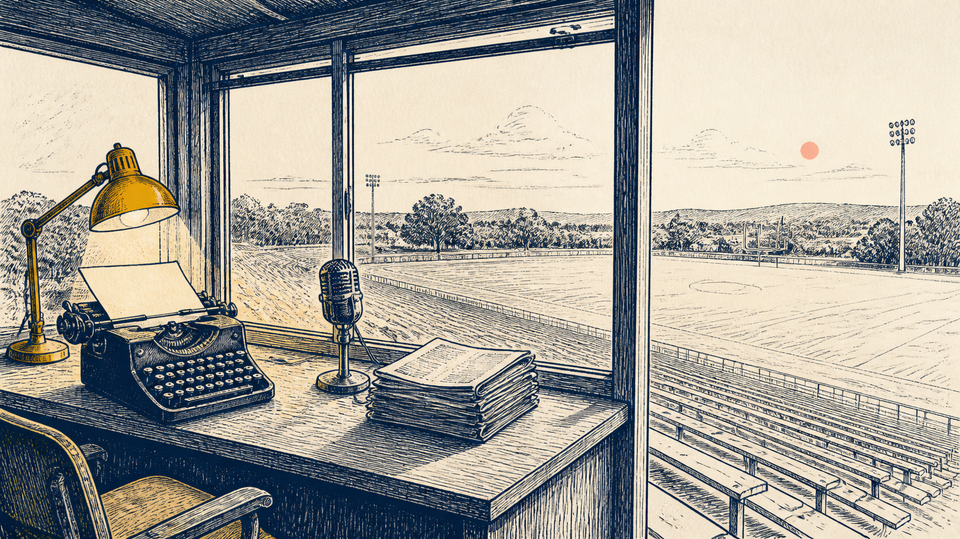
The Seating Chart · Part II of III: The onlooker who explains
Near the end of The Sound of Music, the von Trapp family sings at the Salzburg Festival. The hall is full, and some of the best seats belong to men in Nazi uniform. The Captain begins "Edelweiss"; his voice gives out, and his family carries it. Then he turns to the house and asks them to sing too. They do. For a moment the audience isn't watching a show; it's quietly defying the men in the front rows.
Edelweiss” at the Salzburg Festival, The Sound of Music (20th Century Fox, 1965).
Community theatres stage this musical more than almost any other (Kincaid Regional Theatre has staged it four times since 1983), and audiences love that scene. I love it too. The hall itself is another of the rooms I wrote about in Part I, built for one purpose and put to another: the film shot the scene in Salzburg’s Felsenreitschule, a riding school cut into a rock quarry centuries ago and later turned into a festival stage. But this is a series about seats, and that scene invites a question: who wrote the crowd that way, and what did the real crowd do?
The real crowd
The real Georg von Trapp was the exception. According to the National Archives, he "refused to fly the Nazi flag on their house," "declined a naval command," and turned down "a request to sing at Hitler's birthday party." The family didn't climb over the Alps. "We left by train," his daughter Maria said, "pretending nothing" (Gearin, 2005).
Austria, mostly, didn't pretend. When Hitler spoke from the Heldenplatz in Vienna in March 1938, the United States Holocaust Memorial Museum's own photograph record calls it "a jubilant crowd" (USHMM, n.d.). In that April's plebiscite, more than 99 percent voted to join the Reich (Associated Press, 2011). One historian's account of the musical in Austria puts it plainly: Georg was "the odd man out" (History News Network, n.d.).
The film made the odd man out look like the town. That isn't a crime; it's what stories do. But it's the press box at work: the people who weren't on the field, telling everyone afterward what the crowd was like.
Three ways to explain it away
Austria had its own press box. In 1943, the Allies' Moscow Declaration called Austria "the first free country to fall a victim to Hitlerite aggression." Austria took the first half of that sentence and left the rest, which also named its part in the war. For more than four decades, the "victim thesis" held. Only in 1991 did Chancellor Franz Vranitzky acknowledge Austrians' "share of responsibility," which Austria's own House of History says "marked the official end of the victim thesis" (Haus der Geschichte Österreich, n.d.).
So the movie was a hard sell at home. As Julia Antopol Hirsch tells it, it was a hit "in every country it opened in, except the two countries where the story originated," and it ran "only three days" in Salzburg. In West Germany, a studio branch manager "approved the unauthorized cutting of the entire third act": no Nazis, no escape, just a wedding and a happy ending. The director and the studio restored the film and fired him (Hirsch, 1993, as cited in "The Sound of Music (film)," n.d.).
That's three press boxes for one story. Hollywood softened the crowd. Austria told itself it had been the victim. And a man in an office simply cut the Nazis out. Salzburg's own theatre didn't stage the musical until 2011, swastika flag and all, and some in the audience found it hard to watch (Associated Press, 2011).
Falmouth, retold
The same thing happened here, on a smaller stage.
In Part I, I quoted the Maysville paper the evening after William Jackson was taken from the Falmouth jail in March 1887: "The people thought he deserved hanging, hence the lynching last night, which was done in a quiet determined manner" ("Mobbed at Falmouth," 1887). That's the first layer. The paper wasn't there; it explained.
Forty years later, a Louisville Courier-Journal column looking back "40 Years Ago" told it differently, and the Falmouth Outlook reprinted it in 1927. In that version, it happened on March 8, three days after the verdict. About fifty men tied Jackson to a walnut tree at the north end of the South Licking Bridge and shot him. He was cut down the next morning and buried in the old cemetery. The county's historical society later reprinted the Outlook, and a regional history website reprinted the society (nkyviews.com, n.d.).
The two versions disagree on the day, the place, and the way he died. I'm not going to choose between them here. Someone with the court record and the Cincinnati papers of that week may settle it, and I'm looking. What I notice is that each layer is calmer than the last. By the time the story reached the website, it read like local color.
Then came a fifth layer. This fall, a search engine's AI summary blended both versions, set the date in "mid-March," and added that Jackson "may have suffered from a severe mental illness." The 1887 paper says nothing of the kind. A machine had found an explanation, and the explanation was the victim.
That's the press box in its purest form: it doesn't throw a punch or tie a rope. It supplies the reason.
Under a spell
Why would anyone reach for that sentence? The best answer I know comes from Dietrich Bonhoeffer, the German pastor who joined the resistance to Hitler and was executed in April 1945, weeks before the war in Europe ended. At Christmas 1942, a few months before his arrest, he wrote a short essay for a handful of friends and fellow conspirators, "After Ten Years," taking stock of a decade under the Nazis. In Part I, I borrowed its most famous section, which is about stupidity.
He doesn't mean what we usually mean by the word. "Stupidity is a more dangerous enemy of the good than malice," he writes, and it "is not an intellectual defect but a human one." Bright people catch it. It spreads in a crowd, whenever power surges, and it shows up in exactly the person who explains. That person isn't ignorant. He's "under a spell," and he talks in "slogans, catchwords." For him, "facts that contradict one's prejudgment simply need not be believed." The result is a person "capable of any evil and at the same time incapable of seeing that it is evil" (Bonhoeffer, 1942/2017).
Notice where that leaves the explainer. You don't have to cheer at the bridge to help. You only have to find the calm sentence afterward, the one that lets everyone go back to supper.
Susan Sontag made the same point about pictures. Lynching photographs were taken as souvenirs, many of them showing smiling onlookers, and she warned that "the display of these pictures makes us spectators, too." She didn't think the problem was seeing too much. "It is passivity that dulls feeling," she wrote, and "our sympathy proclaims our innocence as well as our impotence" (Sontag, 2003). That's why I won't show you a lynching photograph in this series. An explanation can do the same work as a picture.
The feed is today's press box. Every disaster arrives with its commentary attached: who deserved it, what it means, why it isn't what it looks like. Most of us now spend more time in the press box than in the stands.
Explaining from far away
Distance doesn't help. In the 1970s, Ervin Staub notes, some Western writers looked at Cambodia under the Khmer Rouge and chose to "uncritically celebrate 'Democratic Kampuchea,'" discounting reports of mass killing as propaganda (Staub, 1989). They weren't in Phnom Penh. They had good seats a world away and a theory to protect. I'll come back to Cambodia in Part III, because I've sat in a seat there too.
The pulpit as press box
The most powerful explainer is often the one who speaks for God. That's not a charge against faith. It's a finding about authority, and it cuts across traditions.
The sociologist Helen Fein, studying why Jews survived in some countries under Nazi control and died in others, found that the bonds of protection ran inside a "sanctified universe of obligation," a circle drawn by a sacred authority (Fein, 1979, p. 4). Where a dominant church spoke up early, more people lived. "Where the church had legitimated anti-Semitism earlier," she writes, as in Hungary, "warning time made little difference" (Fein, 1979). The pulpit had already explained who was outside the circle.
Bonhoeffer's own name is still being used this way. In 2024, descendants of his siblings said they were "horrified" to see his legacy "distorted and misused" by Christian nationalists, and reminded readers that he had rejected "religious zealotry, nationalism, militarism, and blind obedience" (Bonhoeffer family, 2024). His biographer Eric Metaxas and others dispute that reading; the argument is live.
The pattern runs right through this year. After Charlie Kirk's assassination, his movement began describing him as a martyr and its politics as a spiritual battle (Religion News Service, 2026). The writer Tia Levings, who grew up in that world, put the risk in one line: "A dead, sainted hero is never disloyal" (Levings, 2026). And yet, at the same memorial, Erika Kirk forgave the man accused of killing her husband, and Christina Littlefield of Pepperdine University said, "You really saw the gospel preached at that memorial" (Religion News Service, 2026). The same pulpit can explain a death into a weapon or into mercy. Which one it chooses is the whole question.
I'm in the press box too
I owe you a confession of my own, the way Augustine offered his in Part I.
In Part I, I quoted the historian J. Winston Coleman on the crowd at Cheapside. He's useful for the fact of the crowd. But his 1940 book tells the auctions through an elderly Black man's dialect and lingers on the looks of the women being sold. That's a press box too, and I took a sentence from it.
And I write these pages with an AI as a research partner. The summary that diagnosed William Jackson came from a machine like the one that helps me. That's why every claim here is cited and every quote checked against the page. The press box isn't somewhere other people sit. It's wherever someone explains what happened to someone else.
The view from below
So how do you get out of the press box? Bonhoeffer's answer, from the same essay, is a change of angle. He wanted to learn "to see the great events of world history from below, from the perspective of the outcasts, the suspects, the maltreated, the powerless." And he warned against the explainer's favorite pose, contempt: "We must learn to regard human beings less in terms of what they do and neglect to do, and more in terms of what they suffer" (Bonhoeffer, 1942/2017).
In Falmouth, the view from below is the one we don't have. Every account of that night was written by someone who wasn't William Jackson. The least I can do is stop smoothing the story over: keep both versions on the table, say what the record doesn't know, and refuse the explanation that makes him the reason.
Where I'm sitting
This is Part II of three. Part I was the crowd that affirms. This was the onlooker who explains. Part III is the good seats: the people and institutions placed to act, who sometimes leave, and the visitor on a tour bus in Cambodia who was me.
Go back to that festival hall in Salzburg. The movie's crowd sings. The real one, mostly, cheered. Somewhere between them is the version we tell ourselves. Before you explain the next thing you watch, ask whose seat you're explaining it from.
Keep going
Read
- Dietrich Bonhoeffer, "After Ten Years," in Victoria J. Barnett (Ed.), "After Ten Years": Dietrich Bonhoeffer and Our Times (Fortress Press, 2017)
- Susan Sontag, Regarding the Pain of Others (Farrar, Straus and Giroux, 2003)
- Joan Gearin, "Movie vs. Reality: The Real Story of the Von Trapp Family", Prologue (National Archives, 2005)
The Seating Chart
- Part I: "The Cheap Seats"
References
Associated Press. (2011, December 16). Salzburg finally embraces "The Sound of Music." Salisbury Post. https://salisburypost.com/?p=97251
Bonhoeffer, D. (2017). After ten years. In V. J. Barnett (Ed.), "After ten years": Dietrich Bonhoeffer and our times. Fortress Press. (Original work written 1942)
Bonhoeffer family. (2024, October 18). Statement by descendants of Dietrich Bonhoeffer's siblings.
Coleman, J. W., Jr. (1940). Slavery times in Kentucky. University of North Carolina Press.
Fein, H. (1979). Accounting for genocide: National responses and Jewish victimization during the Holocaust. Free Press.
Gearin, J. (2005). Movie vs. reality: The real story of the von Trapp family. Prologue, 37(4). National Archives. https://www.archives.gov/publications/prologue/2005/winter/von-trapps.html
Haus der Geschichte Österreich. (n.d.). Victim thesis. https://hdgoe.at/victim_thesis_en
Hirsch, J. A. (1993). The Sound of Music: The making of America's favorite movie. Contemporary Books.
History News Network. (n.d.). [Article on The Sound of Music in Austria]. https://www.historynewsnetwork.org/article/10558
Levings, T. (2026, September 2). Sainting Charlie Kirk serves the MAGA movement [Opinion]. Religion News Service.
Mobbed at Falmouth. (1887, March 11). Daily Evening Bulletin (Maysville, KY), p. 3. Chronicling America, Library of Congress. https://www.loc.gov/resource/sn87060189/1887-03-11/ed-1/?sp=3
nkyviews.com. (n.d.). [Pendleton County item reprinting the Falmouth Outlook, 1927, via the Pendleton County Historical and Genealogical Society newsletter].
Religion News Service. (2026, September 9). One year after Charlie Kirk's death, can faith hold Turning Point together?
Sontag, S. (2003). Regarding the pain of others. Farrar, Straus and Giroux.
The Sound of Music (film). (n.d.). In Wikipedia. Retrieved October 29, 2026, from https://en.wikipedia.org/wiki/The_Sound_of_Music_(film)
Staub, E. (1989). The roots of evil: The origins of genocide and other group violence. Cambridge University Press.
United States Holocaust Memorial Museum. (n.d.). Hitler addresses a jubilant crowd on Vienna's Heldenplatz after Germany annexed Austria (the Anschluss) [Photograph]. Holocaust Encyclopedia. https://encyclopedia.ushmm.org/content/en/photo/hitler-addresses-a-jubilant-crowd-on-viennas-heldenplatz-after-germany-annexed-austria-the-anschluss
Wise, R. (Director). (1965). The sound of music [Film]. 20th Century Fox.