
The Cheap Seats
The Seating Chart · Part I of III: The crowd that affirms
On Thursday, the tenth of March, 1887, the Pendleton Circuit Court did its job. A Black man named William Jackson stood convicted of killing a white man named Fryer, about a year before, in what the paper called "a trivial quarrel." The court sentenced him to twenty years. That night, a mob took him from the Falmouth jail and hanged him from the Kentucky Central railroad bridge just below town.
The Daily Evening Bulletin in Maysville reported it the next evening, in a few column inches between a stock-subscription meeting and a natural gas proposal. "The citizens were much incensed over the crime," it reported. Then came a second paragraph, which opens "Since writing the above we learn": "The people thought he deserved hanging, hence the lynching last night, which was done in a quiet determined manner" ("Mobbed at Falmouth," 1887).
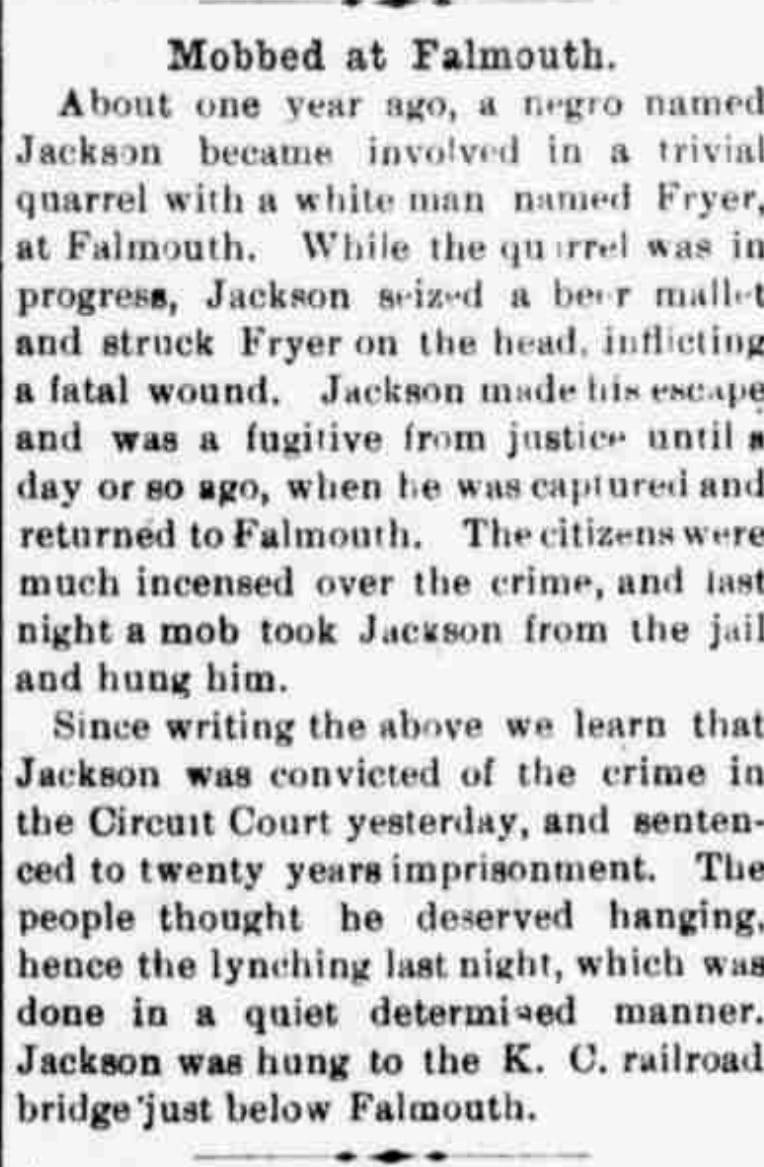
I've read that sentence a dozen times. It isn't the mob that stays with me. It's the paper: the calm voice, the borrowed "the people," the way a court's sentence and a crowd's verdict sit side by side as if they were two opinions about the same thing. Nobody in that story is called a spectator. But somebody wrote it down, somebody set the type, and somebody in Maysville read it over supper and turned the page.
I don't pass the old courthouse often. My days run between the library on Robbins Avenue, south of town, and the theatre off Shelby Street, where I sit on the board. But the railroad still follows the river, and for a month I've been asking a question I can't put down: where were the seats, and who was sitting in them?
A note on the record: the story didn’t stay put. Forty years later a different version was printed, with a different day, a different bridge, and a different way of killing him. It has been reprinted ever since. That retelling belongs to Part II. Here I’m staying with what the next day’s paper said.
A seat in the stands
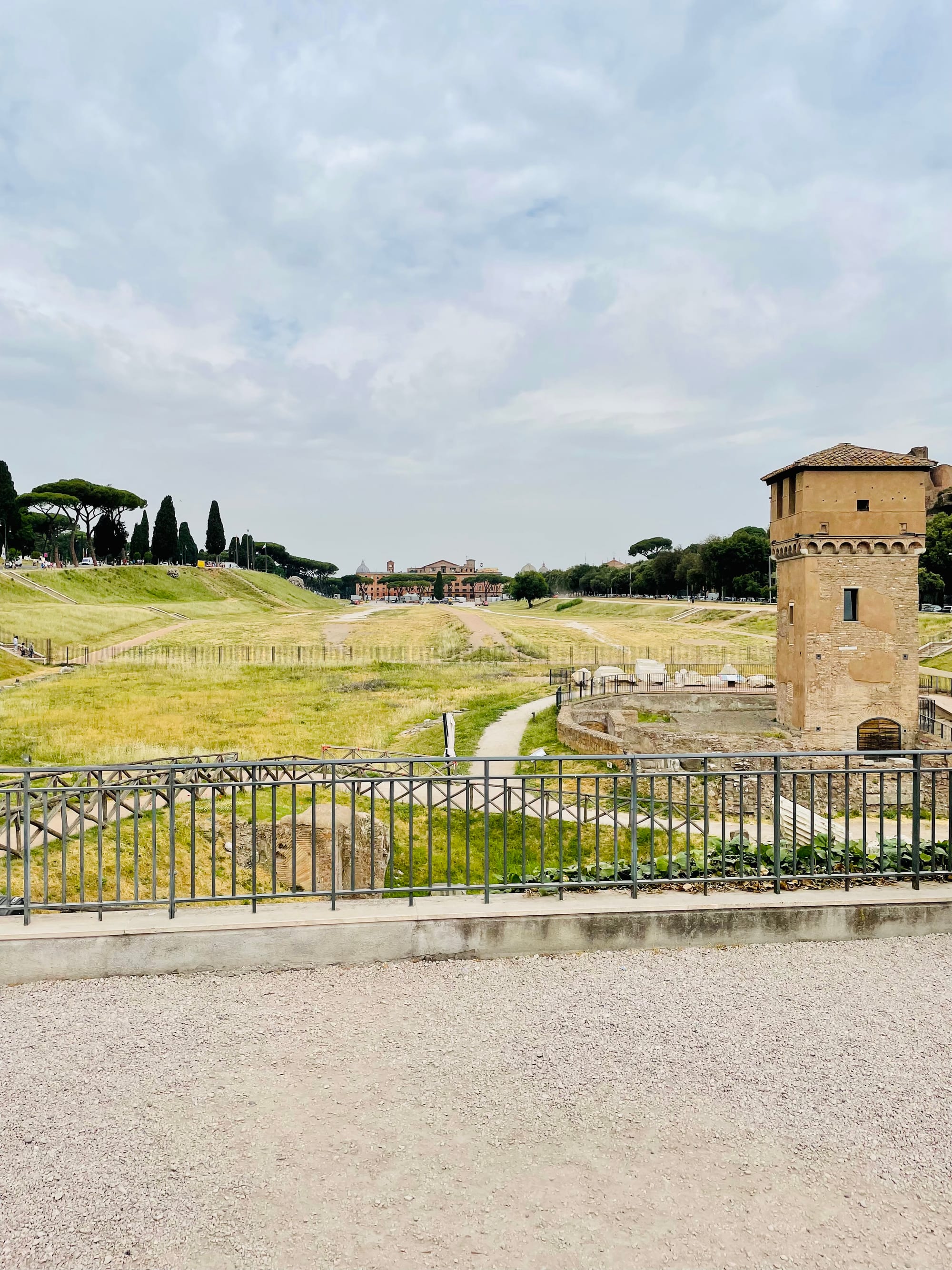
The oldest account I know of a spectator being changed by watching comes from Augustine. His friend Alypius, a law student in Rome, was dragged to the Colosseum by classmates. He swore he'd keep his eyes shut, and he did, until the crowd roared. He looked. "When he saw the blood," Augustine writes, "he drank in the savagery." He "did not turn away but fixed his gaze on it," and "carried away with him the madness that would goad him to return" (Fagan, 2011, p. 1).
Augustine didn't tell that story from above the crowd. In a sermon he admitted, "I myself once sat there too, and raged." Then he asked his congregation how many future Christians, even future bishops, were sitting in the stands right now (Fagan, 2011, p. 1, n. 3).
The historian Garrett Fagan spent a book asking why Romans came by the thousands. His answer has less to do with what happened on the sand than with "what was felt in the stands": excitement, belonging, the pleasure of a crowd agreeing with itself. When the condemned were executed, the satisfaction came from "fears assuaged and prejudices sated" (Fagan, 2011, pp. 185, 285). He also refuses to treat Rome as a freak. The games were "one calibration on a spectrum of ritual violence" (p. 285), and the spectrum runs through every era since, ours included.
The auction block was a stage
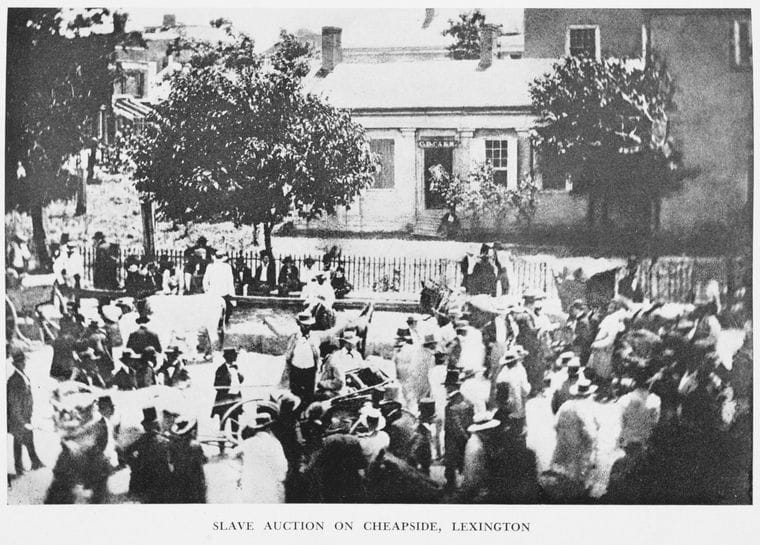
Lexington had a stage too. On a spring morning in 1852, a crowd gathered at the auction block on Cheapside, by the courthouse lawn, "to witness and participate" in the sale of a Fayette County estate (Coleman, 1940, p. 134). Those two verbs are the whole subject of this series in one 1940 sentence. Some people came to watch, and some came to buy, and from the block I doubt anyone could tell them apart.
The trade needed buildings. The slave trader Lewis Robards held people in eight-foot cells, and as business grew he bought "an old theater which he remodeled into a jail" (Lucas, 1992, p. 89).
I sit on a community theatre's board, and I can't read that sentence lightly. In Lexington, a stage was converted into a pen. The point isn't the irony; the point is the people held there. But it's a reminder that a room built for watching can be put to any use, and that the audience doesn't decide what the room is for. Whoever holds the keys does.
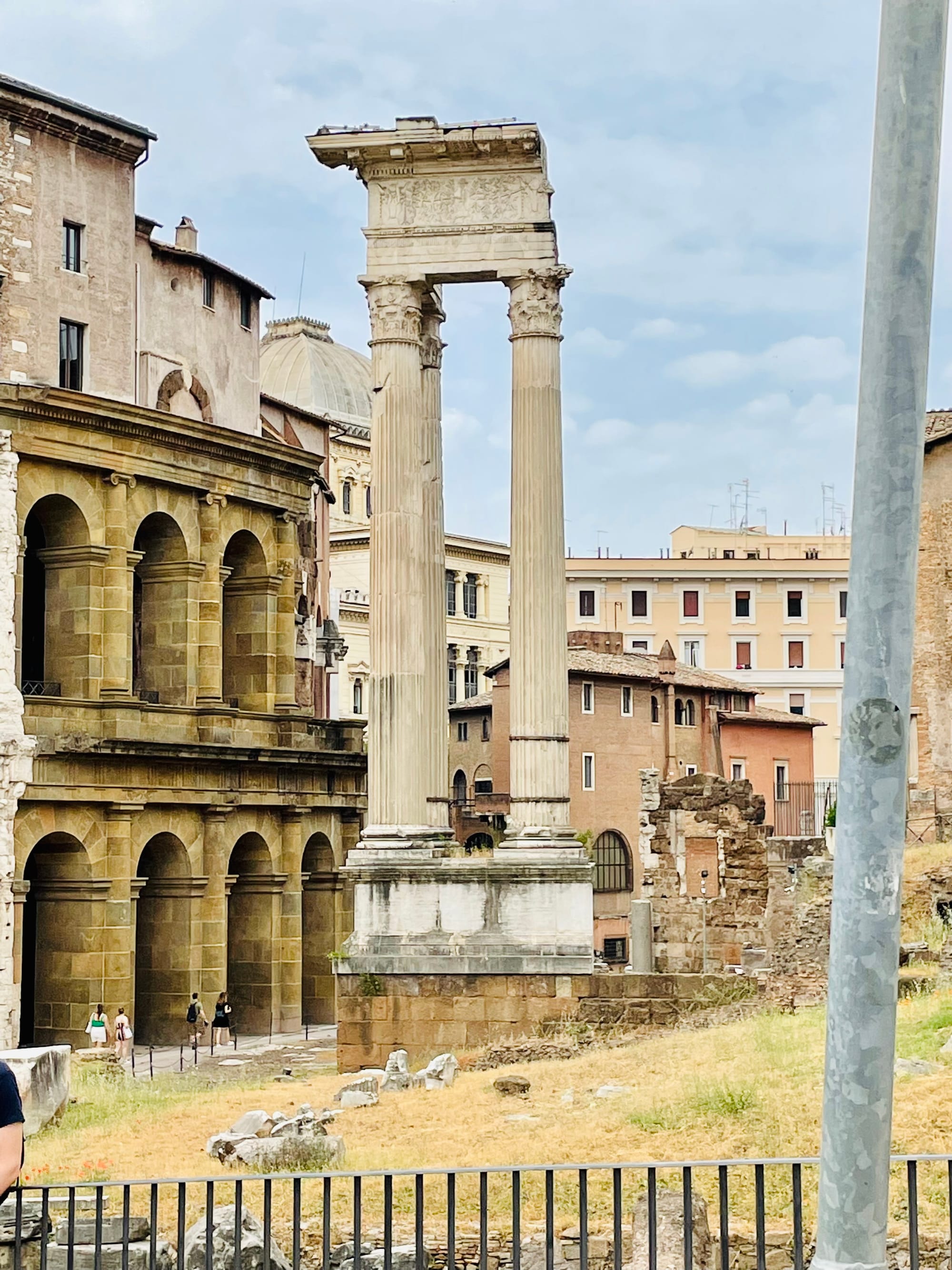
I’ve stood outside a room like that. In Rome, a few streets from the Circus, is the Theatre of Marcellus, built in the reign of Augustus for an audience of thousands. Over the centuries, its seats became a fortress, then a palace, and today people live in apartments built on top of them. I’ll come back to rooms built for watching more than once in this series, because they keep changing hands.
The photographs Bonhoeffer saw
On January 12, 1931, a mob of thousands in Maryville, Missouri, took a Black man named Raymond Gunn from officers, marched him to a country schoolhouse, chained him to the roof, and burned the building. The National Guard was in town the whole time. Its commander said he could act only if the sheriff asked, and the sheriff didn't ask (Raper, 1933/2012).
That winter a 24-year-old German theologian was in New York on a fellowship at Union Theological Seminary, and spent a good deal of his time in Harlem. Dietrich Bonhoeffer "read the story of that lynching and viewed the graphic photographs" (Williams, 2014, p. 22). Eleven years later, in Berlin, he wrote about what turns ordinary people into a crowd.
Closer to home, I wrote in "The State as Spectator" about Owensboro in 1936, when thousands gathered before dawn to watch the state hang Rainey Bethea, and parents carried children, some of them babies, on their shoulders to see. There, the state built the seats.
The cheap seats, now
On October 12 this year, at a rally in Youngstown, Ohio, a woman in a "Release the Epstein Files" T-shirt was knocked down and punched. Deputies walked her out, and from the stage she was mocked (Li, 2026). I wrote about that night in "The Field of Encounter."
The violence runs in more than one direction. In April, a 31-year-old gunman stormed the Washington Hilton during the White House Correspondents' Association dinner, with the president in attendance; he has pleaded not guilty to attempted assassination. It was the third serious attempt on Donald Trump's life since 2024, after a year that included the arson at Governor Josh Shapiro's residence, the murders of Minnesota legislator Melissa Hortman and her husband, and the assassination of Charlie Kirk (Mogensen, 2026).
Even a murder can become a show. In August, two right-wing media figures staged a paid debate over Kirk's killing, promoted like a prize fight. Michael Knowles of the Daily Wire, no liberal, called it "the Super Bowl of Charlie murder content," and asked that the money go to Kirk's children so no one would be "profiting off our buddy's corpse" (Sommer, 2026).
So is this a new era of political violence? The political scientist James Piazza thinks our moral polarization has made violence "more normalized," and that it has "dampened public backlash against political violence when it occurs" (Piazza, 2026). Other scholars push back on calling it unprecedented. Joseph Young at the University of Kentucky calls the attacks "troubling" but sees no sign "we're descending into civil conflict." Dartmouth's Sean Westwood says this is "a relatively calm part of American history" and that "we have a bit of myopia" (Mogensen, 2026). They're right to say it. Lincoln, Garfield, McKinley, King, and both Kennedys were killed in other decades.
I don't think the honest claim is that violence has hit a peak. It's narrower and more uncomfortable: what has changed is how we watch it. Dampened backlash is a political scientist's phrase for a crowd that stays in its seats.
The power of the one
At Christmas 1942, a few months before the Gestapo arrested him, Bonhoeffer wrote a short essay for a few friends and co-conspirators, "After Ten Years." Its most quoted section is about stupidity, and he means something precise by it. Stupidity, he says, "is not an intellectual defect but a human one." It isn't something people are born with; it's something that happens to them in a crowd. "Every strong upsurge of power in the public sphere, be it of a political or a religious nature, infects a large part of humankind with stupidity." And then: "The power of the one needs the stupidity of the other" (Bonhoeffer, 1942/2017).
He has a warning that reads like a reply, across fifty-five years and an ocean, to the Maysville paper. Under those conditions, he writes, "our attempts to know what 'the people' really think are in vain." The paper knew exactly what "the people" thought. It told its readers, and it called the result quiet.
Bonhoeffer's cure isn't an argument. He says plainly that you can't reason someone out of this, and that "only an act of liberation, not instruction, can overcome stupidity" (Bonhoeffer, 1942/2017). Liberation from what? I'd say from the seat itself: from the comfort of being one more face in the stands.
The ones who stood up
It's possible. In the Huguenot village of Le Chambon, in Vichy France, villagers led by their pastor, André Trocmé, sheltered thousands of Jews, most of them children, under threat of deportation or death. The psychologist Ervin Staub, who studies how genocides happen, points to what came next: some of the Vichy police and officials who were supposed to hunt the refugees began warning the village of raids instead. In Trocmé's words, they were "converted" (Staub, 1989). The bystanders changed the perpetrators. That is the most hopeful finding I know: when the seats empty, the show changes.
Where I'm sitting
This is Part I of three. Next comes the press box: the people who don't throw a punch or tie a rope but explain it afterward, in "a quiet determined manner." That includes the newspapers, the retellings, the feeds, and one of the most beloved musicals ever staged. Then come the good seats: the people and institutions placed to act, including a country that left Cambodia and a visitor who once rode a tour bus through it.
For now, a question I'm asking myself before I ask you. Not what would you have done in Falmouth. Everyone answers that one the same way. Ask instead: where are you sitting now, and who sold you the ticket?
Keep going
Read
- Dietrich Bonhoeffer, "After Ten Years," in Victoria J. Barnett (Ed.), "After Ten Years": Dietrich Bonhoeffer and Our Times (Fortress Press, 2017). Short enough to read in one sitting.
- Garrett G. Fagan, The Lure of the Arena: Social Psychology and the Crowd at the Roman Games (Cambridge University Press, 2011)
- Reggie L. Williams, Bonhoeffer's Black Jesus: Harlem Renaissance Theology and an Ethic of Resistance (Baylor University Press, 2014)
- Marion B. Lucas, A History of Blacks in Kentucky, Vol. 1 (Kentucky Historical Society, 1992; free from UKnowledge) <!-- URL CHECK: deep link to the Lucas volume -->
Earlier on Possibility Pages
References
Bonhoeffer, D. (2017). After ten years. In V. J. Barnett (Ed.), "After ten years": Dietrich Bonhoeffer and our times. Fortress Press. (Original work written 1942)
Coleman, J. W., Jr. (1940). Slavery times in Kentucky. University of North Carolina Press.
Fagan, G. G. (2011). The lure of the arena: Social psychology and the crowd at the Roman games. Cambridge University Press.
Li, D. K. (2026, October 13). Trump rally protester attacked in act of 'senseless' political violence, Ohio mayor says. NBC News. https://www.nbcnews.com/news/us-news/trump-rally-protester-attacked-act-senseless-political-violence-ohio-m-rcna603249
Lucas, M. B. (1992). A history of Blacks in Kentucky: Vol. 1. From slavery to segregation, 1760–1891. Kentucky Historical Society.
Mobbed at Falmouth. (1887, March 11). Daily Evening Bulletin (Maysville, KY), p. 3. Chronicling America, Library of Congress. https://www.loc.gov/resource/sn87060189/1887-03-11/ed-1/?sp=3
Mogensen, J. F. (2026, May 12). Is the U.S. in a new era of political violence? Experts say it's complicated. Scientific American. https://www.scientificamerican.com/article/is-the-u-s-in-a-new-era-of-political-violence-experts-say-its-complicated/
Piazza, J. (2026, April 26). Latest attack threatening President Trump reflects rising political violence in US [Interview by A. Serrano]. The Conversation. https://theconversation.com/latest-attack-threatening-president-trump-reflects-rising-political-violence-in-us-281513
Raper, A. F. (2012). The tragedy of lynching. Dover. (Original work published 1933)
Sommer, W. (2026, August 13). The Charlie Kirk murder business gets its crassest spectacle yet. The Bulwark. https://www.thebulwark.com/p/the-charlie-kirk-murder-business-crass-spectacle-candace-owens-andrew-wilson-debate
Staub, E. (1989). The roots of evil: The origins of genocide and other group violence. Cambridge University Press.
Williams, R. L. (2014). Bonhoeffer's Black Jesus: Harlem Renaissance theology and an ethic of resistance. Baylor University Press.